The practical answer
- Short answer
- Stop hiring 'theme tweakers.' To scale a Shopify Plus practice in 2026, you need a Hydrogen-ready engineering team. Here are the salary benchmarks, bill rates, and hiring ratios that drive 12x exits.
- Best fit
- Industry: Ecommerce Technology. Function: Engineering Leadership
- Operating path
- Team & Hiring → Operational Excellence → Transaction Execution Services
- Key metric
- 36% Annual turnover rate for technology teams in 2025, driven by burnout and skill mismatch.
The 'Theme Tweaker' Era is Over
For the last decade, building a Shopify agency was relatively straightforward: hire junior developers who knew HTML, CSS, and Liquid, and set them loose on theme customizations. The margins were healthy, the talent was affordable (often $50-$75/hr cost), and the technical ceiling was low. In 2026, that model is a material risk for your valuation.
The market has bifurcated. On one side, you have commoditized 'Theme Shops' fighting for $20k projects. On the other, you have 'Commerce Engineering' firms executing $200k+ headless builds on Hydrogen and Remix. The talent required for the latter isn't just 'better'—it's a completely different job description. You are no longer hiring web designers; you are hiring software engineers.
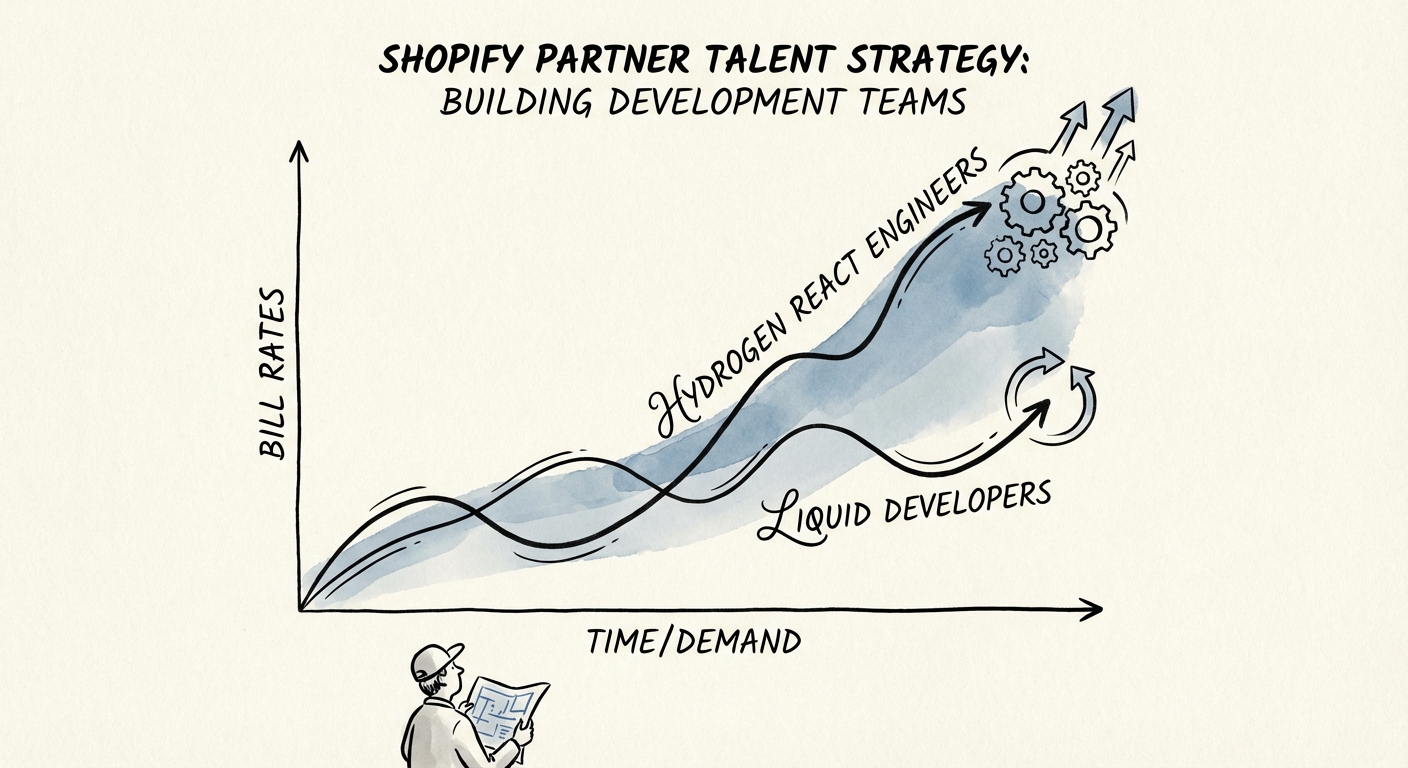
Our data shows a massive bill rate divergence in the partner ecosystem. Legacy Liquid generalists are stalling at bill rates of $125-$150/hr, while partners with proven React and Hydrogen capabilities are commanding $225-$250/hr. If your talent strategy is still optimized for Liquid, you aren't just missing revenue; you're building a team that is technically insolvent for the enterprise deals you want to win.
Your 'Gold' status is a vanity metric if your engineering team can't ship headless builds without burning 40% of the budget on rework. The partners trading at 12x multiples aren't just agencies—they are software consultancies.
The 'Paper Tiger' Certification Trap
In an effort to climb the Shopify Partner Program tiers, many founders rush to accumulate certifications. They hire developers who can pass a multiple-choice exam but cannot architect a scalable headless storefront. We call this the 'Paper Tiger' trap. You have the badges, but you don't have the capability.
The Cost of Technical Debt in Human Capital
When you put a 'Certified Liquid Developer' on a complex Hydrogen project, two things happen: the project blows its budget due to rework, and your turnover spikes. Technology sector turnover is currently averaging ~36% annually (approx. 3.0% monthly separations), but in agencies forcing legacy talent into modern engineering roles, we see attrition spike above 45%.
The financial hit lands immediately. Replacing a mid-level engineer costs approximately 1.5x to 2x their annual salary in recruitment fees, lost billable hours, and ramp time. For a senior React engineer earning $140,000, a mis-hire is a $240,000 mistake. You cannot afford to treat engineering hiring as a volume game.
The 'Pod' Structure: A Blueprint for 2026
To break the cycle of high turnover and low margins, you must restructure your delivery teams. The 'Army of One' freelancer model doesn't scale. High-performing Shopify Plus partners are moving to a 'Pod' structure that balances cost with technical excellence.
The Optimal Engineering Ratio
We recommend a 1:2:1 ratio for Hydrogen-ready pods:
- 1 Lead Architect (React/Node.js): The 'Bar Raiser.' They own code reviews, architecture, and difficult integrations. Cost: $140k-$160k. Billable at 50% (rest is oversight).
- 2 Mid-Level Engineers (Liquid/Hydrogen): The 'Builders.' They handle the bulk of component development. Cost: $90k-$110k. Billable at 85%.
- 1 Junior Developer (QA/Content/Config): The 'Apprentice.' They handle content entry, basic config, and QA. Cost: $60k-$75k. Billable at 75%.
This structure allows you to maintain a blended margin of 55%+ while delivering enterprise-grade code. It also provides a clear career path, which is the only proven antidote to the industry's 36% turnover rate. Stop hiring for 'Shopify experience' alone. Hire for engineering discipline, then teach them commerce.