
The practical answer
- Short answer
- Series A-to-B founders fire their VP of Engineering right when the rebuild starts working. Here's the month-by-month signal map and how to read the dip correctly.
- Best fit
- Industry: B2B SaaS. Function: Engineering Leadership
- Operating path
- Team & Hiring → Operational Excellence → Transaction Execution Services
- Key metric
- 40% Drop in engineering velocity for 6 months following a premature VPE termination at the 9-month mark.
The board deck that gets a good VPE fired
Picture a $30M ARR B2B SaaS company, Series A behind it, Series B conversations starting. Eight months ago the two technical founders hired their first real VP of Engineering because they couldn't keep merging their own pull requests at 1 a.m. The month-9 board update has one slide that ends the relationship: feature throughput is down sharply since the new VPE started. The founders read it as buyer's remorse. It's actually the single clearest sign the hire is working.
I've watched this exact teardown happen and then been called in to rebuild engineering leadership after the fact more than once. The pattern doesn't vary much. The VPE gets terminated around month nine. Within six weeks, the two or three senior engineers who'd quietly been waiting for "adults in the room" read the firing as a signal that the founders will never let go of the codebase — and they leave. Now you've lost the executive and the institutional memory the executive was hired to protect. The roadmap slides a year. And it lands in the middle of due diligence, which is the worst possible audience for "our engineering org is in transition."
The severance check is the cheapest part of this. Harvard Business Review puts the organizational cost of botched executive succession at well over 200% of the leader's salary — and that figure was built for general management roles. In an engineering org you add a tax HBR never had to model: the next VPE rips out the half-built CI/CD pipelines and test scaffolding their predecessor left behind, because nobody inherits a half-finished platform migration and keeps it. So you don't pay for one rebuild. You pay for two, back to back, with a demoralized team in between. If you want the dollars-and-cents version of that, our diagnostic on calculating the true cost of a bad tech hire walks the math.
A VP of Engineering at month nine looks slow for the same reason a runway looks empty right before takeoff. Fire them then and you don't get speed back — you get a second teardown.
Read the dip like a chart, not a verdict
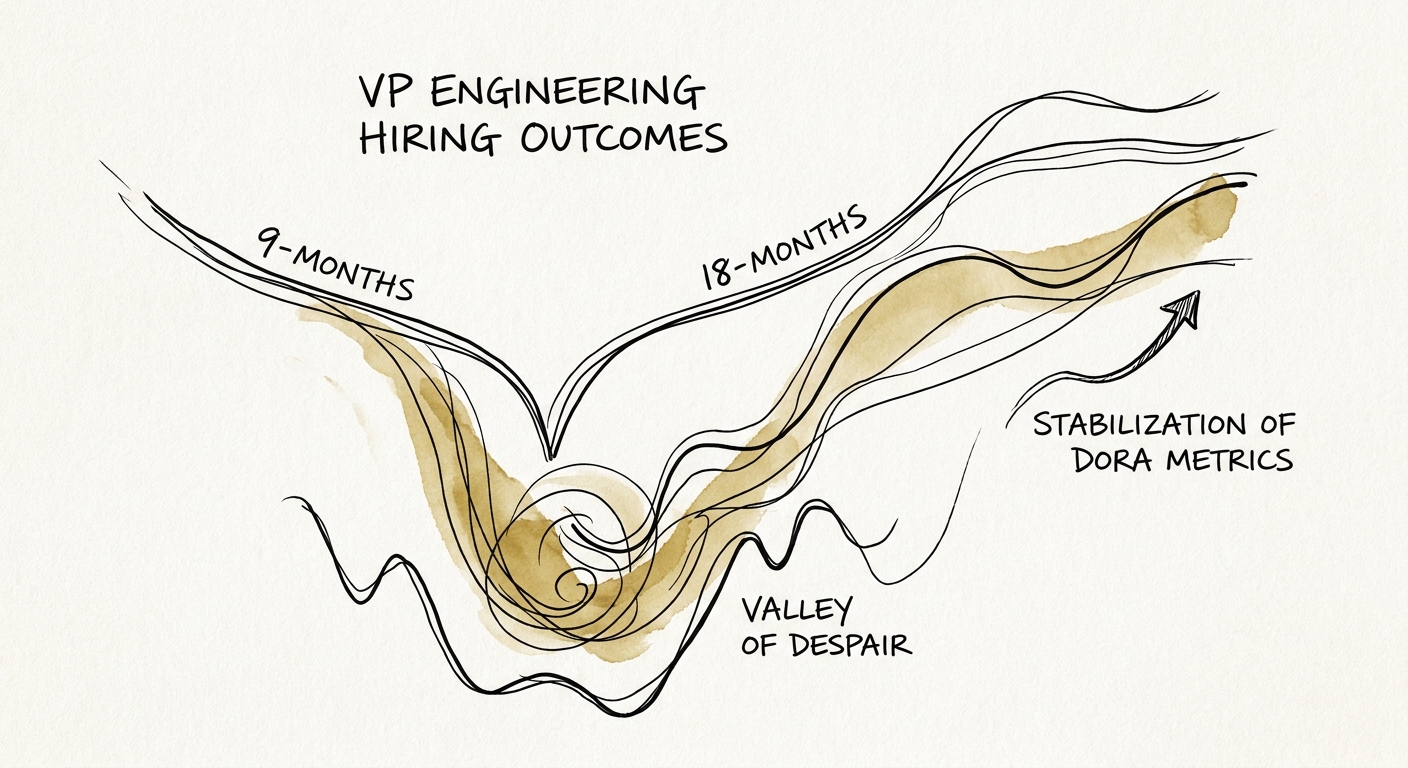
The reason month nine is so dangerous is that it sits at the bottom of a curve the founders have never seen before. Their entire experience of engineering was the hero-culture era: someone ships something overnight, it mostly works, the demo lands. A competent VPE deliberately ends that era — and the cost shows up before the benefit does.
Here's the rough shape of a VPE who is doing the job right at a company this size:
- Months 1–3, the audit. Listening, mapping who actually knows what, finding the three systems that are one bad deploy away from a multi-day outage. Output looks unchanged. Founders are happy.
- Months 4–9, the teardown. Branch protection goes on. A real review process replaces "merge it, we'll fix it later." Tests get written for code that never had any. Raw feature output drops, because for the first time shipping requires the thing to actually be tested. This is where the founders panic.
- Months 10–18, the payoff. The pipeline that felt like friction becomes the thing that lets you ship on a Friday without holding your breath. The founders are no longer in the critical path. A new hire is productive in two weeks instead of two months.
The trap is that the curve looks identical to incompetence right up until month ten. The only way to tell them apart is to stop staring at feature count. McKinsey's Developer Velocity Index work found top-quartile engineering orgs grow revenue several times faster than the bottom quartile — and you do not claw your way into the top quartile while replacing your engineering leader every three quarters. Stability is a precondition, not a reward.
Why a buyer cares about the calendar
Growth-equity and PE diligence teams ask one question about engineering leadership that founders rarely anticipate: how long has this person been here, and is the founder still merging code? A VPE past 18 months is evidence the platform runs on process instead of two people's memories. A revolving door at the top of the org chart reads as key-person risk and gets priced in as a discount — exactly when you can least afford it. If you've already cycled through one executive hire and feel the second one wobbling, the failure pattern in why so many first executive hires don't survive 18 months is worth reading before you sign the next offer letter.
What the CEO actually does between month 6 and month 10
Surviving the dip is not the VPE's job alone — it's mostly the CEO's. Three concrete moves change the odds.
1. Cap feature demand at 80%, on purpose. If you hand a new VPE a legacy codebase and also demand 100% of capacity goes to new features, you've designed the failure. Carve out a hard 20% for refactoring and automation and protect it the way you'd protect a customer SLA. The founders who skip this are the ones reading the throughput slide nine months later.
2. Switch the scoreboard before the dip arrives. Story points and lines of code will betray you in exactly this window. Move the conversation to the four DORA metrics — deployment frequency, lead time for changes, change failure rate, and time to restore service. The useful part isn't that they're industry-standard; it's that they go in the right direction during the teardown. Deploy frequency climbs and change-failure-rate drops while raw feature count is still flat. That's the early proof you can put in front of a nervous board instead of a story you have to tell.
3. Translate, every week, between product and engineering. Around month seven your product managers will say "engineering is too slow," and they'll be technically correct about throughput and completely wrong about value. The CEO has to be the one who says, out loud, that the unglamorous work happening now is what keeps the platform from collapsing at $50M ARR. Nobody else has the standing to defend invisible work.
One honest caveat: sometimes the hire really is wrong, and you do need to act. The tell isn't slow output — it's the DORA metrics flatlining or worsening past month six, or the senior engineers losing confidence in the plan. If you ever do find yourself suddenly without an engineering leader, our 48-hour stabilization plan for when your CTO quits covers the first moves. But the far more common failure isn't a bad VPE — it's a good one fired at the exact moment their work was about to compound. Endure the dip, watch the right four numbers, and the 18-month foundation is what turns a teardown into a valuation premium instead of a do-over.