
The practical answer
- Short answer
- Stop hiring 'paper tigers.' A data-driven guide for founders on building a Google Cloud Partner team that delivers delivery margins, not just badges.
- Best fit
- Industry: Cloud Consulting. Function: Engineering Leadership
- Operating path
- Team & Hiring → Operational Excellence → Transaction Execution Services
- Key metric
- $165k Avg. Salary for Professional Cloud Architect (2025)
The 2026 Partner Network Shift: Capacity vs. Capability
For years, the Google Cloud Partner Advantage program was a volume game. You needed a specific number of certifications to unlock the "Premier" badge, and that badge was the gatekeeper to deal registration discounts and the Partner Directory. This created a perverse incentive: founders rushed to hire anyone with a Professional Cloud Architect badge, often ignoring whether that person had ever actually deployed code to production.
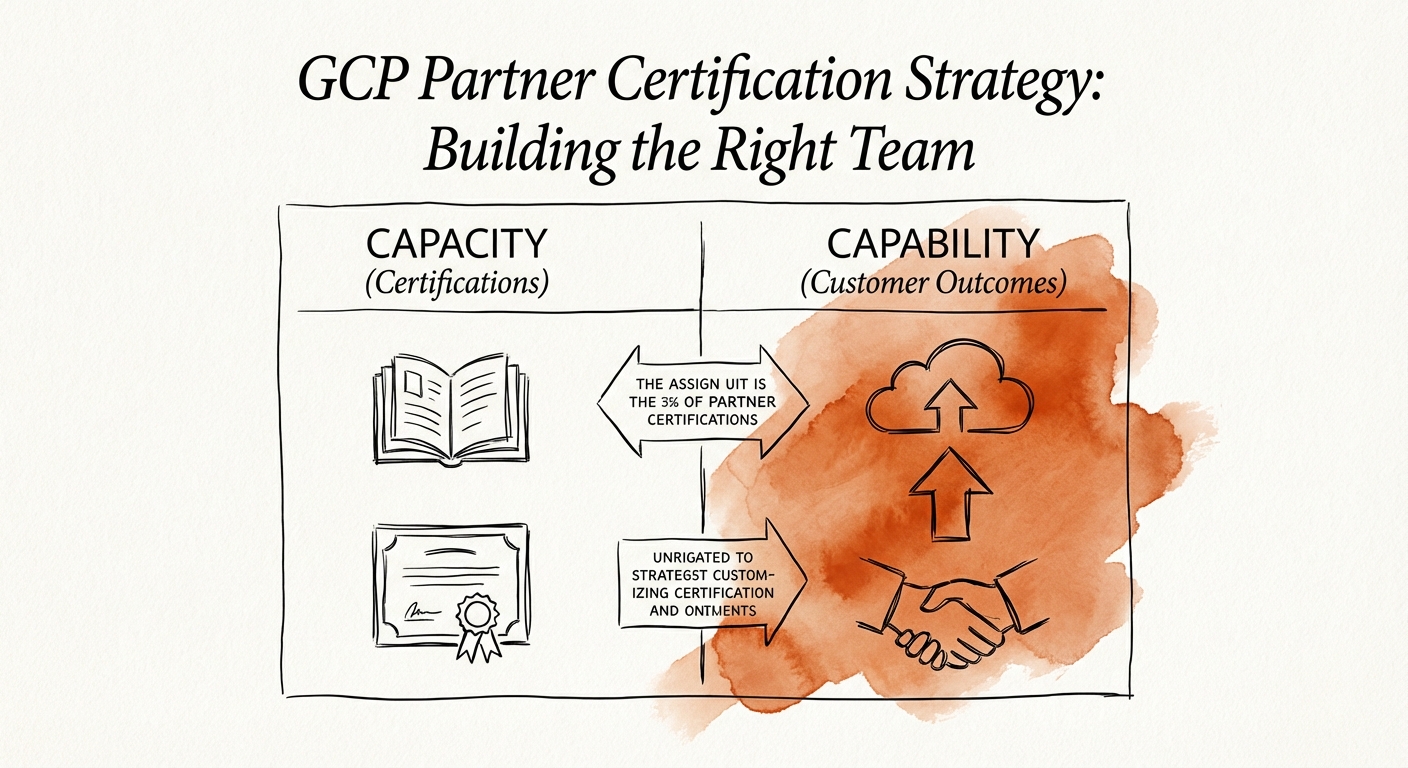
We call these hires "Paper Tigers." They look ferocious on your slide deck, but they fold under the pressure of a real client migration. In 2026, this strategy isn't just operationally dangerous; it's becoming obsolete. With the rollout of the Google Cloud Partner Network (GCPN) in Q1 2026, Google is fundamentally shifting how it measures partners. They are moving away from static "business plans" and toward a dual-scorecard of Capacity (skills/certifications) and Capability (verified customer outcomes).
If you are a Series B founder, this changes your hiring roadmap. You can no longer just stack "Associate Cloud Engineers" to hit a quota. You need a certification strategy that maps to billable competency. The market data is clear: A "Paper Tiger" hire costs you approximately $240,000 when you factor in salary, recruiting fees, and the inevitable three-month replacement cycle. Worse, they torch your reputation with the Google field reps you rely on for referrals.
A 'Paper Tiger' hire costs you $240,000 and torches your reputation with Google field reps. You can fake a badge, but you can't fake a migration.
The Ideal Competency Pyramid: Architecting Your Org Chart
Stop viewing certifications as a compliance checklist. View them as a proxy for your billable rate ceiling. In 2025, the salary for a Professional Cloud Architect averages $165,000, while an Associate Cloud Engineer commands roughly $124,000. If you are building a services firm, your margin depends on the ratio between these two roles.
The 1:3:1 Rule
For every 1 Principal Architect (Fellow or highly experienced Professional), you should hire 3 Delivery Engineers (Professional/Associate mix) and 1 Junior/Associate (for leverage). Here is why this specific mix matters for your valuation:
- The Principal (The Rainmaker): Holds the Professional Cloud Architect or Data Engineer cert. They don't just pass exams; they lead the "Design Wins" that Google's new program prioritizes. They justify a $300+/hr bill rate.
- The Delivery Core (The Margin Builders): These engineers hold Professional Cloud Developer or Cloud Security Engineer certs. They do the heavy lifting. If they are "Paper Tigers," your projects will bleed hours, and your utilization rates will crash as they spend time fixing their own bugs.
- The Juniors (The Future): They hold the Associate Cloud Engineer cert. You bill them out at lower rates to blend your margin, but they must be mentored by the Principal.
Warning on Specializations: Generalist partners are dying. The 2026 GCPN framework rewards depth. A Data Analytics or Security Specialization requires a rigorous third-party audit. You cannot fake this with exam dumps. You need a team that has actually delivered the work, or you will fail the audit and lose your badge.
Detecting the 'Paper Tiger' in the Interview
The proliferation of "exam dump" sites means a candidate can memorize the answer key to the Professional Cloud Architect exam in a weekend. I have interviewed "Senior Architects" who could recite the definition of Google Spanner but couldn't explain when not to use it.
To protect your hiring accuracy, you must shift your interview tactics:
- Ban Definition Questions: Never ask "What is BigQuery?" Ask, "Tell me about a time BigQuery was the wrong choice for a client, and what you used instead." A Paper Tiger only knows the marketing brochure; an operator knows the failure modes.
- The 'Whiteboard' Test: Give them a vague client scenario (e.g., "Migrating a 5TB Oracle DB to GCP with zero downtime"). Watch how they ask requirements. A badge collector jumps straight to solutioning. A real architect asks about network latency, compliance (HIPAA/SOC2), and licensing costs.
- Verify 'Capability' Not Just 'Capacity': In the new GCPN model, Capability is measured by post-sales success. Ask candidates for specific metrics from their past projects: "How much did you reduce the client's monthly spend?" or "What was the query performance improvement?" If they don't know the numbers, they didn't own the outcome.
Your partner status gets you in the door, but your team's competence keeps you there. Do not let a vanity metric on your slide deck destroy your delivery reputation.