
The practical answer
- Short answer
- Your first VP of Sales hire keeps failing because you handed them an undocumented motion, not a system. Here is the 120-day extraction playbook that fixes it.
- Best fit
- Industry: B2B SaaS. Function: Sales Leadership
- Operating path
- Team & Hiring → Operational Excellence → Transaction Execution Services
- Key metric
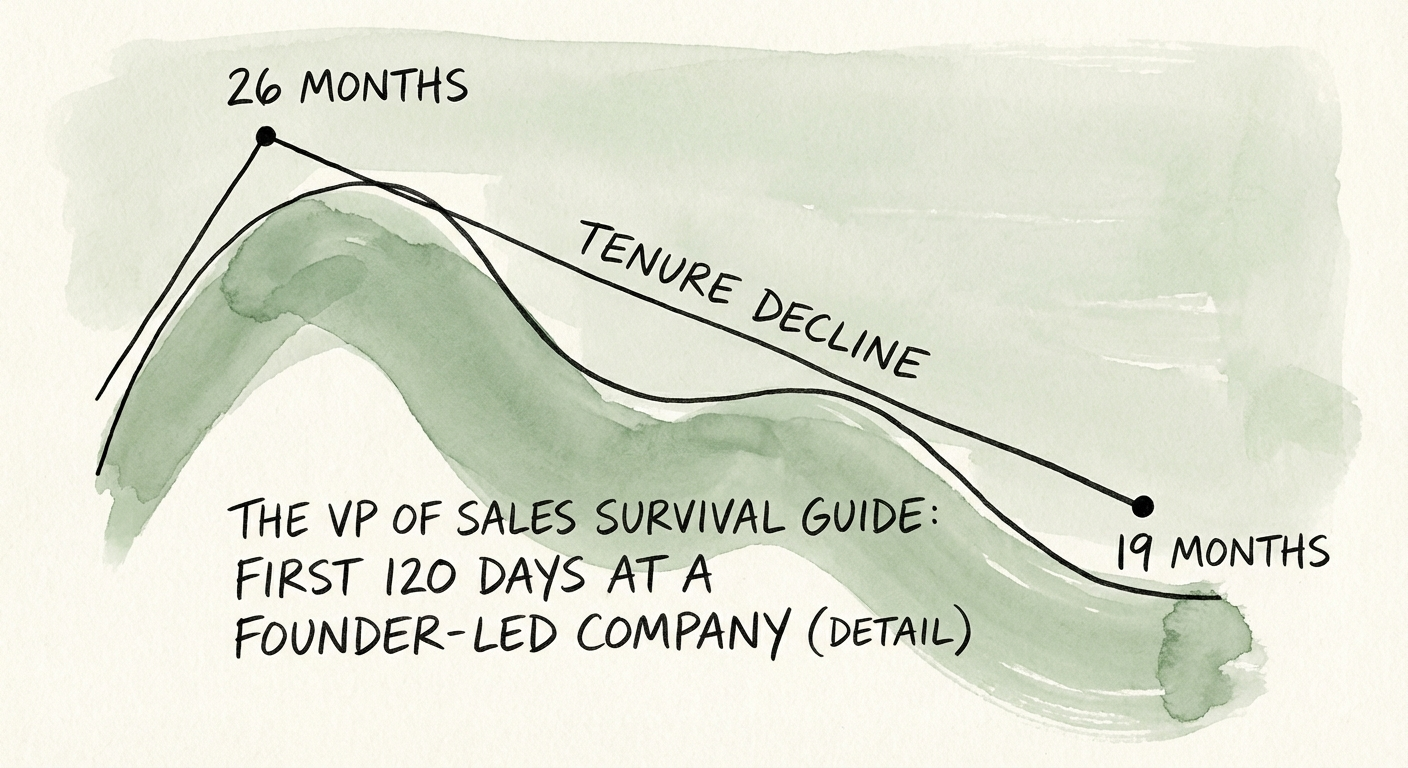
- 19 Months Average tenure of a VP of Sales in high-growth tech firms
The deal they closed in week three is the one that gets them fired in month eight
Picture the Series B win you just lost. A six-figure deal, stuck for two quarters, that closed in three days the moment you, the founder, jumped on a call and said the thing you always say — the offhand line about your roadmap, the customer reference you pull from memory, the discount you authorize because you can read the buyer's hesitation in real time. Your new VP of Sales watched it happen and wrote nothing down, because it didn't look like a process. It looked like you being you.
That is the exact moment the clock starts on a tenure that, according to Gong's analysis of VP of Sales tenure, now runs under two years on average in high-growth tech — and shorter still for the first sales leader a founder ever hires. The Bridge Group's SaaS sales compensation and tenure data tells the same story. This is not a turnover line item. DePaul's Center for Sales Leadership work on the cost of mis-hires counts the severance and recruiter fees, but those are the cheap part. The expensive part is the stalled year of pipeline, the two strong AEs who read the room and start interviewing, and a board that now wants to know why the number you promised at the raise isn't real.
Here is the part founders refuse to hear: the VP usually wasn't incompetent. You hired a smart operator and then handed them a job that didn't exist yet. You wanted them to scale a sales motion. There was no motion to scale — there was you, closing on charisma, domain depth, and the authority to bend any term on the spot. None of that is portable. You hired a manager of an established machine when what you needed was someone to build the machine from the raw material locked in your head.
You did not hire a VP of Sales to be a better version of you. You hired them to turn the deals only you can close into deals a stranger can close on a Tuesday.
The three numbers that lie to you in the first 60 days
The collision is quiet at first. Your VP arrives looking for stages, entry criteria, and exit criteria — the grammar of a repeatable funnel. You think in hustle, conviction, and the deals you can feel turning. Both of you are fluent; neither speaks the other's language; and there's no translation layer between you. So the funnel gets professionalized on the surface while the thing that actually won deals — your founder authority — never makes it into the playbook. Three specific metrics will lie to both of you during this window.
The win rate that doesn't transfer. Say you close one in two qualified deals. You assume a hired rep should land one in three. Strip your founder authority out of the room, though, and that rep may close far fewer — not because they're bad, but because half your win rate was tribal knowledge nobody ever wrote down. You'll blame the VP. The VP will blame the product. The real defendant is the undocumented motion, and it doesn't show up in any dashboard.
The forecast that's fiction with good formatting. By week six your VP will roll out a clean five-stage pipeline review. It will photograph beautifully for the board deck. It is still a guess, because there is zero historical conversion data for a non-founder seller in your business. A forecast built on your personal close rates predicts a world where every rep is you. That world does not exist, and the miss lands in month four when it's hardest to recover from.
The contact list that's already decaying. If you hired them for their Rolodex, you bought the wrong asset. In B2B SaaS a warm-contact list spoils fast — buyers move, budgets reset, champions leave. You want their methodology: how they diagnose a stuck deal, how they qualify out fast, how they build a repeatable demo. The phone numbers were never the point.
A 120-day plan where the VP doesn't carry a number until day 90
Write this into the offer letter, not the first one-on-one: the goal of the first 120 days is not to close deals. It is to extract the deals only you can close and turn them into deals a stranger can run. Quota in month one is a trap that guarantees the short-tenure cycle.
Days 1–30 — Forensic audit, no selling. The new VP rides 20 of your live calls with one job: map your intuition to a process. They review every recorded demo, deck, and email and flag the exact phrases that unlock budget — the proof point, the reference, the framing you reach for without thinking. Then they call the last 10 prospects who said no. A founder almost never hears the real reason for a loss; a neutral third party often does. This month is pure knowledge extraction, and any deal that closes is a bonus, not the assignment.
Days 31–60 — Ship the four-page playbook. Not a 100-page manual nobody opens — a battle card a rep can actually use. The test: hand it to a competent seller who has never met you and watch whether they can deliver your demo and hit your top three objections. Replace "I think they like us" with binary exit criteria you can audit ("Did they introduce us to the CFO? Yes / No"). Then clean the CRM, because every decision after this rides on that data. Most teams skip this and build a playbook nobody ever uses — usually because it was 80 pages and theoretical instead of 4 pages and field-tested.
Days 61–90 — The pilot cohort. Deputize two reps to run the new play. This stage is a clean diagnostic. If the VP can't sell with the playbook, the playbook is broken. If the VP can but the reps can't, the hiring profile is broken. Either failure is cheap to fix now and ruinous to discover at scale.
Days 91–120 — Forecast you can bet on. Now the number arrives. Missing the target is forgivable in a first quarter; missing the forecast is not, because it means the operator can't see their own pipeline. Hold them to forecast accuracy within ten percent, not to a heroic bookings figure. Your job was never to hire a savior to out-close you. It was to hire an architect, then give them the calls, the artifacts, and the runway to turn you into a system. Start by booking the 20 ride-along calls before their first day — that's the one thing only you can set up, and it's the whole game.