
The practical answer
- Short answer
- Mid-market software firms are buying AI licenses without assessing who can actually wield them. Here is how to map the gap before it shows up in diligence.
- Best fit
- Industry: Software & Technology. Function: Engineering Leadership
- Operating path
- Team & Hiring → Operational Excellence → Transaction Execution Services
- Key metric
- $20,000 Cost savings per employee when upskilling existing engineers in generative AI rather than replacing them.
Your Copilot license is making the codebase worse
I walked into a $50M-ARR portfolio company last year that had every box checked on the board's AI roadmap: enterprise Copilot seats for every engineer, a freshly stood-up vector database, a line item in the deck about "AI-accelerated delivery." Then I pulled the velocity metrics. Story throughput was down. Reverted PRs were up. The "acceleration" was a senior team merging hallucinated code they didn't fully understand, then spending the next sprint untangling it. The tool wasn't the problem. The assumption that buying it was the same as being able to use it — that was the problem.
This is the trap specific to mid-market software companies right now. A board or a private equity sponsor mandates an aggressive AI program to support a richer exit multiple, capital gets spent on licensing and infrastructure, and nobody assesses whether the engineering org has the architectural context to turn any of it into shipped product. MIT Sloan's AI Readiness Benchmark work points to exactly this failure mode: organizations layering generative AI onto teams without a formal skills assessment routinely watch delivery metrics degrade — in the company above, roughly 40% off baseline through the first two quarters — before anyone connects the spend to the slowdown.
And you cannot simply hire the gap away, because mid-market budgets lose that auction. Gartner's workforce projections describe a future where the overwhelming majority of the engineering workforce needs to be reskilled rather than swapped out — and the small pool of engineers with genuine applied-AI architecture experience commands premiums that hyperscalers and well-funded startups will always outbid you for. So the real question for a 40-to-200-person engineering org isn't "who do we recruit." It's "who, on this team, can actually be taught to wield what we already bought."
A React expert is not an AI engineer. The skill that matters now is building something deterministic on top of a model that is, by design, never the same twice — and most internal AI assessments never test for it.
What you are actually testing for (it isn't seniority)
Here is the mistake I see in nearly every assessment a mid-market firm runs internally: they grade AI readiness on the same axis as software seniority. Their best React-and-Node engineer scores highest, gets handed the AI initiative, and stalls — because shipping a reliable feature on top of a foundational model has almost nothing to do with front-end mastery. It is a different discipline. You are building something that must behave deterministically on top of a component that is, by design, non-deterministic. That requires data fluency, retrieval architecture, evaluation rigor, and a comfort with probabilistic outputs that traditional CRUD work never demanded.
The symptoms of testing on the wrong axis are concrete and they cost money. Cloud compute bills spike because nobody optimized the vector queries — every retrieval scans far more than it needs to. You accumulate a graveyard of features that demoed beautifully in staging and fall over under real concurrency. This is why PwC's Global CEO Survey on AI found a majority of executives naming a lack of internal technical skill as the reason their AI work is stuck in perpetual proof-of-concept. The proof-of-concept ships. The production system never does.
So when I assess a mid-market engineering team, I run three concrete tests, not a quiz. First, data fluency: hand an engineer a proprietary dataset and a model, and watch whether they can wire up retrieval without leaking PII into a prompt or a log — most can't, and that single failure is a diligence red flag on its own. Second, retrieval and cost architecture: can they explain why a query is expensive and redesign the index, or do they just throw more compute at it? Third, evaluation: when the model returns something plausible but wrong, do they have a way to catch it before a customer does? The engineer who passes is rarely the loudest voice in the AI channel. More often it's the quiet data engineer who already thinks in terms of lineage and data gravity. Misread who your real talent is and you end up over-hiring expensive outside specialists who can't navigate your legacy systems — and then paying the true cost of a bad tech hire on top of the AI bill.
The reskilling math, and why it survives diligence
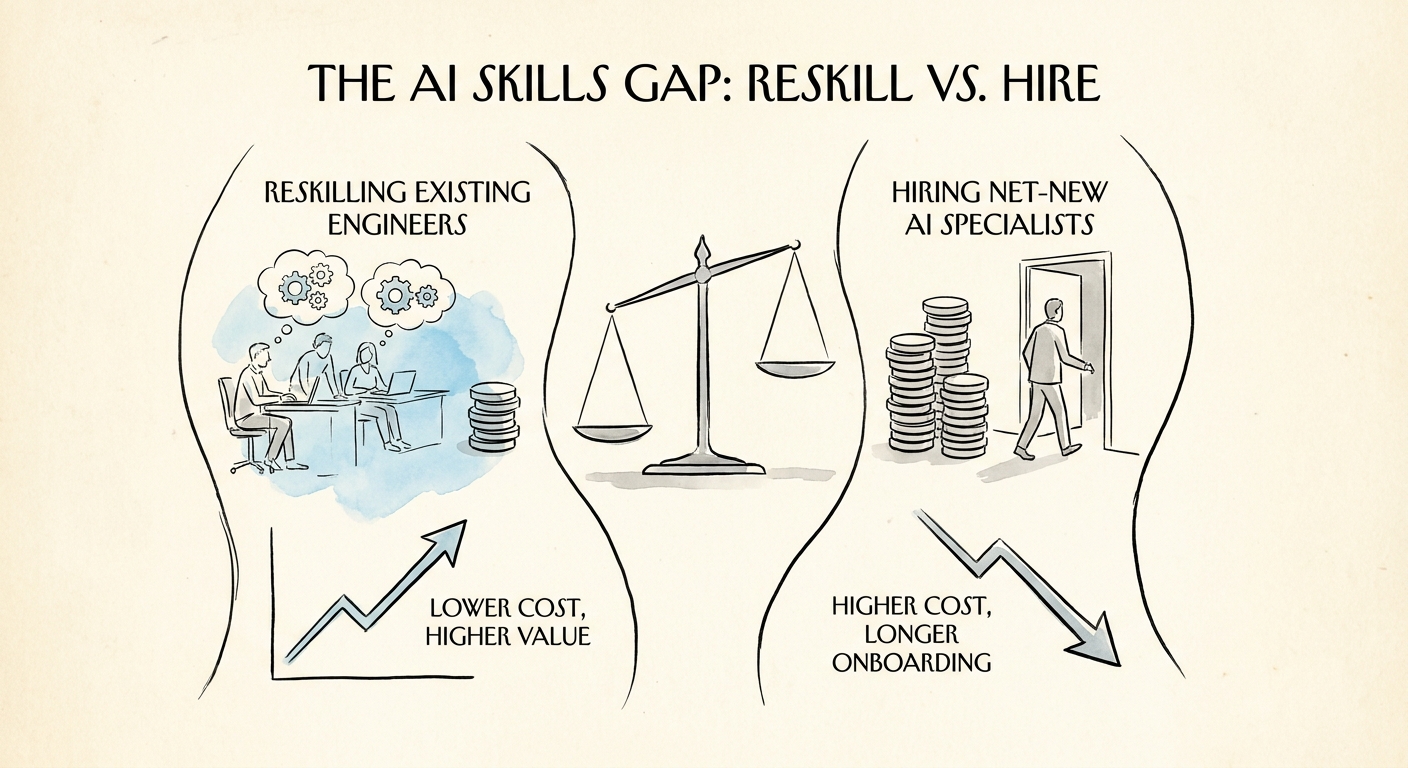
Once you've mapped who can be taught, the plan writes itself — and it is mostly internal. Ripping out your tenured engineers to replace them with "AI-native" hires is how mid-market software companies go backward fast. Those engineers carry the institutional memory of your billing logic, your weird customer edge cases, the load-bearing technical debt nobody documented. That knowledge does not transfer in an onboarding doc. It is far cheaper and faster to teach your domain experts the AI tooling than to teach an AI specialist your domain.
The economics back this up bluntly. BCG's reskilling analysis pegs the cost of training an existing senior developer in applied generative-AI architecture at roughly $20,000 less per head than the all-in cost of replacing that person — and that's before you count the eighteen-month churn risk on a hot-market hire. Layer in the fully-loaded cost of engineer recruiting — fees, ramp time, lost velocity — and cohort-based internal training stops being the prudent option and becomes the obvious one.
One thing to get right that most teams miss: the reskilling cannot stop at engineering. Your product managers have to learn to write requirements for a probabilistic system — "right most of the time" is now a spec, not a bug report. Your QA function has to move from pass/fail assertions to evaluating accuracy and bias on outputs that vary. McKinsey's analysis of generative AI's economic potential finds that organizations running cross-functional reskilling — not just developer training — hit their target return on AI investment roughly 2.5x faster. Monday-morning move: before you approve another seat or another database, pick five engineers and run the three tests above. The score sheet — who passed, who's coachable, who's mismatched — is the only AI roadmap a sophisticated buyer will actually believe in the data room. The firms that command a premium at exit aren't the ones with the most AI features. They're the ones that re-architected the people, not just the stack.