
The practical answer
- Short answer
- The 20% agency fee is the cheap part. Here's the real fully-loaded cost of a senior engineer hire — interview hours, the ramp-period velocity tax, and how to cut it.
- Best fit
- Industry: Software / Tech. Function: Engineering
- Operating path
- Team & Hiring → Operational Excellence → Transaction Execution Services
- Key metric
- 62 Hours of senior developer time burned per accepted offer in a typical Series B hiring process.
The invoice says $32,000. The hire costs you a quarter of a million.
Pull up the offer you just approved for a senior software engineer. The recruiter's invoice — 20% of a $160,000 base — reads $32,000. That's the number your CFO modeled. It is also the smallest line item in the entire transaction. The fully-loaded cost of getting that engineer from signed offer to net-positive contributor lands closer to $240,000, and almost none of it appears on a single invoice you can object to.
The gap lives in two places nobody puts in the headcount model: the hours your own senior engineers burn screening candidates, and the months you pay full salary for a fraction of full output. Both are real cash. Both come straight off the team you already have.
I saw this clearly auditing a Series B SaaS company whose technical founders were certain their pipeline was lean. We pulled their calendar exports and applicant-tracking logs and counted it out: 62 hours of senior developer time per accepted offer — phone screens, take-homes, panel loops, debriefs, the inevitable "let's get one more person's read." At a blended internal rate of $150 an hour, that's $9,300 of your best engineers' time per hire, spent not building product. Stack that across a 15-person hiring plan and you've quietly spent an entire product release cycle running interviews.
The Society for Human Resource Management (SHRM) pegs the national average cost-per-hire at $5,475 — a figure that, applied to specialized engineering talent, breeds dangerous boardroom confidence. Run the real math instead: the $32,000 agency fee, the $9,300 in engineering interview time, and roughly $4,500 in sourcing and coordination overhead. You're at $45,800 in hard cost before the new hire has been provisioned a laptop. And that's the part that's nearly done bleeding. The expensive part hasn't started.
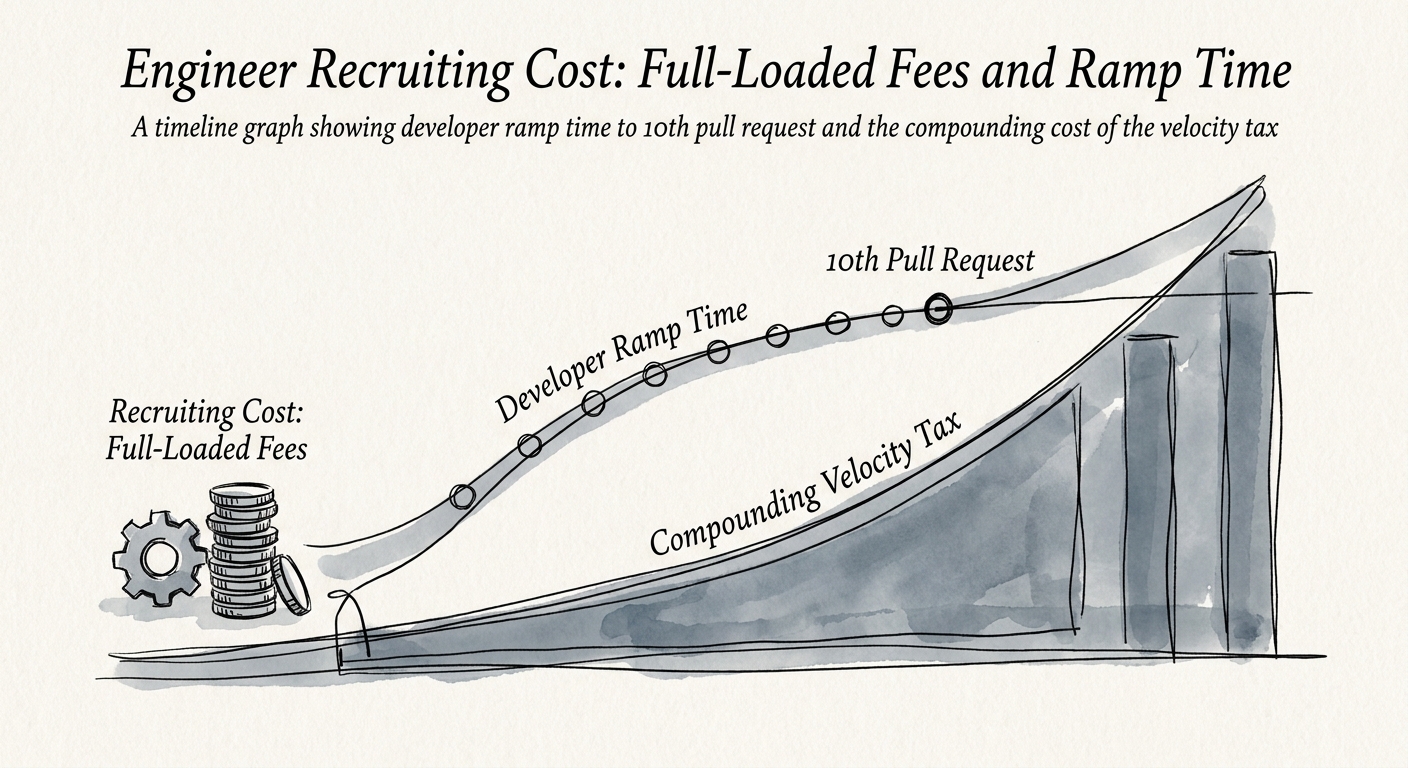
Onboarding isn't an HR task. The day a new engineer ships their tenth pull request is a number on your CTO's scorecard — and every week you shave off it is margin you keep.
The velocity tax: you're paying two salaries for one output
A senior engineer does not arrive at full throughput. For the first stretch they arrive below zero — they consume the time of your strongest people through code reviews, architecture questions, and the slow archaeology of understanding your deploy pipeline, your service boundaries, and the load-bearing hacks nobody documented. Every hour they spend ramping is partly an hour pulled off a senior reviewer. That's the velocity tax: you're funding two salaries to get one engineer's worth of shipped work.
There's a clean metric for when the tax lifts — Time to 10th Pull Request. The tenth merged PR is roughly where a new engineer stops asking "how do we do things here" and starts answering it. Microsoft Research found that even with AI coding assistants like GitHub Copilot deployed, new developers take an average of 11 weeks to fully realize productivity gains and hit peak commit velocity. Strip out structured onboarding and that timeline routinely drifts to 91 days. The AI tools help — they don't teach a stranger your domain.
Put an actual number on it. Say that senior engineer earns $160,000, so $40,000 across their first quarter. If they operate at roughly 40% effective output during the ramp — generous, for the first six weeks — that's $24,000 in salary paid for value not delivered. Add it to the $45,800 you already spent acquiring them and you're $69,800 in the hole before the first quarter closes. This is exactly why calculating the true cost of a bad tech hire belongs in diligence, not the exit interview. Lose that engineer at month four and you haven't lost a salary — you've torched a $70,000 investment that never reached breakeven, plus the cadence of the squad that absorbed them.
You can't kill the cost. You can cut the ramp in half.
The acquisition cost of elite engineers is a market reality — argue with it and you lose the talent. The ramp is where you actually have leverage, and most teams give it away by treating onboarding as paperwork. Benefits enrollment and payroll setup belong to HR. Time to 10th PR belongs to your CTO, and it should live on their scorecard with a target attached. The lever that protects margin isn't paying recruiters less; it's getting that tenth PR merged in week five instead of week thirteen.
The math compounds against you if you ignore it. Gartner projects a baseline 20% annual employee turnover holding across the tech sector. If you're replacing a fifth of your engineering org every year and each replacement needs a full 90 days to reach baseline, your roadmap is running a permanent tax it never budgeted for. Three moves bend the curve:
Make day-one a real commit, not a slide deck. If a new hire can't merge a small, low-risk fix to production on their first day, the problem isn't them — it's that your environment provisioning, repo access, and getting-started docs are broken. Fixing that one bottleneck reclaims the idle first week for every future hire, not just this one.
Assign one named owner for the ramp, not the whole channel. A designated domain-expert buddy who fields architecture and review questions contains the velocity tax to a single planned resource instead of letting a new hire ping-pong across the team and quietly degrade five people's output at once.
Interview for systems comprehension, not algorithm trivia. Engineers who reason about service boundaries, data flow, and deploy pipelines onboard noticeably faster than those who only grind whiteboard puzzles, because ramp speed is mostly about navigating an unfamiliar system. Our 92% hiring accuracy framework screens for exactly that comprehension. The $240,000 engineer is a fixed cost of competing for senior talent. Whether that spend becomes a sunk loss or a compounding asset is decided entirely by how many weeks of ramp you're willing to engineer out.