The practical answer
- Short answer
- Acquired engineering teams often face a 47% attrition rate in Year 1. Learn the 'Observability First' integration strategy that protects velocity and retains top talent.
- Best fit
- Industry: Private Equity / Software. Function: Engineering Leadership
- Operating path
- Migration & Integration → Turnaround & Restructuring → Transaction Advisory Services
- Key metric
- 47% Employee turnover rate within the first year post-acquisition (EY Data).
The Integration Paradox: Why 'Standardization' Kills Velocity
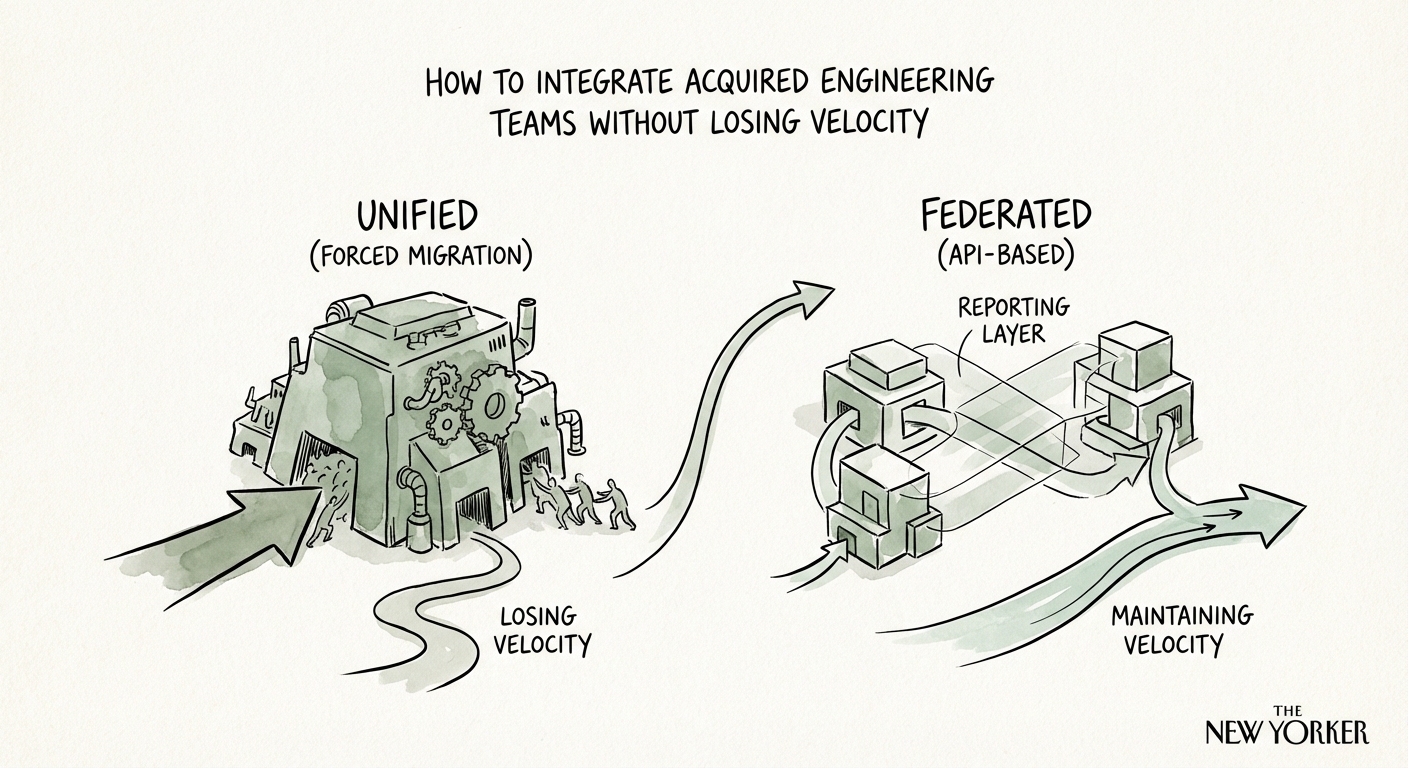
The standard Private Equity playbook for technology integration is efficient, logical, and catastrophic. It usually looks like this: acquire a target, immediately mandate a migration to the parent company’s Jira instance, unify the CI/CD pipelines, and standardize coding conventions. The goal is visibility and synergy. The result is what we call the 'Velocity Tax'—a 30% to 50% drop in deployment frequency and a spike in attrition that destroys the very asset you just bought.
According to EY, 47% of employees leave within the first year of a merger or acquisition. In engineering, this number is often higher because developers view their toolchain as their primary work environment. When an acquirer forces a 'lift and shift' of tooling in the first 90 days, they aren't just changing software; they are disrupting the flow state of the team. We see this repeatedly: a high-performing team is acquired, forced to adopt a clumsy corporate Jira workflow, and suddenly, their 'Cycle Time' (the time from first commit to production) balloons from days to weeks.
The paradox is that by trying to gain visibility through standardization, you destroy the output you wanted to observe. The most successful acquirers in 2026 are flipping this model. They accept that heterogeneity in tooling is the price of velocity. They don't force the acquired team to work like the parent company; they only ask them to report like the parent company.
The fastest way to kill a software company is to force a high-velocity team to adopt a low-velocity process in the name of 'synergy.'
The 'Observability First' Strategy: Federation over Unification
Instead of a 'rip and replace' integration, the most sophisticated Operating Partners are deploying an 'Observability First' strategy. This approach leaves the acquired team’s daily workflow (IDE, Git, Jira/Linear/Asana) untouched for the first 12 months but normalizes the data exhaust from those tools into a central executive dashboard.
1. The API-Led Reporting Layer
Rather than forcing a migration to a single Jira instance, use an engineering intelligence platform (like Plandek, Jellyfish, or a custom warehouse solution) to ingest data from the target’s existing tools. Map their 'Done' status to your 'Completed' metric. This gives you immediate visibility into productivity metrics like Cycle Time and Deployment Frequency without forcing a single engineer to change their login.
2. The 'Do No Harm' CI/CD Hook
Security is the only non-negotiable. However, you don't need to rebuild their entire build pipeline to secure it. Instead of forcing a migration to your Jenkins or GitHub Actions setup, inject security scanning (SAST/DAST) as a blocking step in their existing pipeline. This ensures compliance without breaking their deployment velocity. It signals to the team that you care about risk, not control.
This 'Federated' approach prevents the 'Context Switch' drain—which research shows is the #1 productivity leak in software development. By preserving their environment, you preserve their momentum.
The 120-Day 'Do No Harm' Roadmap
To avoid the 47% attrition cliff, structure your post-close engineering integration plan around autonomy, not assimilation.
Days 0-30: Observation & Stabilization
Do not change a single tool. Your only goal is to install 'listeners'—connect their repo and project management tools to your reporting layer. Establish a baseline for their DORA metrics (Deployment Frequency, Lead Time for Changes, Mean Time to Recovery, Change Failure Rate). If you don't have a baseline, you cannot measure the impact of future changes.
Days 30-60: The Security Handshake
Introduce the 'Non-Negotiables': centralized identity management (SSO) and security scanning. Frame this as 'removing friction' for the engineers—"We are handling the security audit so you don't have to." This builds trust. Avoid merging code repositories unless there is a critical dependency.
Days 60-90: The Guild Model
Instead of a top-down mandate to 'adopt our coding standards,' create cross-company 'Guilds' (e.g., a Frontend Guild, a DevOps Guild). Invite the acquired team's leaders to present their best practices. Often, the acquired company has better modern practices than the platform company. This reverse-integration approach validates their expertise and dramatically improves retention. See our comprehensive integration guide for specific milestones.
The goal of engineering integration isn't to make everyone the same. It's to make everyone productive. Velocity is an asset; uniformity is a vanity metric.