The practical answer
- Short answer
- Stop building 'Frankenstein' platforms. Learn why API federation cuts integration TCO by 50% and accelerates cross-product revenue in PE roll-ups.
- Best fit
- Industry: B2B Technology. Function: Engineering & Product
- Operating path
- Migration & Integration → Turnaround & Restructuring → Transaction Advisory Services
- Key metric
- 50% Reduction in integration TCO over 3 years using API-led connectivity vs. point-to-point.
The 'Spaghetti Discount': Why Point-to-Point Integration Kills Deal Value
In the first 100 days of a platform acquisition, the pressure to demonstrate "synergy" is immense. The sales team wants to sell a unified suite, and the board wants to see the "platform play" become reality. Under this pressure, engineering teams often default to the path of least resistance: Point-to-Point (P2P) integration.
They build a direct pipe from Product A’s customer database to Product B’s billing engine. Then they build another pipe for single sign-on (SSO). Then another for reporting. It works—for a month. But as you acquire Product C and Product D, this approach creates a quadratic complexity curve. You aren't building a platform; you are building a "Frankenstein" architecture—a fragile web of hard-coded dependencies that breaks every time a source system updates its schema.
The Hidden Cost of 'Quick Wins'
While P2P integration looks cheaper on Day 1, the technical debt compounds immediately. Industry benchmarks indicate that point-to-point integrations eventually cost 2-3x more to maintain than API-led architectures because they lack reusability. Every new connection is a custom build, leading to a linear (or exponential) cost curve.
For Private Equity sponsors, this manifests as the "Spaghetti Discount." When it comes time to exit, the buyer's technical due diligence will reveal that your "integrated platform" is actually three separate codebases held together by duct tape and fragile scripts. This discovery creates a massive red flag regarding scalability and future maintenance costs, often leading to a re-trade or a valuation haircut.
Real integration isn't just about moving data; it's about creating a unified capability. If your engineering team is spending 60% of their time fixing broken integration scripts, they aren't building the features that drive the 14x multiple you promised the investment committee.
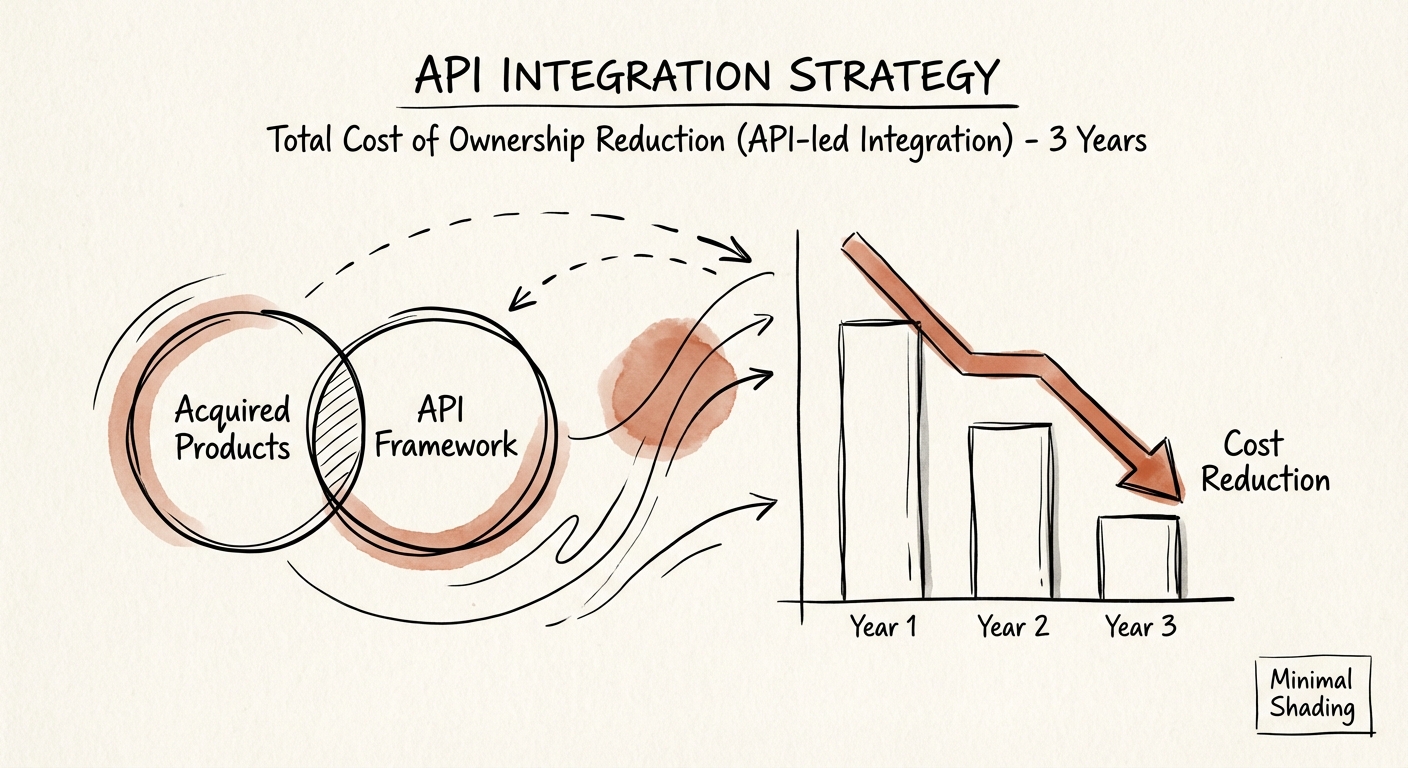
The most striking takeaway... is that API-led integration is financially more cost-effective than a point-to-point approach. Furthermore, the gap between the two options widens over time as reuse increases.
The Federation Playbook: Creating a 'Virtual Platform' in 90 Days
The alternative to the Spaghetti mess is API Federation. Instead of rewriting acquired applications or creating a spiderweb of direct connections, you build a lightweight "Federation Layer" (often using GraphQL or an API Gateway) that sits above the acquired products.
This layer acts as a facade. It presents a single, unified API to your frontend applications and third-party partners, while the backend systems (Product A, B, and C) remain largely autonomous. This decouples the interface from the implementation.
Why Federation Wins in M&A
This approach aligns perfectly with the Private Equity hold period:
- Speed to Market: You can launch a unified "Customer 360" dashboard in weeks by stitching together data at the API layer, rather than waiting 18 months for a database migration that may never happen.
- Risk Mitigation: You avoid the massive risk of "rip and replace" migrations. If Product B fails, the Federation Layer handles the error gracefully without taking down the entire suite.
- Future-Proofing: When you acquire Product D next year, you simply plug it into the Federation Layer. The frontend apps don't need to change.
Data from MuleSoft and other integration leaders suggests that organizations adopting this API-led approach see a 50% reduction in Total Cost of Ownership (TCO) over three years compared to P2P models. The savings come from reuse. Once you build a "Customer API" for the portal, you can reuse it for the mobile app, the partner ecosystem, and the internal support tool without writing a single extra line of integration code.
The 'Kill Switch' for Stale Code
Federation also provides a roadmap for eventual consolidation. Once the facade is in place, you can slowly strangle the legacy backend services one by one, replacing them with modern microservices, without the customer ever noticing. This allows you to pay down technical debt strategically, rather than pausing the roadmap for a year to rewrite the platform.
Benchmarks: Measuring Integration Success
How do you know if your integration strategy is working? Stop tracking "number of APIs built" and start tracking metrics that correlate with deal value.
1. API Reuse Rate
Benchmark: >30% by Year 2.
In a healthy API ecosystem, at least 30% of your APIs should be reused across multiple projects or channels. If every new feature requires a new API, you are still building point-to-point, just with better labels. High reuse rates drive the margin expansion that PE firms crave.
2. Integration Lead Time
Benchmark: <4 Weeks.
How long does it take to add a new acquired product to your "Unified Dashboard"? With a mature Federation Layer, this should be a configuration task, not a development project. If it takes 6 months to expose a new acquisition's data to your customers, your integration velocity is too slow to support a "buy-and-build" strategy.
3. The 'Frankenstein' Ratio
Benchmark: 0.
Measure the number of direct database connections between separate products. In a federated architecture, this number should be zero. Every cross-product interaction must go through the API layer. This ensures that you can swap out underlying systems without breaking the entire enterprise.
For Operating Partners, the mandate is clear: Do not accept an integration plan that relies on "syncing databases." Demand an API strategy that creates a composable enterprise. It is the difference between selling a loose collection of assets and selling a true platform.