
The practical answer
- Short answer
- FDI reviews and antitrust second requests freeze cross-border deals 4-6 months. Here's how clean teams and federated architecture let you integrate anyway.
- Best fit
- Industry: Private Equity & Technology M&A. Function: M&A Integration & Operations
- Operating path
- Migration & Integration → Turnaround & Restructuring → Transaction Advisory Services
- Key metric
- 30% of mega-deals exceeding $1 billion are actively delayed by prolonged regulatory reviews.
The Signature Is Worthless Until a Regulator You've Never Met Says So
Here is the moment that breaks every cross-border integration plan I've watched go sideways: the deal is signed, the press release is out, the board is congratulating itself, and then a foreign direct investment screening office requests "supplementary information." That phrase is bureaucratic for "we're going to sit on this for half a year." Antitrust second requests and FDI reviews are now extending cross-border timelines by an average of four to six months, and the cruelest part is that this clock starts after you've publicly committed and your competitors know exactly who to poach. Greenberg Traurig's Q1 2026 M&A Report describes regulators demanding data extraction at a depth that pushes timelines out by half a year as a matter of routine, not exception.
Picture a transatlantic software carve-out, say a US sponsor buying a 120-person European platform with a German entity in the structure. The plan was textbook: 90 days from signing to Legal Day 1. Then a national security screen on the European side triggered a freeze. While everyone waited, three product leads got recruited away, the customer base started asking pointed questions, and the original financial thesis quietly drifted from reality. The thing about regulatory limbo is that it doesn't pause the business, it pauses only you. The market keeps moving, the talent keeps fielding calls, and your synergy model keeps assuming a Day 1 that hasn't arrived.
This is not a fringe risk for trophy deals. PwC's Global M&A Trends indicates that up to 30% of mega-deals over $1 billion are now actively delayed by prolonged regulatory review. When a third of the upper-market deal space is structurally stalled, the 100-day playbook isn't aggressive, it's fiction. The operators who win cross-border deals have stopped asking "how fast can we integrate after close?" and started asking "how much integration can we legally accomplish before close, while the clock runs?" If you want the milestone logic that should kick in the moment clearance lands, our breakdown of M&A integration timeline benchmarks covers the 30, 60, and 90-day sequence.
The deal didn't fail at close. It failed during the eight months I sat on my hands waiting for a foreign competition authority, paying retention bonuses to people who left anyway.
Gun-Jumping: The Rule That Forces You to Watch Your Own Deal Decay
Most first-time cross-border buyers don't lose money on the close. They lose it during the wait, and they lose it because of one specific legal constraint they didn't price in: gun-jumping. Until clearance, the two companies must operate independently, no shared roadmaps, no joint pricing, no migrating customers onto your platform, no consolidating the back office. So the work that creates value, IT consolidation, system harmonization, org design, sits frozen by law, not by choice. And frozen technical work doesn't stay still; it rots. Bain & Company's M&A integration analysis shows systems-integration cost estimates routinely overrunning by 20% to 50% when timelines slip and technical debt goes unaddressed during the wait. Every month the clock runs, your integration gets more expensive to execute, before you've executed any of it.
Then there's the customer base, which has no idea what gun-jumping is and only knows that the company they buy from just got acquired by foreigners and went quiet for eight months. That silence is the gift you hand your competitors. They walk into your acquired accounts spreading doubt about the roadmap, the support model, and whether the product survives. It works because the decision to switch isn't rational. Deloitte's banking M&A integration research found 36% of customers who leave after an acquisition do so for emotional reasons rooted in brand confusion and prolonged uncertainty. You can't legally reassure them with an integrated roadmap yet. So they leave on a feeling, and the revenue line you underwrote the deal on starts shrinking while you're still waiting to take the keys.
Now do the arithmetic that PE operating partners consistently skip. You're carrying outside counsel in two jurisdictions, retention bonuses for the people most likely to bolt, and duplicate software licenses across both stacks, call it a serious monthly burn for the privilege of waiting. That spend hits year-one cash flow directly, and none of it buys integration progress. The longer the freeze, the more execution risk piles up for the day clearance finally lands. This is the same compounding decay we map in the "Month 6 cliff", except a cross-border deal can hit that cliff while you're still legally barred from doing anything about it.
Integrate in the Shadows: Clean Teams and Federated Architecture
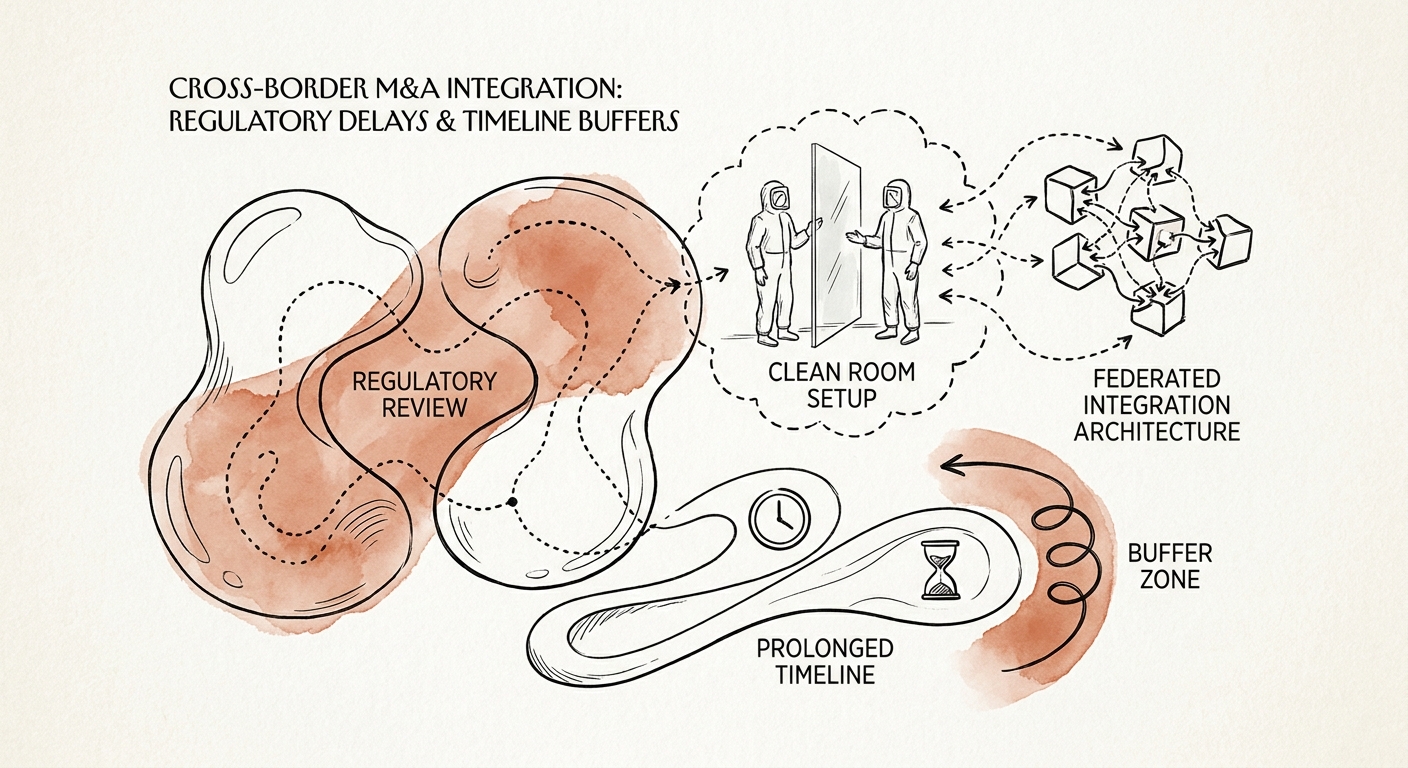
The buyers who beat the regulatory clock don't wait it out, they do the legal version of integrating before they're allowed to. The first move is a clean team: independent third-party advisors, walled off from your deal team, who can lawfully see competitively sensitive data from both companies during the freeze. Gun-jumping bars you from acting on that data, not a properly firewalled neutral party from analyzing it. Put a clean team to work modeling product overlap, mapping ERP harmonization, and finalizing org design while the regulator deliberates. When Legal Day 1 arrives, you're not starting discovery, you're executing a plan that's already been pressure-tested. That's the difference between a 90-day sprint and a 90-day standstill on the back end of clearance.
The second move is architectural, and it's the one cross-border buyers get backwards. Stop designing for an immediate rip-and-replace migration that assumes a clean, on-time Day 1, because cross-border deals almost never get one. Design instead for federation: systems that run independently but talk through secure API layers, so value flows even if a regulator clears the financial merger but blocks data transfer across a border. PitchBook's Q3 2025 Global M&A Report ties cross-border flows directly to shifting regulatory scrutiny, which means structural flexibility isn't a nice-to-have, it's the thing that keeps a deal alive when one jurisdiction approves and another stalls. A federated architecture lets you capture commercial synergy without betting the integration on a migration the regulator can veto.
So here's what you actually do Monday: build the regulatory buffer into the model as a default, not a contingency. For any deal crossing borders, load six months of extended retention packages for the people you cannot afford to lose, reserve capital for a prolonged review in both jurisdictions, and give the board a timeline that assumes the freeze instead of pretending it won't happen. Stand up the clean team at signing, not at clearance. And spec the integration as federated-first. The deals that survive cross-border limbo are the ones where the buyer kept doing the work in the shadows, legally, deliberately, so that nothing about the wait dictated the synergy outcome. When the buffer period ends and you can finally act, our post-acquisition Day 1 IT checklist covers the 47 tasks that can't wait another hour.