
The practical answer
- Short answer
- 86% of acquirers fall short — usually between day 30 and 90. The PMI playbook: freeze by day 30, cut non-customer spend by 60, lock the model by 90.
- Best fit
- Industry: Private Equity & Enterprise M&A. Function: Operations & Integration
- Operating path
- Migration & Integration → Turnaround & Restructuring → Transaction Advisory Services
- Key metric
- 30 Days Secure business continuity, establish financial reporting, and freeze all high-risk operational migrations.
The Salesforce migration scheduled for Day 45 is where the deal quietly dies
Here is the moment I watch for in every portfolio integration: the deal team's 100-day plan lands on the management team's desk, and somewhere around line 14 it says "consolidate to single CRM by Day 45." That single bullet has killed more synergy than any failed price increase. Someone built it in a spreadsheet where data migrations are instantaneous and sales reps don't quit. They aren't, and they do.
The hard truth isn't that most integrations fail to capture synergy. It's when they fail. PwC's M&A integration research [2] found 86% of acquirers fall short of integration success, and in the deals I've rebuilt, the value rarely leaks at close. It leaks between Day 30 and Day 90, after the deal team has moved on and the operators are left trying to run a financial model as if it were an operating manual. A 100-day plan and a 90-day integration timeline are not the same document. One is a target. The other is a sequence — and sequence is the whole game.
So treat the first 30 days as a freeze, not a sprint. Your only job in this window is to make the acquired team and their customers believe the deal wasn't a mistake. Secure access controls and credentials. Stand up consolidated financial reporting so you can actually see the combined P&L. Lock communications so people hear about their jobs from you, not from a vendor's automated lockout email. And explicitly freeze the irreversible stuff: no forced ERP cutover, no sales-org restructuring, no CRM migration. Write the freeze list down and circulate it, because the deal model is silently pulling in the opposite direction the entire month.
This is also where pre-LOI diligence quietly earns its keep. If you ran real operational due diligence, your integration office already knows where the body of integration risk is buried — which contracts have change-of-control clauses, which two engineers hold the keys to the billing system, which customers represent a third of net revenue retention. You spend Day 1 to Day 30 protecting those, not discovering them. Pulse-survey the acquired team weekly. Watch invoice accuracy and ticket resolution like a hawk. Synergy comes later. Month one is survival.
A 100-day plan written by the deal team is a financial model wearing a calendar's clothes. The integration timeline has to be written by people who know which Tuesday the invoices break.
Days 31-60: cut the spend that doesn't touch a customer, and nothing else
On a $200M B2B SaaS platform we worked, the thesis was textbook: two overlapping CRMs, duplicative vendor stacks, a clean consolidation story. The deal team's plan mandated full Salesforce migration by Day 45. We pulled it. Forcing technical convergence faster than human adoption doesn't save money — it incurs what we call the integration tax, the operational debt you pay when reps can't find their pipeline and renewals slip a quarter. That migration, on that timeline, would have eaten the quarterly forecast it was meant to protect.
What month two is actually for: the cuts that never reach a customer. Overlapping procurement contracts. Redundant software licenses (you'll find more than the data room admitted to). Duplicative corporate services — the second payroll provider, the third expense tool, the two facilities contracts on the same building. Bain's integration work [3] is blunt that the acquirers who plan during diligence rather than after close realize materially more synergy, and Day 31 to 60 is where that planning either meets reality or evaporates. Track every dollar as a run-rate against the original deal model, so the board sees quantifiable wins by Day 60 without you having touched the revenue engine.
The discipline is a simple test: does this change cross the customer-facing line? Renegotiating a freight contract doesn't — cut it now. Merging the two sales teams' commission plans does — leave it alone. The fastest way to trigger the integration mistakes that destroy deal value is to redesign comp before you understand why the acquired reps sell the way they do. You can align coverage rules and set price floors to kill channel conflict in month two. You cannot reverse-engineer a sales culture in 30 days. Save that for the next phase, with a design, not a deadline.
By Day 60 you should have a defensible run-rate number, a stabilized roster, and the operating scaffolding in place — decision rights drafted, the org chart sketched, the migration sequencing planned but not yet executed. You've earned the right to do the hard part. You haven't done it yet.
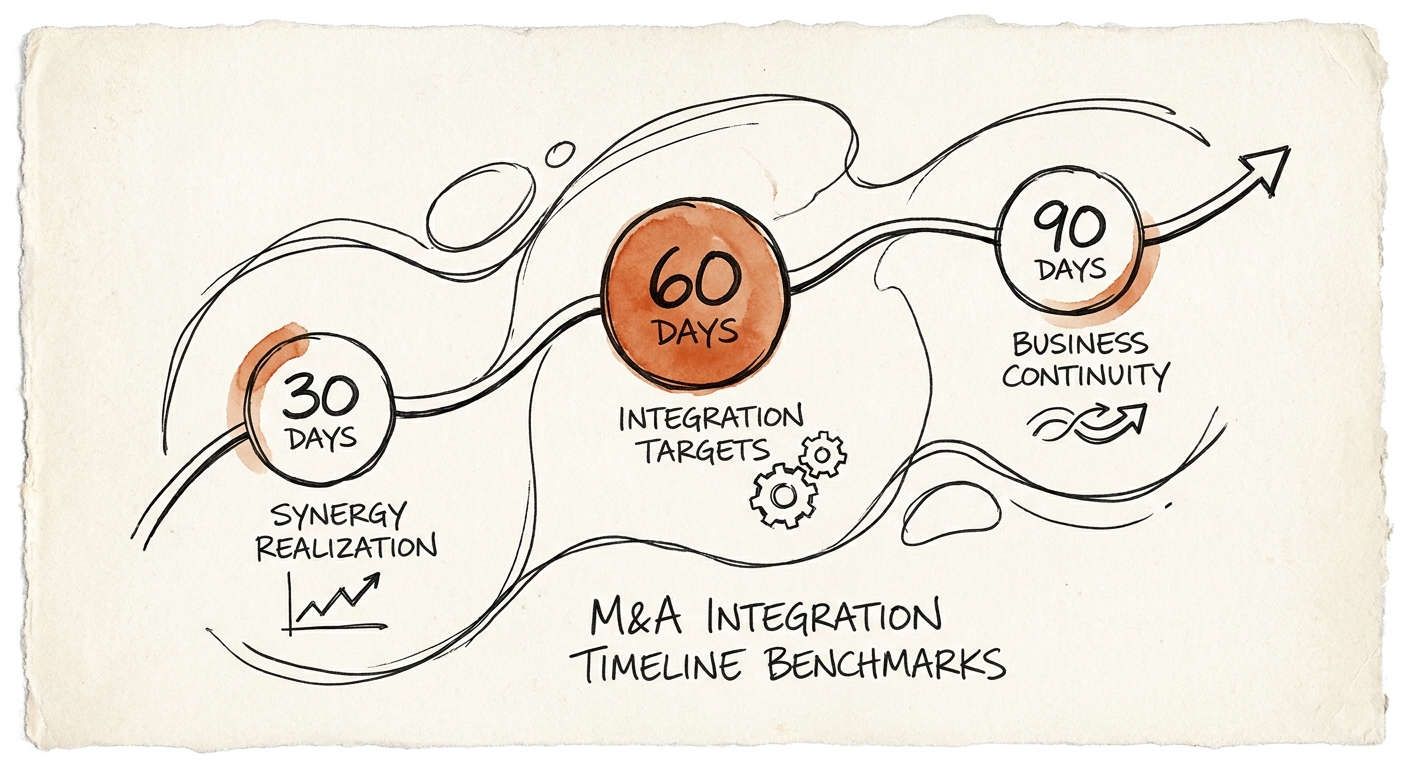
Days 61-90: lock the operating model before integration fatigue does it for you
Day 61 is when the steering committee stops showing up on time. The novelty is gone, the easy savings are booked, and both legacy businesses start drifting back into their old silos. Harvard Business Review [1] puts M&A failure rates at 70% to 90%, and a lot of that failure isn't a bad thesis — it's loss of momentum at exactly this inflection point. The deals that hold their value treat month three as the start of the real work, not the victory lap.
This is when the 100-day value creation plan finally flips from defense to offense. Lock the org structure for real. Finalize long-term executive incentives so your key operators are committed for the hold period, not testing the market. Solidify decision rights so the combined entity stops escalating every choice to the sponsor. And only now do the staged system migrations begin — the same CRM consolidation you refused to rush at Day 45, executed deliberately from test environment to live cutover, with rollback plans, after the people who use it have been brought along. Day 75 with a tested cutover beats Day 45 with a forced one every time.
Month three is also when customer-facing changes go live: brand transitions, unified offerings, combined SLAs. Audit them relentlessly. Build one simplified scorecard every business leader can read in 30 seconds, tracking realized synergy against the original deal model alongside the metrics that tell you if you broke something — net revenue retention, support resolution time, churn. If NRR dips the week after a brand change, that scorecard should make it impossible to ignore.
Be honest about what Day 90 is and isn't. It is not "integration complete" — full synergy realization routinely runs 12 to 18 months. It is the point where the deal's trajectory is set. Hit these three checkpoints — freeze and stabilize by 30, cut the non-customer spend by 60, lock the operating model by 90 — and the rest of the hold becomes compounding value creation instead of permanent firefighting. Your Monday move: pull your current 100-day plan and mark every line that crosses the customer-facing line. Then move every one of them out of month one.