
The practical answer
- Short answer
- Discover how to rationalize overlapping technology stacks post-merger. Learn why 27% of acquired cloud spend is wasted and how to capture G&A synergies in the first 100 days.
- Best fit
- Industry: Private Equity / Software. Function: Technology Strategy
- Operating path
- Migration & Integration → Turnaround & Restructuring → Transaction Advisory Services
- Key metric
- 27% Of acquired cloud spend is wasted due to lack of governance and over-provisioning (Flexera/NMS, 2025).
The 'Shadow IT' Iceberg in Your New Portfolio Company
In the rush to close a deal, financial due diligence often captures the headline numbers—EBITDA, ARR, and gross retention—but misses the granular reality of the technology stack. You know the target uses Salesforce and NetSuite. What you don't see is the sprawling underbelly of "Shadow IT" that accounts for 30-40% of total IT spending in the average mid-market enterprise.
Post-acquisition, this invisible spend becomes a silent source of deal-value erosion. We call it the "Inactive License Tax." It comes from three sources:
- Duplicate Tools: The acquired marketing team uses Asana, while your platform company uses Monday.com. Both subscriptions renew automatically, often on credit cards outside central procurement.
- Orphaned Instances: Test environments, legacy servers, and "sandbox" accounts spun up by engineers who left two years ago, still billing monthly to an ignored department code.
- The Multi-Cloud Trap: According to 2025 benchmarks, 27% of acquired cloud spend is wasted due to over-provisioned resources and lack of governance.
For a Private Equity sponsor, this isn't just an operational annoyance; it is a direct hit to the efficiency metrics you modeled in the 100-day plan. If you are buying a platform to execute a "Buy and Build" strategy, leaving these overlapping stacks unresolved creates a "Frankenstein" architecture that slows down every subsequent integration by months.
The most expensive decision in post-merger integration is the decision to 'wait and see.' Every month you run overlapping stacks is a month you are funding your own complexity tax.
The 60-Day Rationalization Framework: Keep, Kill, or Coexist
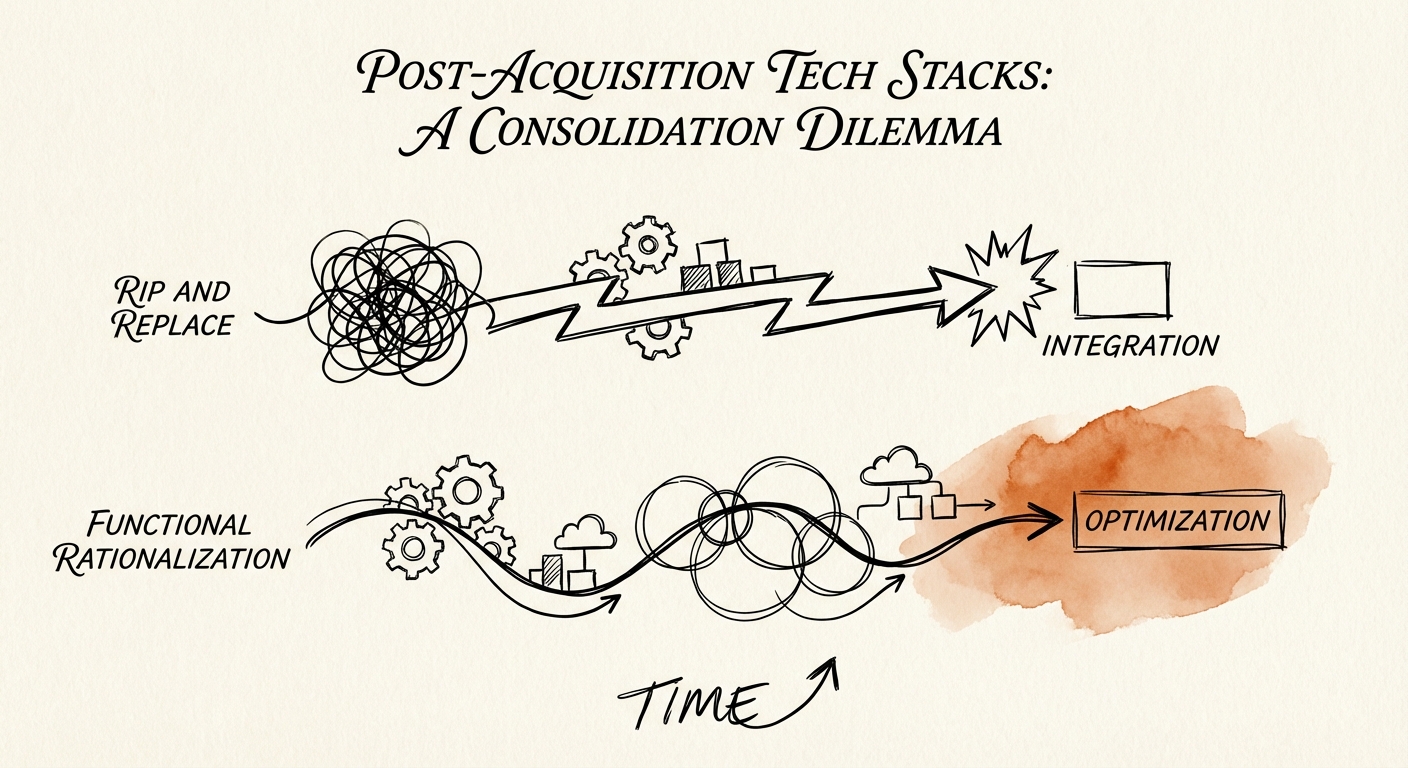
The instinct for many Operating Partners is to mandate a "Rip and Replace" strategy immediately—forcing the acquired entity onto the platform's stack. While logical on a spreadsheet, this often triggers a "Productivity Dip" that kills momentum. Instead, we recommend a Functional Rationalization Audit within the first 60 days, categorizing every tool into one of four buckets:
1. The Core Backbone (Mandatory Migration)
These are the systems of record: ERP (Financials) and CRM (Revenue). Consolidation here is non-negotiable for unified reporting, but the timeline matters. Migrating a $50M target from Quickbooks to NetSuite is a 6-month project; rushing it breaks the finance function. Budget for the integration cost, but prioritize data visibility over immediate system unification.
2. The Productivity Layer (Loose Coupling)
Tools like Slack vs. Teams, or Jira vs. Linear. Do not force migration here in the first year unless the savings exceed $100k. The "friction cost" of retraining engineering teams often outweighs the license savings. Let them coexist, but implement Single Sign-On (SSO) to ensure security governance.
3. The 'Inactive' Layer (Immediate Sunset)
This is your quick win. Run a generic ledger query for all software vendors. You will find duplicate Zoom accounts, unused LinkedIn Sales Navigator licenses, and AWS instances with 0% utilization. Kill these immediately. Our data shows this step alone typically recovers 8-12% of the target's non-headcount OpEx.
4. The Strategic Assets (Reverse Migration)
Sometimes, the target has a better stack than the platform. If the acquired company has a modern, AI-enabled support stack (e.g., Zendesk with advanced automation) and the platform is stuck on legacy Salesforce Service Cloud, consider a "Reverse Integration." Move the parent to the child's stack. This signals to the acquired team that you value their operational maturity, boosting retention.
Execution: Breaking the 'Sunk Cost' Fallacy
The biggest barrier to consolidation isn't technical—it's emotional. The VP of Sales at the acquired company loves their customized HubSpot instance. They will argue that moving to Salesforce will "kill deal velocity." They might be right, but usually, they are protecting their autonomy.
To navigate this, focus on the Data Model, not the User Interface. Ensure that customer data flows seamlessly between systems first (using middleware like MuleSoft or Boomi) before you force a UI change. This buys you time to manage the change management properly.
Furthermore, look for the "G&A Arbitrage." Bain's 2025 analysis suggests that integration provides a unique window to rethink General & Administrative costs, potentially realizing 25% or more in savings by implementing AI and process automation during the consolidation phase. Don't just lift and shift; lift and modernize.
Ignoring tech consolidation doesn't make the problem go away; it compounds it. A delay in rationalization is a decision to accept higher opacity, higher security risk, and lower exit multiples. The firms that win in 2026 are those that treat technology integration as a value creation lever, not just an IT ticket.