
The practical answer
- Short answer
- A 100-day guide for PE Operating Partners to capture 30% IT cost synergies after a technology acquisition. Benchmarks, negotiation tactics, and consolidation frameworks.
- Best fit
- Industry: Private Equity. Function: Operations
- Operating path
- Migration & Integration → Turnaround & Restructuring → Transaction Advisory Services
- Key metric
- 27% Average percentage of SaaS and cloud spend that is wasted in post-merger environments due to redundancy and shelfware.
The 'Shadow' P&L: Why Your CIM Is Lying About IT Spend
In every deal model I see, there is a standard line item for "IT Synergies." It is usually pegged at a conservative 10-15% of the combined technology budget. This number is safe, it is defensible in the investment committee, and it is almost always wrong.
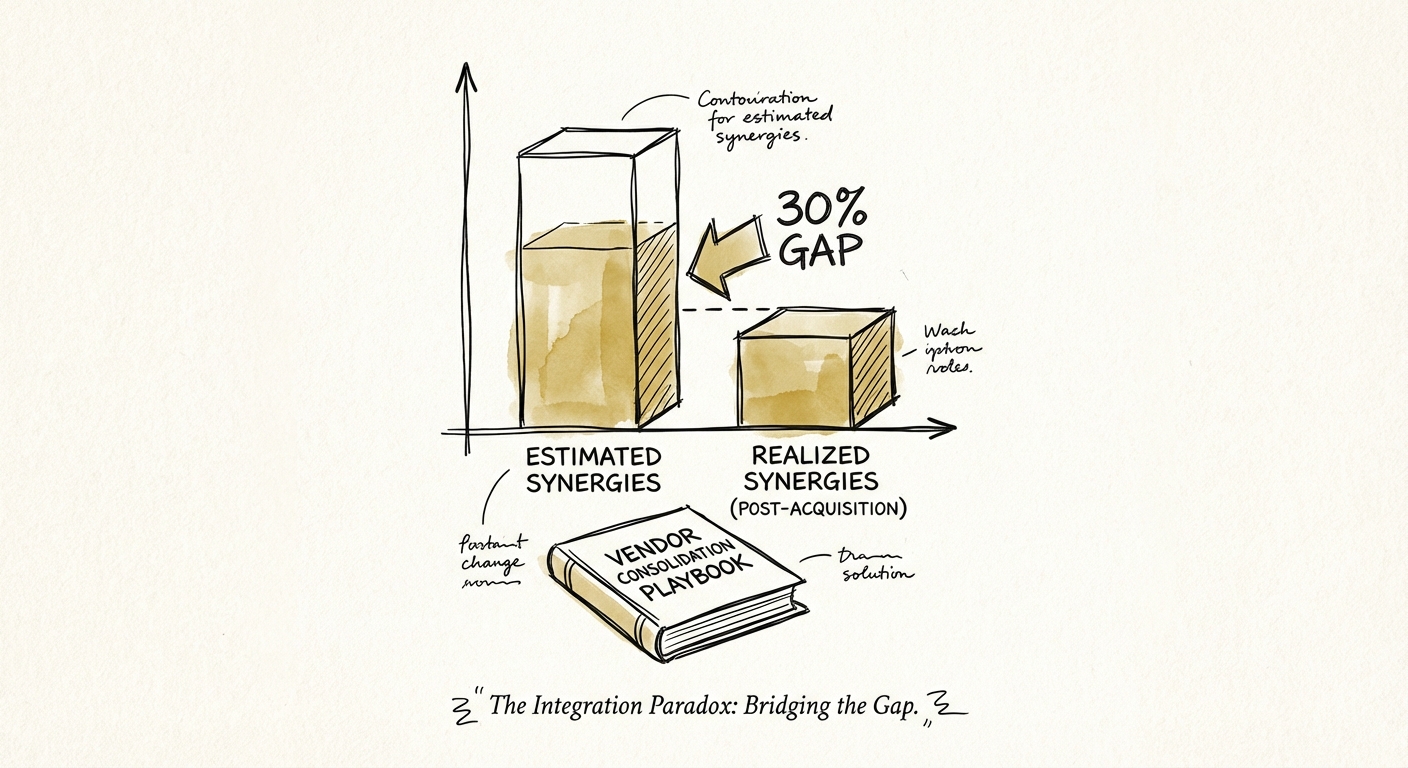
The reality of 2026 technology stacks is that the true redundancy rate is closer to 30%. According to 2025 data from Flexera and NMS Consulting, approximately 27% of cloud and SaaS spend in the average enterprise is wasted—allocated to shelfware, unused seats, or duplicate capabilities. In a merger scenario, this waste compounds. You don’t just inherit a target’s revenue; you inherit their "Shadow IT."
The average mid-market technology company now utilizes over 275 discrete SaaS applications. The Confidential Information Memorandum (CIM) lists perhaps 50 of them—the "Core" stack like Salesforce, NetSuite, and AWS. The other 225 live in the expense reports of department heads, paid for via corporate cards, often with auto-renew clauses that trigger 30 days post-close. This is where your EBITDA synergy dies. While your integration team focuses on the massive ERP migration that won’t yield savings for 18 months, thousands of dollars in monthly recurring revenue (MRR) bleed out through "Inactive Apps"—duplicate project management tools (Asana vs. Monday), redundant dev tools, and forgotten marketing subscriptions.
You don't just inherit a target's revenue; you inherit their 'Shadow IT.' The CIM lists 50 apps; the credit card statements list 275. That gap is your synergy.
The 'Kill, Keep, or Merge' Framework
Operating Partners often hesitate to cut vendors early because they fear disrupting the "velocity" of the acquired team. This is a mistake. The "velocity tax" of maintaining two disparate toolsets is far higher than the friction of a migration. You need a disciplined triage framework executed in the first 100 days.
1. The 'Kill' List (Days 1-30)
Identify functional duplicates with low data gravity. These are tools like Slack vs. Teams, Zoom vs. Webex, or Box vs. Dropbox. There is no "best of breed" argument here that justifies paying double. Pick the standard of the acquiring platform (or the dominant player) and mandate a cut-over date. If you delay this decision, you legitimate the silo.
2. The 'Merge' List (Days 30-90)
These are high-gravity systems like CRMs or ERPs. You cannot kill these overnight without breaking the business. However, you can consolidate the commercial agreements immediately. Even if you are running two Salesforce instances for a year, you should be paying for them under one contract. See our guide on M&A integration budgeting for benchmarks on these transition costs.
3. The 'Contain' List (Indefinite)
Some niche tools (e.g., a specific CAD software for R&D) have no overlap. The goal here isn’t consolidation but containment. renegotiate these contracts to align with the new entity's fiscal year and payment terms. Ensure they don’t have "poison pill" auto-renewals that lock you in for three years.
Weaponizing the 'Change of Control' Clause
The single biggest missed opportunity in post-merger vendor management is failing to leverage the "Change of Control" event. Vendors view your acquisition as a payday; they expect to upsell you. You need to flip the script.
A Change of Control often triggers a clause that allows either party to terminate or renegotiate. Even if the contract is silent, the implication of a merged entity reviewing its vendor landscape creates leverage. Your message to every vendor in the first 30 days should be uniform: "We are reviewing all vendor relationships for the combined entity. All renewals are paused pending this review."
This is where you execute the Reverse Audit. Instead of waiting for Oracle or SAP to audit your license usage (which they will, aggressively, post-merger), you proactively audit their compliance with your new standards. Are they SOC 2 compliant? Do they meet your new data residency requirements? Use these gaps to force early termination of redundant contracts without penalty. For a deeper dive on what to check immediately, refer to our Day 1 IT Checklist.
Finally, do not sign the "standard" assignment letter they send over. These letters often subtly reset contract terms or remove favorable grandfathered pricing. Treat the assignment as a new negotiation. If you don't, you aren't just missing synergies; you're actively eroding the deal value you promised the investment committee. For benchmarks on what IT spend should look like post-optimization, check our 2025 IT Spend Benchmarks.