
The practical answer
- Short answer
- PE sponsors model a 15% IT vendor savings post-close, then redundant SaaS costs rise 12% in year one. Here's the contract math that decides which to cut.
- Best fit
- Industry: Private Equity Operations. Function: IT Integration & Operations
- Operating path
- Migration & Integration → Turnaround & Restructuring → Transaction Advisory Services
- Key metric
- 51% of SaaS licenses are wasted or unused in the average enterprise organization, compounding redundancy costs during M&A.
Fourteen days before the letter of intent was signed, the target company quietly renewed a 36-month, auto-renewing SaaS commitment. By the time we found it — deep in a secondary order form, not the primary vendor schedule the quality-of-earnings team had reviewed — the platform company owned a contract it could not exit without paying the vendor for software it would never run again. That single document was part of $3.2M in overlapping SaaS spend hiding inside a $400M managed-services roll-up with three bolt-ons.
This is the gap nobody models. The standard integration thesis says two companies become one ERP, one CRM, one cloud bill — and the savings flow to EBITDA. The numbers say otherwise. Sponsors routinely pencil in a 15% cut to IT vendor spend in the first year. What actually tends to happen is a roughly 12% increase in redundant software costs, driven by termination penalties and renewal dates that were synchronized by the vendor, not by you.
The reason is that the consolidation everyone draws on a slide is precisely the event enterprise software contracts are engineered to resist. You are not acquiring a tech stack; you are acquiring a stack of master service agreements with staggered renewals, minimum-seat commitments, and termination-for-convenience language written by people who do this for a living. The redundancy doesn't politely double when you combine two companies. Per Zylo's 2026 SaaS Management Index, the average enterprise already wastes 51% of its SaaS licenses and carries roughly $4.1M in overlapping functionality before any deal closes. Bolt a second org onto that and the waste compounds, because each business unit defends its legacy tool like territory — what I call the Inactive License Tax.
A change-of-control clause feels like an exit door until you read it. On most SaaS contracts, the door is locked and the vendor is holding the only key — priced at the remaining contract value plus a penalty.
Why "change of control" is not an exit door
The most expensive assumption an operating partner can make is that a change-of-control clause lets you walk away from a redundant contract for free. It almost never does. Fewer than 14% of standard SaaS agreements include a fee-free exit triggered by an acquisition. Vendors protect their ARR, and they staff retention desks specifically to monetize M&A events — they can see the deal coming the moment your diligence team requests the contract files.
So when you try to kill a duplicate vendor after close, the bill that comes back is usually the remaining total contract value plus a termination penalty in the 15-20% range. And that bill is getting steeper: Gartner's 2025 Cloud Contracting Report found average buyout costs are up 42% over three years as vendors tighten their termination-for-convenience language.
The double-pay seat
The trap that eats synergies fastest is the true-up. Say you decide to move the acquired company's 300 users onto the platform company's existing enterprise agreement. Your incumbent vendor will happily expand your seat count — and the acquired target's legacy vendor will still invoice you for its contracted minimum, because that contract hasn't expired. You are now paying twice for the same person to use the same category of software. I've watched platform companies torch 30% of projected integration synergy inside 90 days doing exactly this with Microsoft 365 or Salesforce seats, simply because nobody ran the exit math before flipping the migration switch.
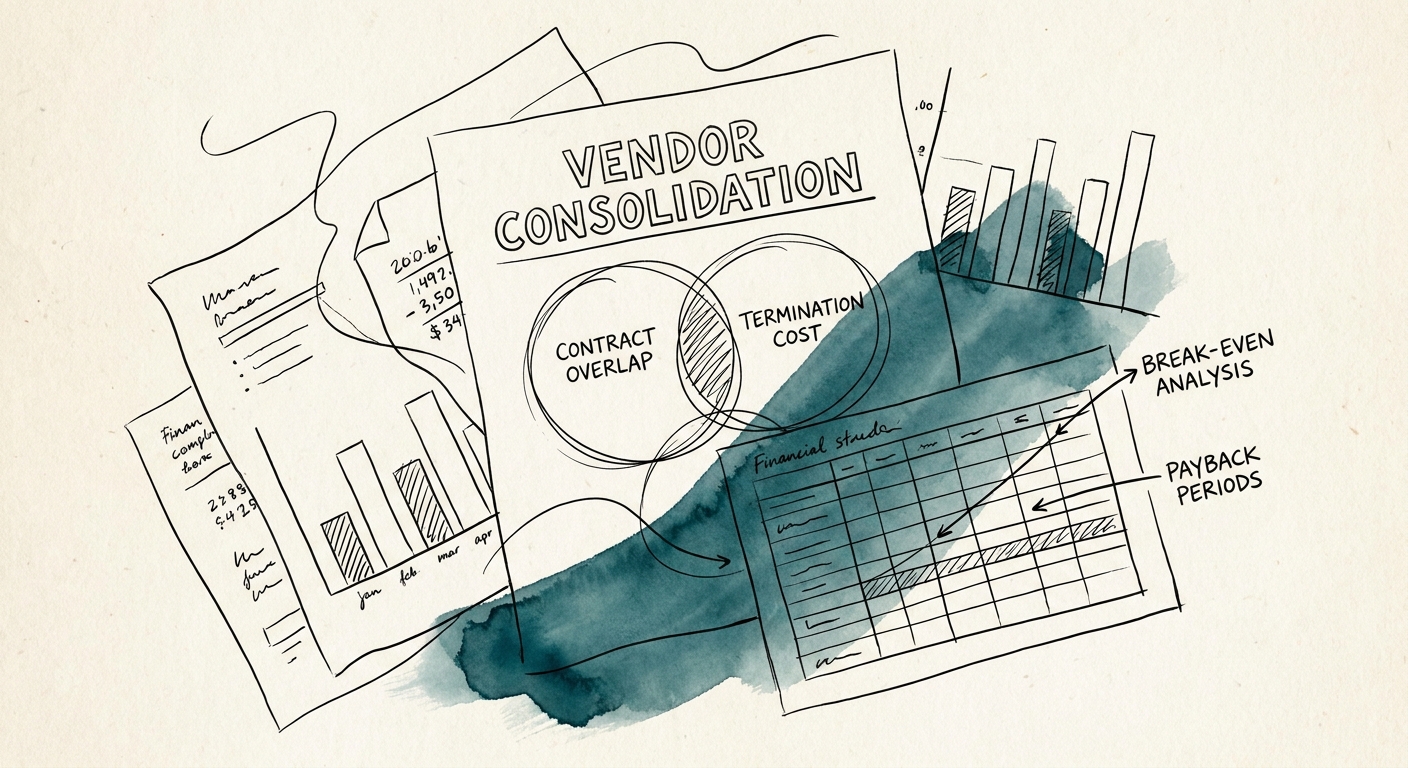
The discipline that prevents it is a break-even calculation per overlapping contract, not a portfolio-wide guess. For each duplicate, add up four numbers: remaining contract value, the hard termination penalty, the data-extraction fees the vendor will inflate to slow your churn, and the internal labor to actually migrate. Then compare that to what you'd otherwise pay to let the contract die on its own schedule. If the payback period to terminate runs past 14 months, the right answer is frequently to leave the legacy contract alone, freeze any new seats on it, and consolidate at its natural renewal. Breaking a contract on principle when the math says ride it out is how you turn savings into a loss. That single break-even — done per contract, before you sign anything — is the spine of any real vendor consolidation playbook.
The first 100 days, in the order that matters
Vendor rationalization is not a procurement chore you assign to IT and check on next quarter. It is a date-driven race against renewal clocks that started ticking before you owned the company. Three moves, in sequence.
1. Freeze the spend on close day
The day the deal closes, freeze all software purchasing and renewals at the acquired entity. Pull the corporate cards that have been funding shadow IT and route every signature authority to the platform CFO. This matters because a large share of SaaS spend — Zylo's data puts it at nearly half — happens outside formal procurement, which means new auto-renewing commitments can land while you're still doing org charts. Your Day 1 IT Checklist should treat signature authority as a thing you seize, not a thing you announce.
2. Run the renewal-date autopsy in week one
Every auto-renewing contract has a notification window — the 60 or 90 days before renewal in which you must give notice to get out. Miss it by a single day and you're legally bound to another 12 to 36 months of redundant spend, no negotiation. So before you touch a single migration, build a calendar of every notification deadline across both companies' contracts. We run automated contract-intelligence tooling in the first week specifically to surface those trigger dates, because a missed window is a seven-figure mistake that no amount of later negotiating leverage can undo.
3. Make your incumbents eat the termination cost
When you migrate the acquired users onto your primary vendor, do not accept a pro-rated expansion at the standard rate. You are bringing combined scale to the table — use it. Put the contract up for competitive review and make your incumbent absorb the buyout penalties on the legacy contracts you're killing as the price of keeping your business. McKinsey finds acquirers who structurally leverage their new combined scale in vendor talks capture 15-20% more cost synergy than those who just merge two rate cards and hope.
The throughline: contracts don't consolidate because you wrote it on the integration plan. They consolidate when you know the exact exit cost and the exact renewal date for every line, and you act on both before the clock runs out. Manage the overlap and the dates, or the vendors will quietly bill the synergy back out of your EBITDA.