
The practical answer
- Short answer
- Acquired engineering teams often face a 30% productivity drop post-close. Use this 60-day diagnostic playbook to stabilize talent, map dependencies, and prevent the 'Velocity Tax' that kills deal value.
- Best fit
- Industry: Private Equity. Function: Technology
- Operating path
- Migration & Integration → Turnaround & Restructuring → Transaction Advisory Services
- Key metric
- 15.4% The percentage of acquired employees who now leave within the first 3 months (Employ, Jan 2026), nearly double the historical average.
The Diagnosis: Why You Lose 30% of Throughput on Day 1
The deal is closed. The press release is live. The integration kick-off meeting ended with applause. And then, silence.
For the next 90 days, your newly acquired engineering team will ship approximately 30% less code than they did the week before signing. We call this the "Velocity Tax." It is not malicious; it is the inevitable byproduct of "organizational interrupt." Every hour spent in an HR onboarding session, a finance synergy meeting, or a "cultural alignment" workshop is an hour not spent shipping features. But the tax goes deeper than calendar clutter.
In 2026, the primary driver of this velocity drop is uncertainty. Engineers operate on context. When you acquire a software company, you sever that context. Questions arise immediately: Will we have to migrate to their Jira instance? Will they kill our tech stack? Is my equity package competitive? Until these questions are answered, engineers hedge. They stop refactoring code (too risky). They delay major architectural decisions (too uncertain). They update their LinkedIn profiles.
Recent data from Employ indicates that while first-year turnover has stabilized, three-month retention rates dropped to 84.6% in 2025. This means over 15% of your acquired talent—often the most marketable engineers—will leave before you even finish your 100-day plan if you mismanage the transition. You bought the code, but the value is in the people who know how to deploy it. If you trigger the Velocity Tax, you aren't just delaying the roadmap; you are eroding the asset.
You bought the company for its IP, but the IP walks out the door every evening. If you optimize for 'synergy' before you optimize for 'stability,' you will own a very efficient, empty shell.
The Prescription: The 60-Day Stabilization Playbook
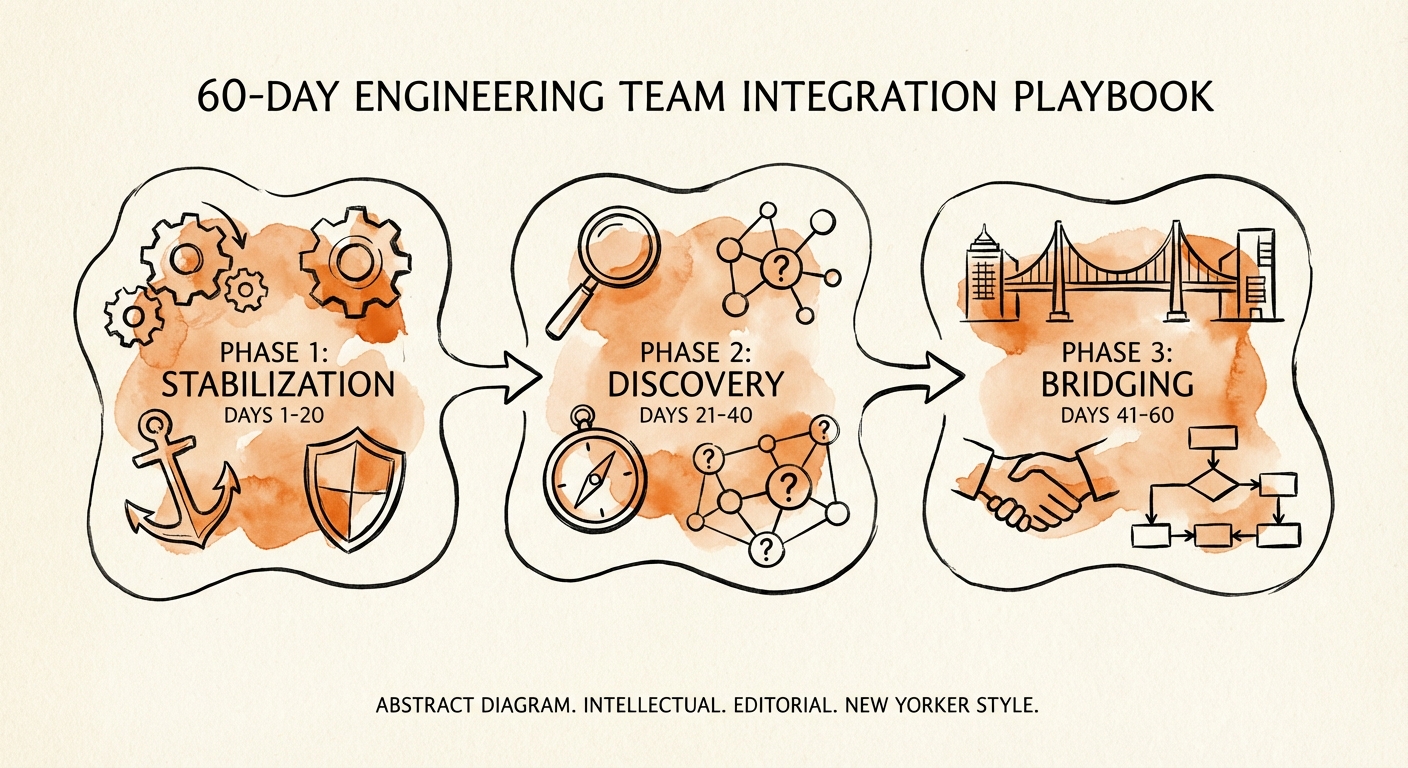
Traditional Post-Merger Integration (PMI) playbooks focus on cost synergies first. For engineering, this is fatal. Your first 60 days must be rigorously focused on stabilization and dependency mapping.
Days 1-15: The "Do No Harm" Phase
Your goal is to prevent the Velocity Tax from becoming permanent. During this window, enforce a moratorium on process changes.
- Freeze Tooling Migrations: Do not force them onto your Jira, GitHub, or CI/CD pipelines yet. The friction of learning new tools while worrying about job security destroys productivity.
- The "Safe Harbor" Statement: Explicitly state what will not change. "We are keeping your tech stack for at least 12 months." Certainty creates velocity.
- Identify the "Load-Bearing" Engineers: These are rarely the people with "Manager" in their title. Look at the commit history. Who reviews the most Pull Requests? Who fixes the build when it breaks? These 3-4 individuals hold the institutional knowledge that keeps the platform running.
Days 16-45: The "Code & Context" Audit
Now that the dust has settled, shift from stabilization to discovery. This is not a "performance review" but a "risk review."
- Audit Technical Debt Risks: Use our technical debt diagnostic to understand hidden liabilities. Is the "next-gen" platform actually a monolith held together by scripts?
- Map the "Bus Factor": If your Lead Architect leaves unexpectedly (or poached by a competitor), can you ship a release? If the answer is no, your integration priority is knowledge transfer, not cost-cutting.
- The "Ambassador" Program: Pair one engineer from the acquiring team with one from the acquired team. Their job is not to manage, but to unblock. They solve the "I don't know who to ask for VPN access" problems that kill momentum.
The Prognosis: Measuring Success Beyond EBITDA
How do you know if your integration is working? Do not look at EBITDA margins yet. Look at Cycle Time and Pull Request (PR) Throughput.
A successful integration sees Cycle Time (the time from first commit to deployment) return to pre-acquisition levels by Day 60. If you are at Day 60 and Cycle Time is still 2x the baseline, you have a cultural rejection problem. This usually manifests as "Process Paralysis"—engineers waiting for permission from new overlords rather than shipping code.
The 2026 Warning Sign
Watch your "Time to First Commit" for retained staff. If your best engineers go from deploying daily to deploying weekly, they are disengaging. In the current market, where 39% of skill sets are becoming outdated and AI proficiency is reshaping roles, engineers want to be on winning, shipping teams. If your integration turns a "shipping culture" into a "meeting culture," the attrition rates will follow the velocity drop.
The Bottom Line: You cannot "efficiency" your way out of a stalled engineering team. Stabilize first, map the talent second, and integrate processes last. The code will follow the culture.