
The practical answer
- Short answer
- Stop paying the 'Velocity Tax.' A diagnostic guide for PE-backed CTOs on merging development environments, unifying CI/CD pipelines, and protecting deal value.
- Best fit
- Industry: B2B SaaS. Function: Engineering
- Operating path
- Migration & Integration → Turnaround & Restructuring → Transaction Advisory Services
- Key metric
- 12-18 Months required for full large-scale post-merger integration, vs. the 90 days most PE firms budget.
The 'Frankenstein' Environment is Bleeding Your EBITDA
In the first 90 days post-acquisition, the pressure to demonstrate "synergy" usually falls on the Sales and Finance teams. Engineering is often told to "keep the lights on" and avoid disrupting the roadmap. This is a strategic error that we call the Velocity Tax.
When you acquire a company, you aren't just buying code; you are buying a way of working. If the target company uses Jenkins on AWS while your platform runs GitHub Actions on Azure, every day you delay integration is a day your engineering efficiency compounds in the wrong direction. Our data suggests that maintaining dual development environments costs 2-4x the initial development cost over the software lifecycle, primarily due to context switching, duplicate tooling licenses, and the "shadow IT" required to prop up legacy pipelines.
The symptoms of a Frankenstein environment are subtle but deadly to deal value:
- The "Works on My Machine" Defense: Developers cannot cross-pollinate because local environments are brittle and undocumented.
- The Security Gap: You have patched your production environment, but the acquired company's "dev" environment is running an unpatched Jenkins instance that is publicly accessible—a prime vector for the insider threats that spike during M&A transitions.
- The Deployment Freeze: Merging code takes 3x longer because there is no unified "merge queue" logic, leading to "integration hell" at the end of every sprint.
You don't merge development environments to save money on servers. You merge them to stop your engineers from needing a passport to visit the other team's code.
The Diagnostic: Auditing the 'Infrastructure Sprawl'
Before you command a "lift and shift," you must quantify the divergence. A blind merge often results in a total standstill where neither team can ship code. We recommend a 5-day infrastructure audit to categorize the target's environment into one of three buckets:
1. The "Modern but Different" (Integration Candidate)
The target uses modern IaC (Terraform/Pulumi) and containerization (Docker/K8s), but on a different cloud or orchestrator.
Verdict: High potential for unification. The "logic" is sound; only the "syntax" differs.
2. The "ClickOps" Nightmare (Quarantine Candidate)
The target's environment was built manually via the AWS Console. There is no IaC. Environments are "snowflakes"—unique and fragile.
Verdict: Do not merge. Encircle this environment. Build a new landing zone in your platform and migrate services one by one (the "Strangler Fig" pattern).
3. The "Legacy Monolith" (Preservation Candidate)
The target relies on on-premise hardware, mainframes, or deeply coupled legacy dependencies that cannot be containerized without a rewrite.
Verdict: Isolate via API gateway. Do not attempt to merge CI/CD pipelines yet. Focus on interface integration, not infrastructure integration.
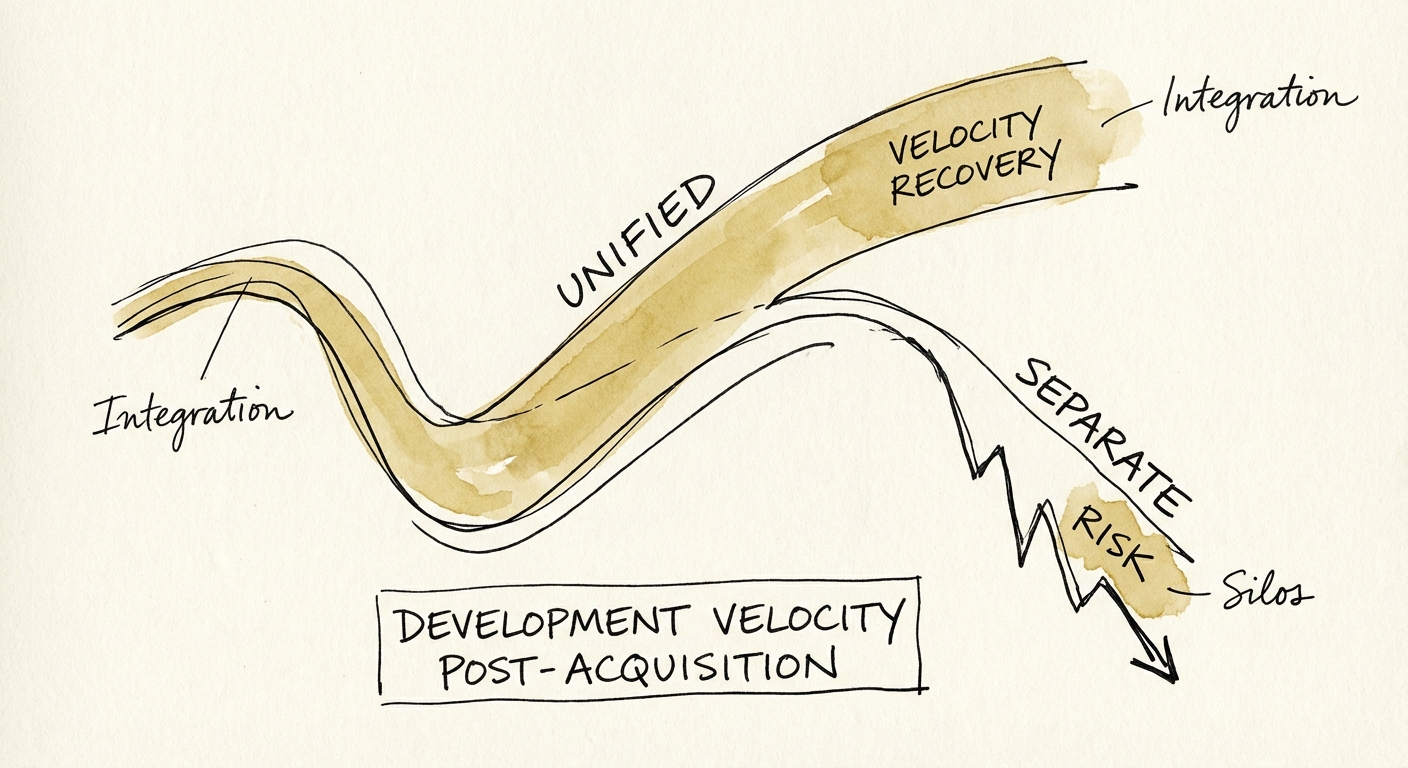
The 100-Day Playbook: From 'Us vs. Them' to 'One Platform'
Your goal is not just to reduce cloud spend (though that will happen); it is to create a Golden Path for developers. If the acquired engineers can ship faster on your platform than their old one, cultural integration solves itself.
Days 1-30: The Security & Connectivity Airlock
Establish a unified identity provider (SSO) immediately. Do not allow shared root accounts to persist. Link the VPCs via Transit Gateway or VPC Peering, but apply strict Security Groups that allow only specific traffic (e.g., CI/CD runners to artifact repositories). Metric to watch: Time to Onboard (TTO) for a new engineer accessing both environments.
Days 31-60: The CI/CD Unification
Pick one pipeline orchestrator. If you are a GitHub shop, move their repo logic to Actions. The code can stay where it is for now, but the build and deploy process must be centralized. This gives you a single pane of glass for deployment frequency and failure rates.
Days 61-90: The 'Strangler Fig' Migration
Identify the most critical microservice in the acquired stack (usually the authentication or billing module). Write a Terraform module that deploys this service into your primary environment. Cut over traffic. Repeat. This methodical consumption prevents the "Big Bang" failures that kill engineering morale.