The practical answer
- Short answer
- Stop hiring "Paper Tigers." Learn the 2026 UiPath talent benchmarks, USN requirements, and why "certified" doesn't always mean "billable."
- Best fit
- Industry: Intelligent Automation. Function: Talent Strategy
- Operating path
- Team & Hiring → Operational Excellence → Transaction Execution Services
- Key metric
- $250k Revenue at risk per 'Paper Tiger' lead developer due to failed deployments and remediation.
The Certification vs. Competence Gap in 2026
In the race to achieve Platinum or Diamond status within the UiPath partner ecosystem, specialized services firms often fall into a predictable trap: prioritizing badge collection over engineering capability. By early 2026, the market is flooded with "Paper Tigers"—developers who have memorized the answers to the UiPath Advanced RPA Developer (UiARD) exam but cannot architect a scalable Robotic Enterprise Framework (REFramework) solution that survives first contact with a client's messy infrastructure.
For Private Equity sponsors and Founders scaling automation practices, this distinction is financial, not just technical. A "certified" developer who lacks deep architectural experience creates what we call "Notebook Code"—automations that work perfectly on a developer's laptop but fail primarily in production. The cost of this failure is not just the developer's salary; it is the $250,000+ in lost billings, remediation credits, and churned accounts that follow a failed enterprise deployment.
The USN Filter: Why Badges Aren't Enough
UiPath has actively combated this via the UiPath Services Network (USN) designation, which remains the gold standard for partner capability. Unlike tiering based solely on license revenue, USN requires a rigorous external vetting process, often administered by third-party platforms like HackerRank. To pass, partners must demonstrate not just coding ability but architectural maturity across specific roles:
- RPA Solution Architect: Must demonstrate scalable design patterns, not just tool proficiency.
- Infrastructure Engineer: Tested on high-availability and multi-node orchestration, not just basic installation.
Partners that rely on "bootcamp" graduates to fill these seats will fail USN accreditation. Our data suggests that the true cost of a bad technical hire in this specific domain is often 30% higher than in general software engineering due to the specialized nature of the "re-work" required.
In 2026, the gap between a 'Certified' partner and a 'Capable' partner is the difference between a 12x exit and a distressed asset sale. You can't fake the USN technical assessment.
The Economics of Elite Automation Teams
The salary bands for genuine UiPath talent have bifurcated in 2025/2026. On one end, there is a commoditized layer of entry-level developers (often offshore or junior onshore) earning $85,000–$95,000. On the other, there is a premium tier of "Automation Architects" and "Agentic AI Engineers" commanding $140,000–$166,000+ in the US market.
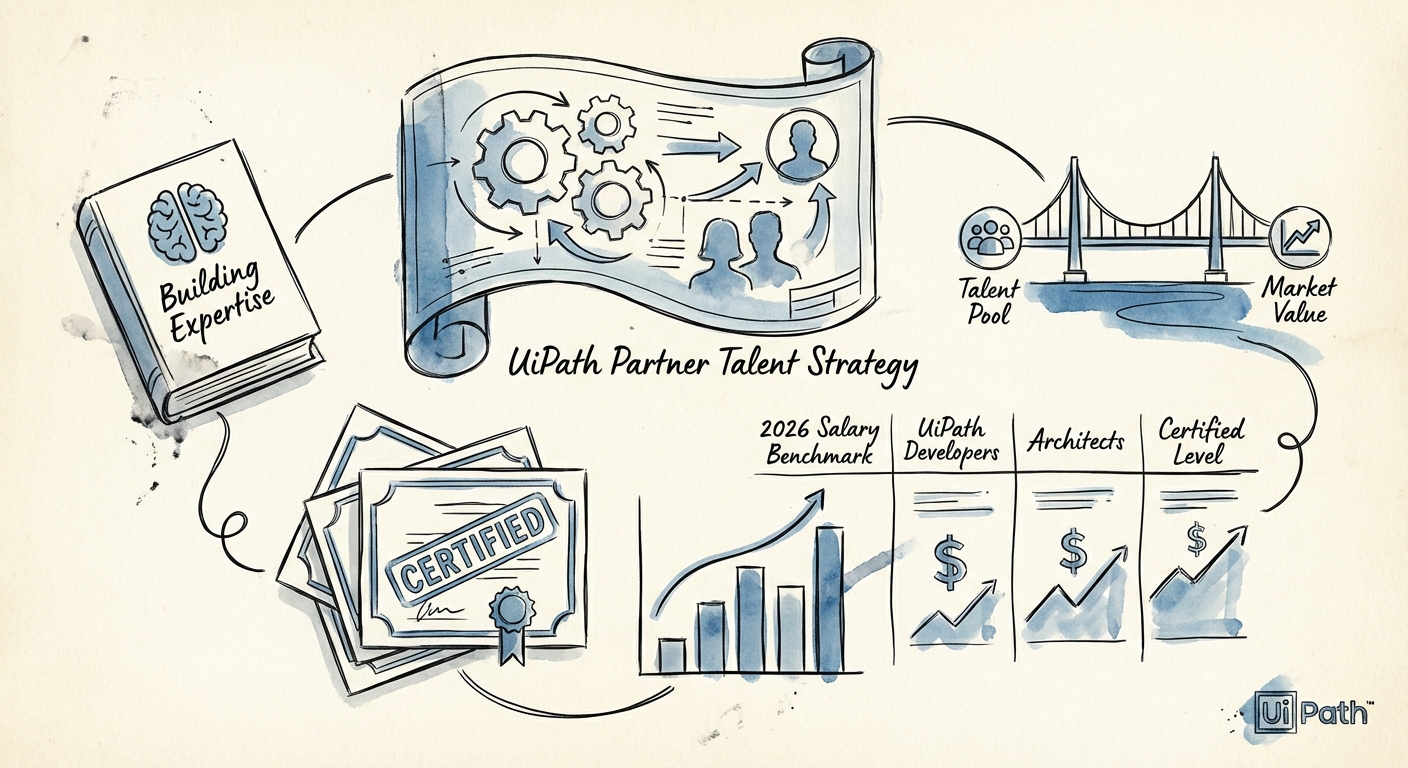
2026 Salary Benchmarks (US Market)
| Role | 25th Percentile | 75th Percentile | Bill Rate Impact |
|---|---|---|---|
| RPA Developer (Junior) | $90,000 | $110,000 | Low ($125-$150/hr) |
| Senior RPA Developer | $115,000 | $145,000 | Mid ($175-$225/hr) |
| Solution Architect (USN Ready) | $150,000 | $185,000 | High ($250-$350/hr) |
| Agentic AI Engineer | $160,000 | $210,000 | Premium ($350+/hr) |
The strategic error many firms make is attempting to bill Junior talent at Senior rates by hiding them behind a single Architect. In 2026, clients sophisticated enough to buy enterprise automation are sophisticated enough to spot this model. They are demanding outcomes, not hours. High-performing practices are shifting their utilization targets to account for the reality that Senior talent generates IP and reusable components, whereas Junior talent simply burns hours.
The "Agentic" Premium
With the rise of UiPath Autopilot and Agentic Automation, the skill profile has shifted. Pure "scripting" is less valuable than the ability to integrate Large Language Models (LLMs) with UiPath's document understanding and action centers. Partners capable of deploying Agentic Process Automation are seeing valuation multiples expand, while legacy "screen scraping" shops are seeing rate compression.
The 2026 Hiring & Retention Playbook
Building a certified team that can actually bill requires a fundamental shift in how you assess and retain talent. The old playbook of "hire fast, fire fast" destroys margins in a services business where ramp time to USN standards is 4-6 months.
1. The "Code-First" Interview
Stop relying on multiple-choice technical questions. Implement a practical coding challenge that mirrors the USN assessment. Give candidates a broken REFramework project and ask them to fix the exception handling logic. This filters out 60% of "certified" candidates immediately.
2. The Bench Strategy
You cannot hire a Senior Architect just-in-time for a project start. The lead time for a USN-caliber architect is 90 days. Best-in-class partners maintain a "warm bench" of certified talent by utilizing them on internal IP development (e.g., building accelerators for SAP or Salesforce) while they wait for deployment. This turns downtime into asset creation.
3. Retention via Specialization
Turnover in the RPA space dropped slightly in 2025 but remains a risk for top performers. The primary driver of attrition for Senior Developers is boredom—stuck maintaining legacy bots. To retain them, you must offer a path to leadership roles in emerging areas like AI Center, Test Suite, or Process Mining. If your best people aren't learning Agentic Automation, they are already interviewing with a competitor who is.