
The practical answer
- Short answer
- A diagnostic guide for executives on preventing Snowflake consumption drift, connecting workloads to business value, and choosing the right implementation partner.
- Best fit
- Industry: B2B Tech / SaaS. Function: Engineering & Operations
- Operating path
- Process Documentation → Operational Excellence → Transaction Execution Services
- Key metric
- Value map Every major workload should map to an owner, business outcome, and cost center.
The Go-Live Illusion: Why Data Projects Stall
You signed the contract, migrated the data, and celebrated go-live. The dashboard is green. Six months later, the CFO is asking why the Snowflake bill has climbed while decision-making speed has not improved.
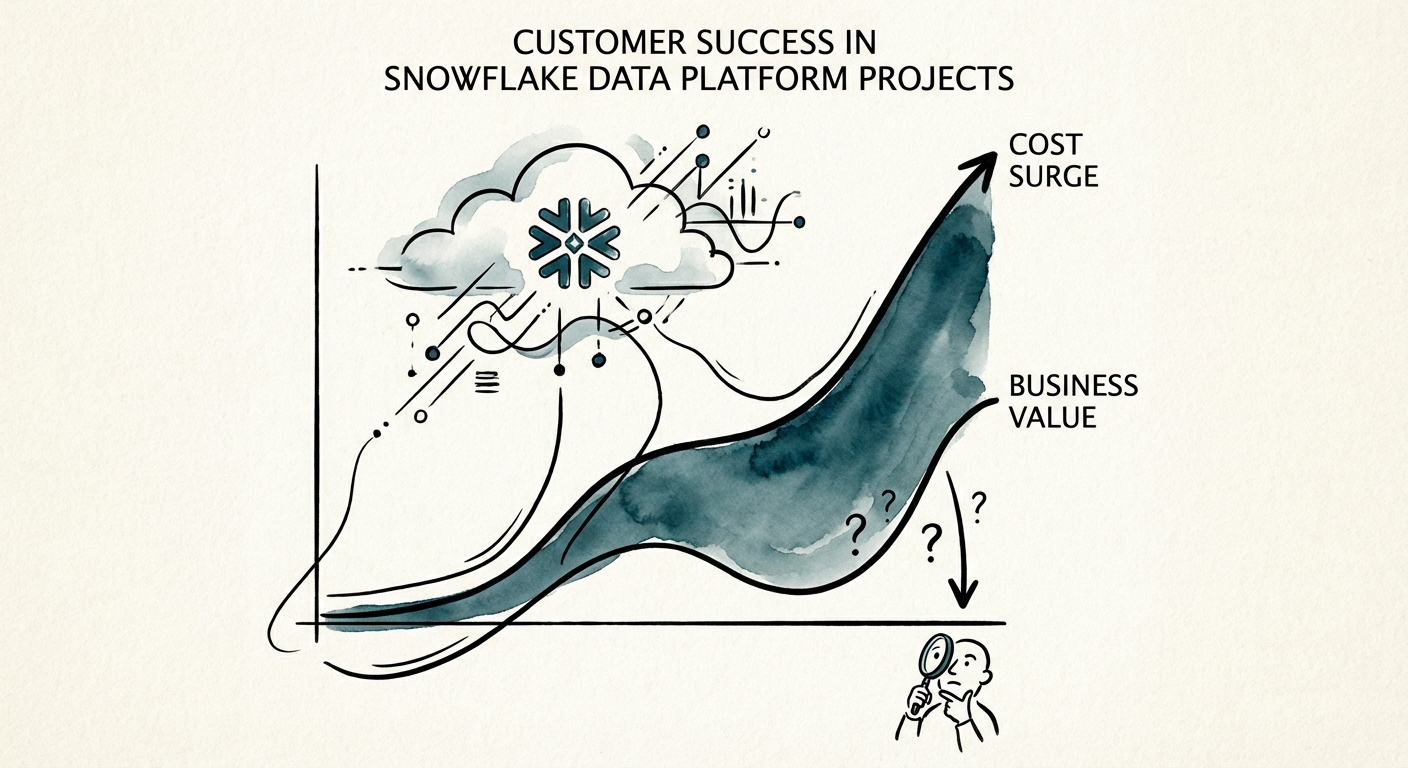
That is the consumption cliff. Snowflake costs can rise quickly when teams add workloads without a consumption architecture. The technology may be working exactly as configured, while the business value remains unclear because usage, cost, ownership, and outcomes were never connected.
For scaling founders and executives, the pain is specific. Queries run, credits burn, and invoices auto-pay, yet the business intelligence remains static. The issue is rarely only code. It is a process and governance gap.
Snowflake consumption only creates value when workloads, owners, costs, and business outcomes are mapped clearly.
The 3 Pillars of Consumption Failure
If you are evaluating partners or auditing a stalled project, look for these three red flags in the operating model.
1. The Select-Star Tax
In a consumption-based model, inefficient queries cost real money. Poor partitioning, weak clustering decisions, and undocumented query patterns can turn normal reporting into a recurring margin leak.
2. Idle Compute
Snowflake charges for compute while a warehouse is running. Auto-suspend, workload isolation, warehouse sizing, and query routing should be explicit decisions, not defaults that nobody owns.
3. The Missing Business Map
Documentation should link Snowflake workloads to business outcomes. If you cannot point to a warehouse and explain its owner, cost center, use case, refresh cadence, and value, you do not have a complete data operating model.
The Fix: From Builder to Architect
Recovering from the consumption cliff requires a shift from heroics to systems. You do not need only a smarter data engineer to write better SQL. You need a process that enforces efficiency by design.
- Tagging taxonomy: Every warehouse, pipe, and storage bucket should be tagged with cost center, project, and owner.
- Quarterly value review: Review cost per insight, dashboard usage, workload value, and idle consumption, not only terabytes migrated.
- Auto-suspend governance: Make always-on compute the exception and document why it is required.
When searching for a partner, ask them to show their process for managing consumption drift. You want a partner who can discuss unit economics, FinOps, value realization, and data governance in the same conversation.