
The practical answer
- Short answer
- 75% of Azure migrations exceed budget due to 'Delivery Drift.' Learn the diagnostic framework to spot process failures before they undermine your project ROI.
- Best fit
- Industry: B2B Tech / SaaS. Function: Customer Success / Operations
- Operating path
- Process Documentation → Operational Excellence → Transaction Execution Services
- Key metric
- 75% of cloud migration projects exceed their original budget (McKinsey).
The 'Silent' Failure: Anatomy of a Stalled Migration
You signed the Statement of Work (SOW) six months ago. The promise was simple: a four-month "lift and shift" to Azure, followed by a 20% reduction in infrastructure costs. Today, you are in Month 9. The bills are coming in from both your legacy data center and your new Azure tenant. Your VP of Engineering is blaming the partner, the partner is blaming "unexpected complexity," and your CFO is asking why the project is $200k over budget.
You are experiencing Delivery Drift.
Most Azure migrations do not fail because of technology. Azure is a mature, robust platform. Migrations fail because of a lack of process documentation wrapped in a veneer of "agile" delivery. According to McKinsey, 75% of cloud migrations exceed their original budget, and 38% are delayed by more than a quarter. This isn't bad luck; it's a structural failure in how projects are managed.
The 'Hero' Trap
The root cause of Delivery Drift is often the "Hero" culture. Your migration strategy relies on one or two lead architects who hold the entire migration path in their heads. They know where the dependencies are. They know which SQL databases need to be refactored and which can be moved as-is.
But they didn't write it down.
When these heroes get overwhelmed (or poached), the project stalls. Without documented tribal knowledge, your migration isn't a process; it's a blocked negotiation. You cannot scale a migration on heroics. You scale it on Runbooks.
You cannot scale a migration on heroics. You scale it on Runbooks. If your 'strategy' is one genius engineer, you don't have a strategy—you have a single point of failure.
The Three Phases of Delivery Drift
Delivery Drift doesn't happen overnight. It creeps in through undefined processes and weak Customer Success (CS) protocols. Here is how to diagnose it in your current project:
Phase 1: The 'Discovery' Void
In the first 30 days, your partner should have produced a detailed Migration Runbook. If they are still "discovering" your environment in Month 3, you are in trouble. A lack of documentation here leads to the "Frankenstein" effect, where legacy technical debt is simply re-hosted in the cloud rather than remediated.
Phase 2: The 'Cost' Surprise
Recent reports highlight Azure customers facing cost overruns of 3x or more due to poor configuration governance. This happens when the migration team focuses on connectivity (getting it to work) rather than optimization (getting it to work efficiently). Without a documented "Definition of Done" that includes cost governance tags and policy-as-code, you are just moving your mess to a more expensive house.
Phase 3: The 'User' Revolt
This is the ultimate failure of Customer Success. Technical teams often forget that a migration affects users. If your CS team hasn't documented a Communication Plan—telling users exactly when downtime will occur and what to do—you will face a revolt. The migration might technically succeed, but if the business rejects it due to friction, the project is a failure.
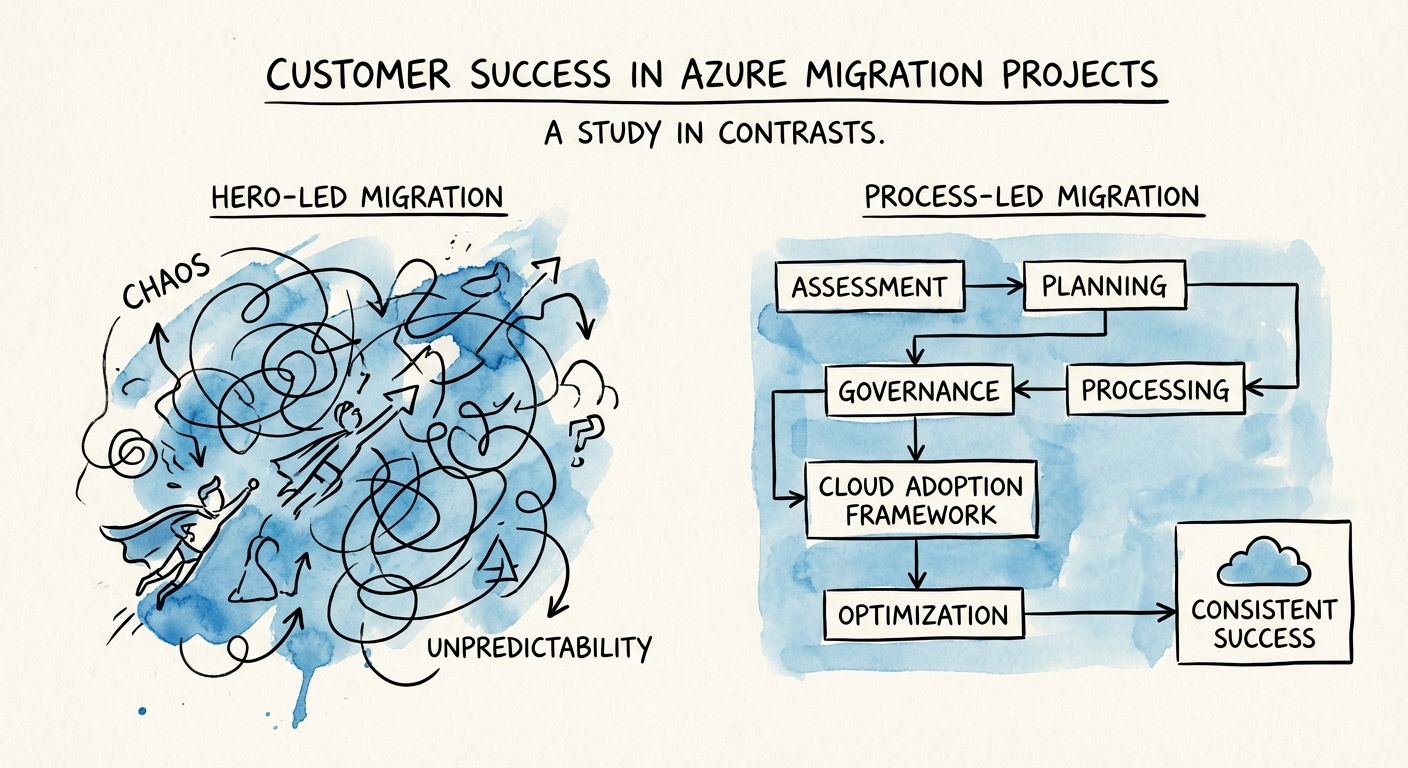
The Fix: Process Documentation as a Rescue Strategy
If your Azure migration is drifting, you don't need more engineers. You need a Librarian. You need to stop the work and document the path forward. Here is the recovery playbook:
1. The Migration Runbook (The 'How')
Force your partner or internal team to pause and produce a step-by-step Runbook for the remaining workloads. This must include:
- Dependency Maps: Which apps break if we move Database X?
- Rollback Procedures: If the cutover fails at 2 AM, what is the exact script to revert? (No improvisation allowed).
- Testing Scripts: How do we prove it works? "It loads" is not a test.
2. The RACI Matrix (The 'Who')
Delivery Drift thrives on ambiguity. Who signs off on the UAT (User Acceptance Testing)? Who pushes the button? Create a RACI matrix that explicitly assigns the "Accountable" person for every cutover. If everyone is responsible, no one is.
3. The Commercial Interlock
Stop treating the migration as an IT ticket. Treat it as a commercial event. Your Customer Success leader needs to align the technical milestones with business value. If a milestone is missed, what is the impact on the P&L? This forces the technical team to prioritize based on value, not just technical ease.
The Operator's Bottom Line
You cannot buy "Azure Success." You can only build it through rigorous process. If your current partner relies on heroes instead of documentation, fire them. The cost of switching is lower than the cost of a failed migration that bleeds your EBITDA for the next three years.