
The practical answer
- Short answer
- Why 18-month SAP projects bleed EBITDA. A diagnostic guide for Service CEOs on stopping 'Delivery Drift' and fixing margin erosion through process documentation.
- Best fit
- Industry: Technology Services. Function: Customer Success
- Operating path
- Process Documentation → Operational Excellence → Transaction Execution Services
- Key metric
- 75% Failure rate of ERP projects to meet original objectives (Gartner).
The "Marathon Trap" in Technical Services
If you run a technology services firm, you know the allure of the "whale" contract. A global enterprise needs an SAP S/4HANA migration. The contract value is $5M+. The timeline is 18 months. On paper, this is the deal that anchors your revenue forecast for the next two years. It is a validation of your firm's maturity. It is a flagship logo for your slide deck.
But 14 months later, that flagship project is dragging your EBITDA underwater.
The project is "Green" on the status report but "Red" in the boardroom. The timeline has slipped by four months. Your best Solution Architect—the one you need for the next big deal—is trapped in daily firefighting meetings. The client's CIO is ghosting your check-ins. And your finance team is quietly reclassifying billable hours as "investment" to avoid showing a negative margin.
The Physics of Delivery Drift
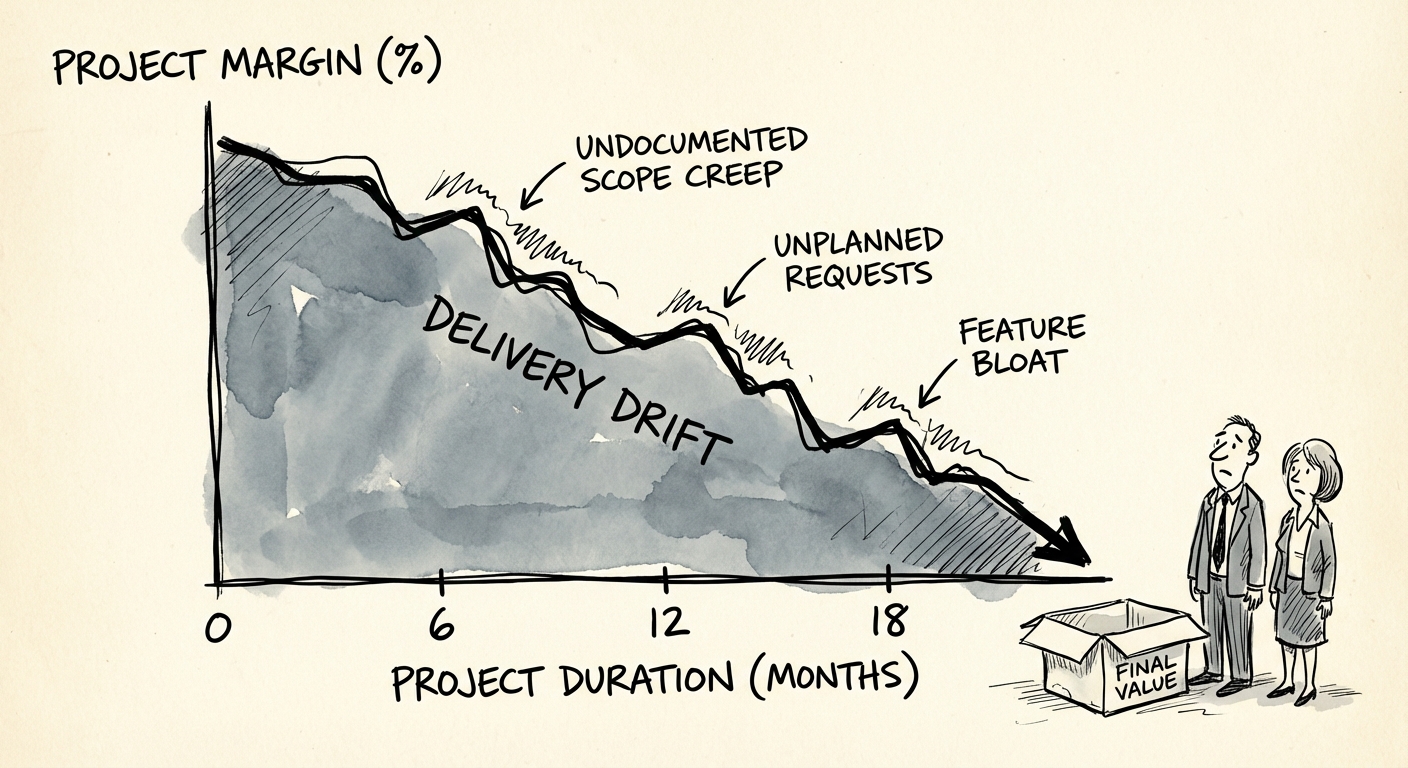
We call this Delivery Drift. It is the silent killer of margin in long-duration technical projects. Unlike a server crash or a security breach, Delivery Drift doesn't happen with a bang. It happens in the microscopic eroding of scope boundaries over hundreds of days.
In a 3-month implementation, "heroics" work. You can throw your best people at the problem, burn the midnight oil for two weeks, and cross the finish line. The adrenaline sustains the effort, and the short duration limits the financial damage.
In an 18-month SAP transformation, heroics are a material risk. You cannot sprint a marathon. When you rely on individual brilliance rather than documented process to manage a long-term engagement, three things happen:
- Tribal Knowledge Evaporation: Your "A-Players" hold the project context in their heads. When they burnout or get pulled to a new sale, the project IQ drops to zero.
- Scope Osmosis: Without rigid, documented change control (SOPs), "small favors" for the client accumulate into hundreds of unbilled hours.
- Success Amnesia: The "Definition of Done" agreed upon at kickoff is forgotten by month 12. You end up chasing a moving target of customer happiness rather than a fixed target of contractual delivery.
The data is merciless. Gartner estimates that 55% to 75% of ERP projects fail to meet their original objectives. For a Service CEO, "failure" doesn't always mean the software doesn't work. It means the project consumed 140% of the budgeted hours, wiping out your profit and stalling your growth.
In a 3-month project, 'heroics' save the day. In an 18-month SAP transformation, 'heroics' are a material risk. You cannot sprint a marathon.
The 3-Point Failure Diagnostic
How do you know if your SAP practice is suffering from Delivery Drift? Look for these three signals in your monthly operating reviews. If you see them, your customer success function is not a value driver—it is a margin leak.
1. The "Green" Project with Red Financials
Your Project Manager reports the status as Green. The milestones are technically being hit. Yet, your delivery margin is eroding month over month. This indicates a disconnect between technical completion and commercial enforcement.
The Diagnostic Question: Does your PM have a documented mandate (and the backbone) to say "No" or "That is a Change Order" to a client request, or are they prioritizing "keeping the client happy" over protecting the P&L?
In many founder-led firms, Customer Success is confused with automatic concession. Your team believes their job is to say "Yes." In a 2-month project, "Yes" costs you $5,000. In an 18-month SAP rollout, "Yes" costs you $500,000.
2. The "Hero" Dependency Ratio
If you cannot rotate your Lead Architect off Project A and onto Project B without Project A collapsing, you do not have a service business. You have a staffing model built around a single point of failure.
The Diagnostic Question: If your lead consultant left unexpectedly tomorrow, does the documentation exist to allow a B-player to pick up the work within 48 hours? If the answer is no, your revenue is not secure. It is merely rented from your employees.
3. The "Month 9" Satisfaction Dip
In long-duration projects, the "Honeymoon Phase" ends around month 6. By month 9, the client is fatigued. The excitement of the kickoff is gone; the reality of data migration and UAT (User Acceptance Testing) has set in. This is where project recovery usually becomes necessary.
The Diagnostic Question: Do you have a documented "Mid-Flight Refueling" process? Most firms have a Kickoff SOP and a Go-Live SOP, but nothing for the messy middle. Without a structured re-alignment process at the halfway mark, the client's expectations will drift away from the SOW (Statement of Work).
Fixing It: From Heroics to Engineering
You cannot solve this problem by "hiring better PMs." You solve it by installing an operational operating system that makes average PMs perform like stars.
1. Document the "Success Architecture"
Stop defining success as "Go Live." That is too vague and too far away. Break the 18-month journey into 6-week "Value Sprints." Each sprint must have a documented Definition of Done that includes commercial sign-off.
The Play: Implement a "Commercial Gate" every quarter. The project does not proceed to the next phase until the client signs a document acknowledging that the previous phase is 100% complete and no further changes can be made to it without a Change Order. This locks in your profit incrementally, rather than risking it all at the end.
2. Automate the Change Control Firewall
Scope creep is an emotional problem. PMs feel bad asking for money. Remove the emotion by automating the process. Use a PSA (Professional Services Automation) tool where any task not linked to a specific SOW line item literally cannot be logged by a consultant.
If the system rejects the hours, the consultant is forced to trigger a Change Request. It turns a confrontation ("I need to charge you more") into a system constraint ("The system won't let me proceed until we authorize this").
3. The "Key Person Dependency" Documentation Standard
Make documentation a billable deliverable, not an administrative afterthought. In your SOW, allocate 10% of hours specifically for "Knowledge Transfer Documentation."
The Rule: No code or configuration is "complete" until the accompanying Loom video or Confluence page is created. This builds a persistent knowledge base that allows you to swap resources (scaling) without destabilizing the project.
Summary
Your ability to scale from $10M to $50M depends on your ability to deliver boring, predictable outcomes on exciting, complex projects. When you master the documentation of delivery, you stop selling "hero hours" and start selling a business outcome. That is the difference between a consultancy that burns out and one that cashes out.