
The practical answer
- Short answer
- Two firms, same EBITDA, triple the exit price. Five structural multipliers decide whether a B2B tech services firm clears 4x or 12x in 2026.
- Best fit
- Industry: B2B Tech Services. Function: Finance & Strategy
- Operating path
- Exit Readiness → Operational Excellence → Transaction Advisory Services
- Key metric
- 12.8x Average EBITDA multiple paid by Private Equity in 2025, vs. 9.9x for Corporate buyers.
Same EBITDA, triple the check
Picture two B2B tech services firms across the table from the same private equity fund. Both clear $2M in EBITDA. Both run lean, both are profitable, both have happy clients. One walks away with an $8M deal structured around a heavy earnout. The other clears $24M in cash at close. The founders are equally smart. The difference isn't the P&L. It's everything the P&L doesn't show.
Most founders never see this coming because they price themselves with cocktail-party math: "I'm doing $2M, services trade at 8x, so I'm worth $16M." That number is fiction. In 2026 the spread between a weak services firm and a strong one isn't a few turns of EBITDA — it's a different universe of buyer.
The data is blunt about it. CLFI's 2025 multiples work shows firms around the $200k EBITDA mark changing hands near 3.1x, while companies that cross the $10M EBITDA line command 8.5x and up. That isn't a smooth ramp you slide up year by year. It's a wall. And the First Page Sage size-band data tells the same story: scale and structure get re-rated, not rewarded incrementally.
The trap nobody warns you about at $1M-$3M EBITDA
If you're a founder-led tech services shop doing $1M to $3M, you're in the worst spot on the map. You're too big for an individual owner-operator to finance off an SBA loan, and too dependent on you to clear the risk bar for a platform PE fund. To a disciplined buyer, your $2M of EBITDA isn't an asset — it's cash flow with a single point of failure attached. If the founder gets hit by a bus, the EBITDA goes with them. Nobody pays 8x for that. They pay 3x and bury the rest in an earnout you'll fight to collect.
There's a second number founders miss entirely: who's actually writing the check. Bain's global PE read on a market hungry for platforms maps to a structural premium — PE has been paying around 12.8x for the right services platform versus roughly 9.9x from corporate strategics. PE pays the premium because they're buying a chassis to bolt acquisitions onto. The strategic is just absorbing your client list into their org chart. If you want the 12x number, you have to look like the chassis. The five multipliers below are exactly what they pressure-test to decide which firm you are.
A buyer isn't pricing what your firm earned last year. They're pricing how much of next year walks out the door the day you stop answering the phone.
The five things a buyer checks before they trust your EBITDA
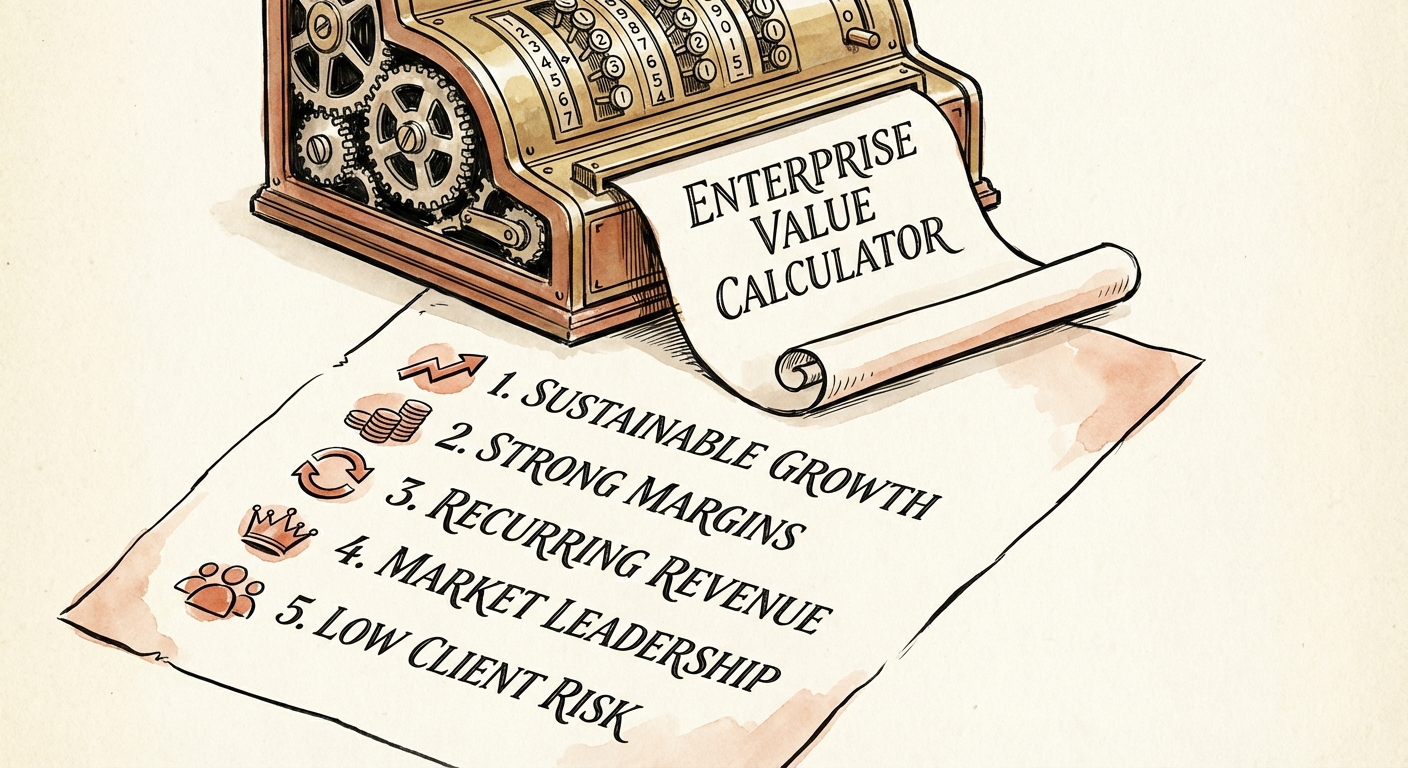
Your P&L answers one question: what did you earn last year? Enterprise value answers a different one: how much of next year survives without you in the room? Score your tech services firm honestly against these five — each one moves the multiple in a direction you can predict.
1. Revenue you keep vs. revenue you re-win every January
In 2026, a dollar of project revenue is worth roughly $0.80–$1.20 at exit. A dollar of contracted recurring revenue — managed services, retained engineering, a platform subscription — is worth $4 to $8. The math is that lopsided. If less than 30% of your revenue is recurring, you're a project shop, and a buyer sees every January 1st as the day your pipeline resets to zero. Cross 50% recurring with Net Revenue Retention above 110% and you sit in roughly a 63% premium over your project-based peers. NRR above 120% is where the premium stops being a rounding error and starts being the whole thesis.
2. The "what happens when you leave" discount (this is the big one)
If you're still the lead salesperson, the senior architect on the hairy accounts, and the last set of eyes before delivery ships, your firm is closer to unsellable than you think. In diligence, a buyer hunts for a second layer — leaders who can win work and ship it without you. No second layer, no platform multiple. Your number gets capped at 3x–4x and the deal gets wrapped in an earnout that ties your payout to performance you may no longer fully control. The cruelest part: the better you are at being indispensable, the worse this discount gets.
3. Client concentration: the silent "pass"
Does one client carry more than 20% of revenue? In 2025 that was an automatic decline for around 60% of PE buyers — not a haircut, a hard no. And the buyers who stay at the table will structure the deal so that you personally eat the loss if that account churns post-close. For tech services firms, concentration creep is sneaky: one big land-and-expand account quietly becomes 35% of revenue while you celebrate the growth. Diversify before you ever pick up the phone to a banker.
4. Documented delivery vs. tribal knowledge
Knowledge that lives only in senior people's heads is a discount, not an asset. Acquirers pay materially more for documented, repeatable processes because documentation is the proof that you've built a system rather than a personality cult. A folder of stale Google Docs nobody opens fails this test. What clears it: live playbooks that actually drive onboarding and delivery consistency — the kind a new senior hire can follow on week two without booking time on your calendar.
5. The pivot from EBITDA to revenue multiples
This is the one that changes the order of magnitude. If you deliver your service through proprietary software — a client portal, an automated workflow engine, IP-backed diagnostics — you can shift from being valued on EBITDA to being valued on revenue. Tech-enabled services firms in 2025 have been trading near 4.5x revenue, which on healthy margins is the equivalent of a 15x–20x EBITDA story. The catch: the tech has to do real work. It has to widen the moat, lower your cost-to-serve, or make clients stickier. A dashboard you slapped on a manual process doesn't count, and a sharp buyer will see through it in the first technical session.
The 24-month build: closing the gap between the two firms
Here's the hard part: you cannot fix any of this during a deal. The 60-day exclusivity window after you sign an LOI is for confirming what's already true, not for becoming a better company. The firm that clears $24M did this work two years before the banker showed up. Run it in three overlapping waves.
Months 1–6 — Make the numbers defensible. Get the personal expenses out of the business and clean up the financials so they survive a Quality of Earnings review. Track your legitimate EBITDA add-backs as you go instead of reconstructing them under deadline pressure. Stand up a forecast that actually predicts the next quarter inside a tight margin. Predictability is the cheapest multiple you can buy.
Months 6–18 — Shift the revenue mix. Repackage hourly and project work into managed outcomes with real contracts behind them. This will dent short-term cash flow, and you should do it anyway — every point you push the recurring percentage up is worth more at exit than it costs you now. The target is clear: clear the 50% recurring line before the CIM goes out, not after.
Months 12–24 — Build the tech layer that re-rates you. Automate the low-judgment parts of delivery and put a real proprietary front-end in front of clients. The goal is to show a buyer that your margin expansion comes from code, not just cheaper labor. That's the difference between defending an EBITDA multiple and arguing for a revenue one.
The two firms at the start of this article weren't born different. One of them spent two years operating like the next owner instead of the current founder. The 3x outcome is a choice, and so is the 12x. Pick the work now, while you still have time to do it before anyone's offering to write the check.