The practical answer
- Short answer
- Why 70% of GCP migrations face delays and cost overruns. A diagnostic guide for Scaling Founders on why 'heroics' fail and how process documentation saves your cloud ROI.
- Best fit
- Industry: Cloud Computing / SaaS. Function: Operations / Engineering
- Operating path
- Process Documentation → Operational Excellence → Transaction Execution Services
- Key metric
- 70% of cloud migration projects face delays or cost overruns due to poor planning and scope definition (DataDot, 2025).
The Diagnostic: 3 Signs Your Migration Is a 'Black Box'
How do you know if your GCP migration is heading for a cliff? Look at your documentation—or lack thereof.
1. The 'Key Person Dependency' of One
If your lead architect (or partner consultant) left unexpectedly tomorrow, would your migration halt? Research indicates that companies lose $47 million annually due to inefficient knowledge sharing, with employees wasting 5.3 hours per week just waiting for information. In a migration, this latency kills momentum.
2. The Consumption Gap (CUD Wastage)
You committed to $1M in GCP spend to get the discount. But six months in, your utilization is at 40%. Why? Because the process for spinning up new environments is stuck in a bottleneck. Your team doesn't know how to use the new tools without asking the "Hero." This isn't a tech problem; it's a tribal knowledge problem.
3. The 'Post-Migration' Slump
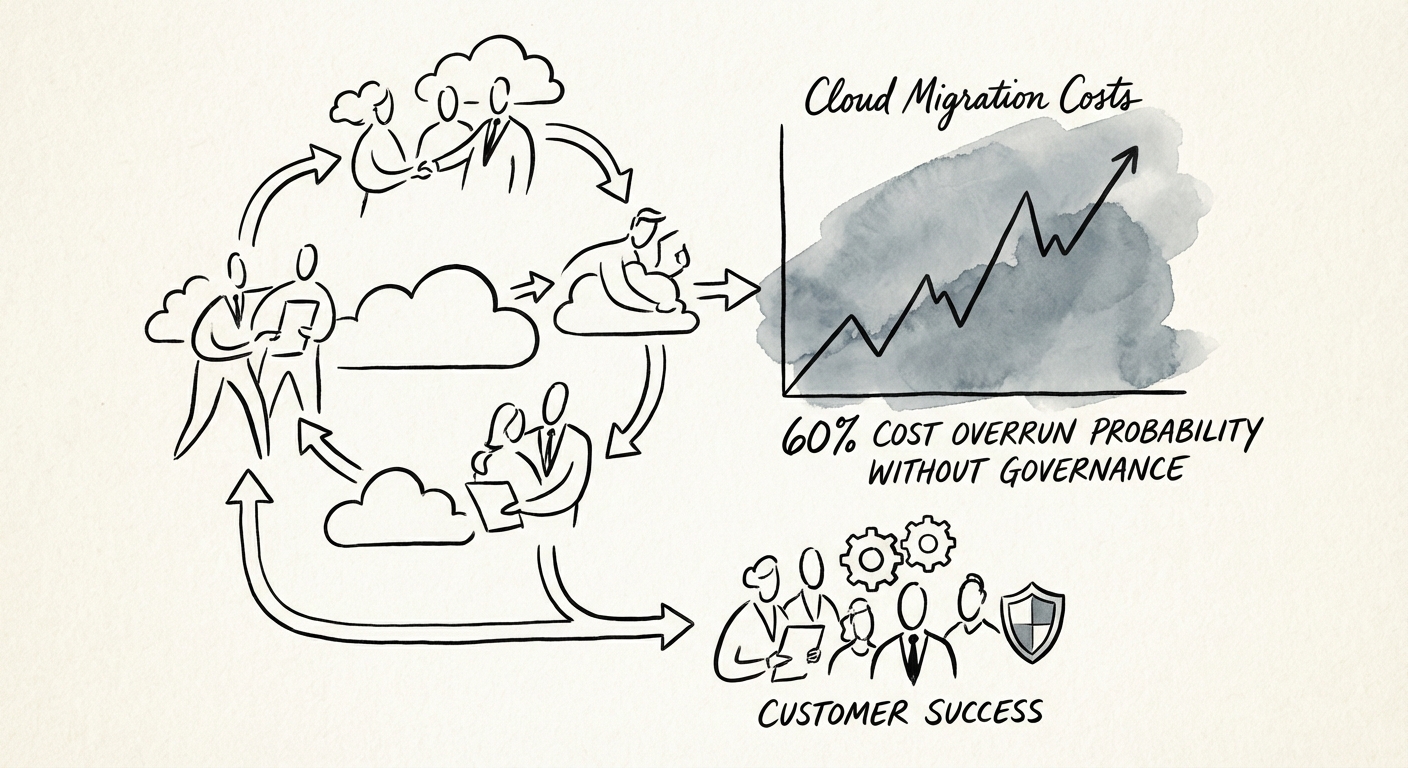
Gartner predicts that through 2025, 60% of infrastructure leaders will encounter public cloud cost overruns. This happens because the process for cost governance wasn't documented. Developers treat GCP like an infinite hard drive because no one wrote the SOP for resource termination.
You don't need another hero working until 2 AM. You need a playbook that lets your team go home at 5 PM while the system scales itself.
The Solution: Vet Partners on Their Playbook, Not Their Certifications
When searching for a GCP migration partner, stop asking about their certification count. Ask about their documentation handover process.
A 'Hero' partner will fix your problems for you. A 'Guide' partner will build the system so you can fix them yourself. Demand the following deliverables before signing the SOW:
- The 'Runbook' Requirement: No migration is complete until the Runbook is tested by a junior engineer. If they can't operate it, it's not finished.
- As-Built Documentation: Not just the architectural diagram, but the configuration logic. Why did we choose this instance type? Why is this IAM role scoped this way?
- The Extraction Clause: Ensure your contract includes a Founder Extraction plan—removing the dependency on the partner's key talent within 90 days of go-live.
Your goal is not just to be on the cloud. It is to be competent in the cloud. That requires systems, not heroics.