The practical answer
- Short answer
- Why 55% of Zendesk implementations fail to scale. A diagnostic guide for PE operating partners and founders on measuring true CX efficiency beyond 'ticket closing'.
- Best fit
- Industry: B2B SaaS. Function: Operations
- Operating path
- Process Documentation → Operational Excellence → Transaction Execution Services
- Key metric
- 55% Failure rate of CRM/CX implementations due to process misalignment rather than technical deficits.
The 'Digitized Call Center' Fallacy
The promise of modern CX platforms like Zendesk is non-linear scaling: the ability to double your customer base without doubling your support headcount. Yet, for many scaling SaaS companies, this promise evaporates in the first six months. Instead of an automated retention engine, they build a "digitized call center"—a high-friction environment where expensive human talent spends 60% of their time answering repetitive questions that a well-architected system should have deflected.
We see this constantly in private equity portfolios. A Series B company buys Zendesk to "professionalize" support. They hire an implementation partner who excels at technical configuration—setting up triggers, macros, and SLA policies. On Day 1, the system works perfectly. By Day 90, the ticket queue is overflowing, customer success team size is ballooning, and Net Revenue Retention (NRR) is flat.
The problem isn't the software. The problem is that the implementation focused on managing tickets rather than eliminating them. According to 2025 industry data, failure rates for CRM and CX implementations hover around 55%, not because of technical bugs, but because of process failures. If your Zendesk instance is designed primarily to route tickets efficiently rather than solve customer problems autonomously, you haven't built a success platform; you've built a ticket factory.
Do not optimize Zendesk for ticket closure alone. Optimize for resolved problems, lower customer effort, and healthier agent capacity.
The Diagnostic: Are You Scaling or Just Swelling?
To determine if your Zendesk implementation is an asset or a liability, look past the vanity metrics of "Average Response Time" or "CSAT." While important, these measure the performance of the factory, not the efficiency of the architecture. The true health of a Zendesk implementation is measured by its ability to deflect low-value contact.
The Deflection Gap
Calculate your Self-Service Deflection Rate: the ratio of unique help center searches and AI-resolved interactions to total tickets created. In elite organizations, this number approaches 30-40%. If your rate is below 15%, your implementation has failed to leverage the platform's core value proposition.
The Burnout Index
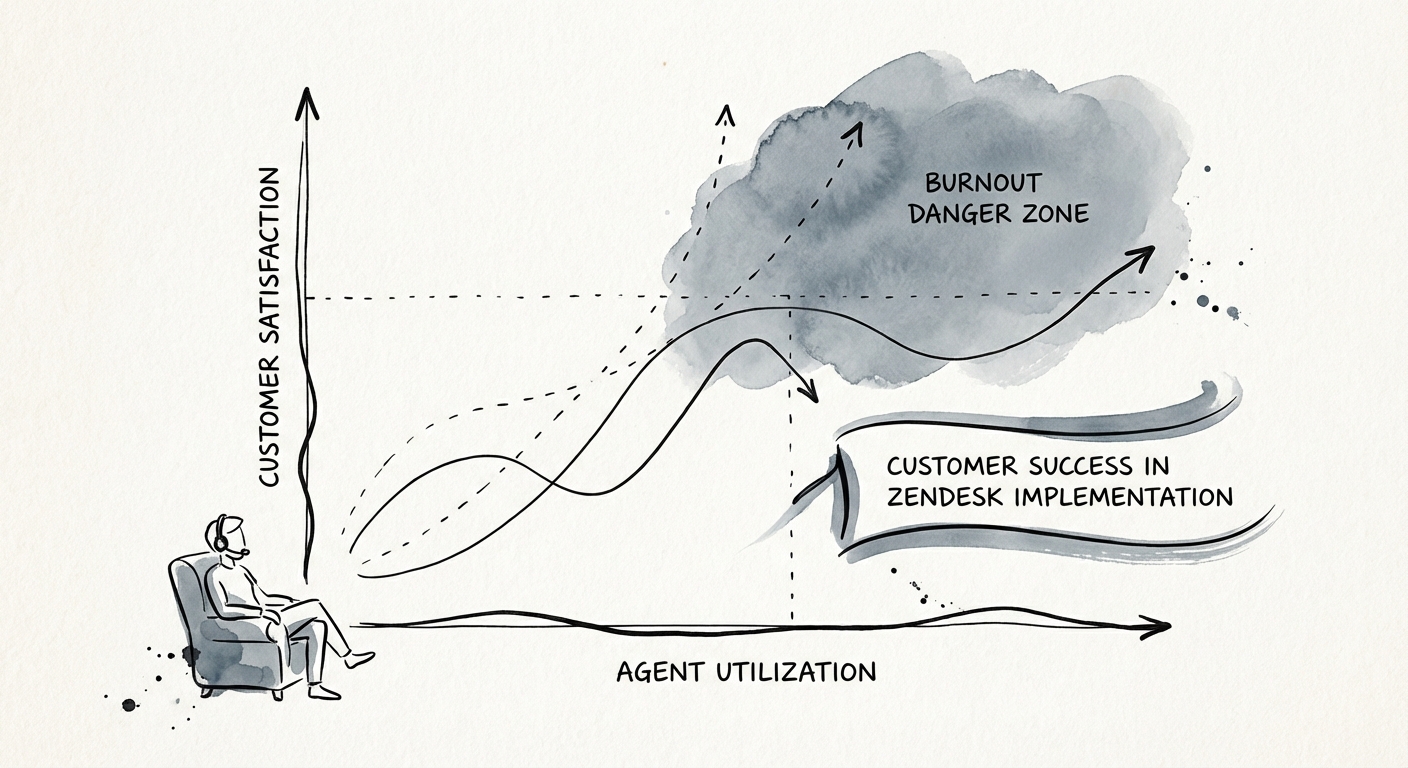
Next, audit your Agent Utilization Rate. While standard benchmarks suggest 70-80% is healthy, sustained utilization above 85% is a leading indicator of churn—not of customers, but of your agents. Data from MetricNet indicates that average agent utilization sits around 48%, but high-growth environments often push this into the red zone. If your agents are at 90% utilization but your Deflection Rate is under 15%, you are burning cash on human glue to fix a broken process.
This "Utilization Gap" is often invisible in board decks until it manifests as a sudden spike in hiring requests or a dip in customer success metrics. It implies that your expensive CSMs are acting as glorified technical support reps, handling Tier 1 issues that should never have reached a human inbox.
The Fix: From 'Configurator' to 'CX Architect'
Recovering from a stalled Zendesk implementation requires a fundamental shift in how you view the project. It is not an IT ticket; it is a revenue operations strategy.
1. Audit Your Knowledge Architecture
Most "shelfware" documentation exists because it was written for compliance, not for customers. Process documentation must be rewritten as customer-facing content. If a macro exists for an agent to answer a question, an article should exist for a customer to answer it themselves.
2. Implement 'Contextual Intelligence'
The 2025 Zendesk CX Trends Report highlights that 90% of CX leaders see positive ROI from AI, but only when it moves beyond basic chatbots. You need partners who can implement "Contextual Intelligence"—systems that use customer data to predict intent. If a customer on the 'Billing' page opens a chat, the system shouldn't ask "How can I help?"; it should ask "Do you need to update your credit card?"
3. Hire Strategy, Not Just Setup
When selecting a partner for remediation, avoid firms that quote based on "number of ticket fields" or "workflows." Look for partners who scope based on Deflection Rate targets and Agent Efficiency gains. You need a CX Architect who understands the difference between closing a ticket and solving a problem.