The practical answer
- Short answer
- Prevent the 30% 'Process Discount' in your SaaS exit. A diagnostic checklist for documentation that drives premium valuations, from IP assignments to revenue recognition.
- Best fit
- Industry: B2B SaaS. Function: Operations
- Operating path
- Process Documentation → Operational Excellence → Transaction Execution Services
- Key metric
- 2x Higher valuation multiple for firms with 'Turnkey' documentation vs. 'Tribal Knowledge' operations.
The 'Tribal Knowledge' Tax: Why You're Losing 30% of Deal Value
In the high-stakes theater of SaaS M&A, there is a silent killer of valuation multiples: Information Asymmetry. When you sign a Letter of Intent (LOI), the acquirer is betting on a future stream of cash flows. But when they open your data room and find that the 'manual' for your business exists solely in the neurons of your founding team, that bet becomes a gamble.
We call this the "Tribal Knowledge Tax." Private Equity firms in 2026 are increasingly applying a Discount for Lack of Marketability (DLOM)—often ranging from 30% to 50%—to companies where core processes are undocumented. Why? Because if your CTO leaves post-close and the architecture diagrams are all mental, the asset they bought depreciates instantly.
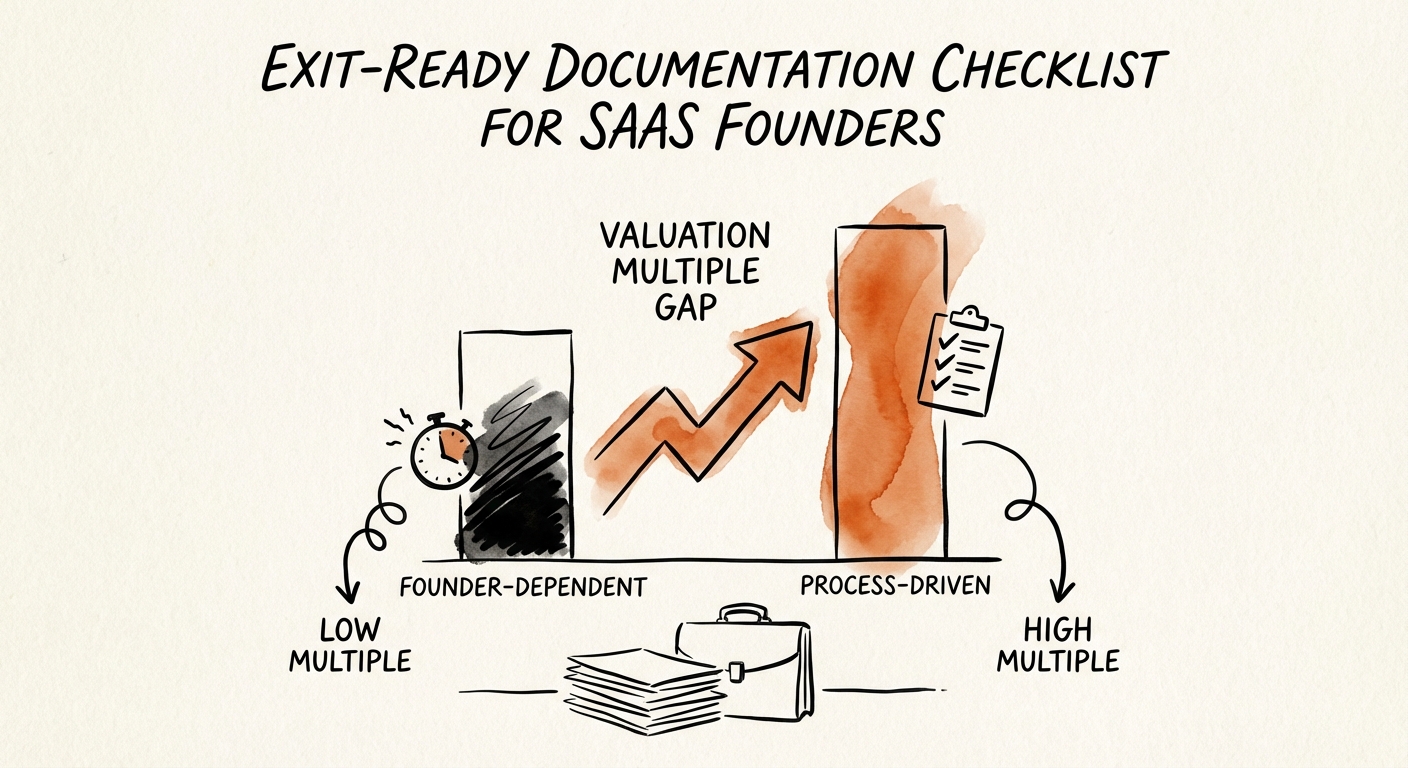
You might have $10M in ARR growing at 40%, but if your sales process is "hire athletes and let them figure it out," you are selling a Founder-Dependent Asset, not a scalable platform. Founder-dependent assets trade at 4x EBITDA. Scalable platforms with transferable processes trade at 12x. The difference is documentation.
Acquirers don't buy code; they buy a revenue-generating machine. If the instruction manual is in your CTO's head, you're selling a prototype, not a platform.
The Diagnostic: Is Your Data Room 'Audit-Ready' or a Red Flag?
To avoid the re-trade, you must audit your documentation against the "Transferability Standard." Can a stranger run this business tomorrow without your phone number?
1. The Technical Asset (The Code is Not Enough)
Buyers don't just check if the code runs; they check if they can own it and maintain it.
- IP Assignment Deeds: Do you have signed agreements from every contractor who ever touched the code? If not, you have a "cloud on title."
- Architecture Diagrams: Not a photo of a whiteboard. We need Visio/Lucidchart diagrams of data flows, API dependencies, and AWS infrastructure.
- Software Bill of Materials (SBOM): A complete inventory of third-party libraries. Open-source license violations (e.g., GPL v3) are an instant deal-killer in 2026 technical due diligence.
2. The Revenue Engine (GTM Documentation)
Prove that your revenue isn't luck or heroism.
- The Sales Playbook: Documented stages, exit criteria, and scripts. This proves your sales process is transferable to new reps.
- Commission Plans: Detailed structures that align with unit economics. Ambiguity here signals future retention risks.
- Cohort Analysis Logic: Don't just show the chart. Document the SQL logic used to define "churn." If your definition differs from the buyer's standard (e.g., ignoring down-sells), you risk a massive working capital adjustment.
3. The Operational Backbone
Routine details can cause expensive disputes.
- Vendor Contracts: Specifically, "Change of Control" clauses. If your AWS credits expire upon acquisition, your margins just collapsed.
- Employee Agreements: Non-solicits and IP protection. Essential for the Human Capital Audit.
- Compliance Evidence: A SOC 2 Type II report is the gold standard, but even a documented security policy and incident response plan can prevent a "security discount."
From 'Shelfware' to Enterprise Value
The goal of this checklist isn't to create "shelfware"—documents that gather dust. The goal is to create Transferable Value. When a Private Equity Operating Partner sees a fully populated, structured data room, they see a "Turnkey Asset."
This perception shifts the negotiation leverage. Instead of defending against risk discounts, you are arguing for a Transferability Premium. You are demonstrating that the machine works, regardless of who is turning the crank. In a market where 47% of deals fail in due diligence, documentation is your insurance policy against a broken deal.
Start today. Pick one area—likely your Technical IP or Sales Process—and document it to the standard of "stranger-ready." Your future exit multiple depends on it.