
The practical answer
- Short answer
- Buyers pay for systems they can run, not heroes they have to keep. Learn why documented Salesforce practices trade at a 2x premium and how to build a 'Transferability' roadmap in 90 days.
- Best fit
- Industry: B2B Tech Services. Function: Operations
- Operating path
- Process Documentation → Operational Excellence → Transaction Execution Services
- Key metric
- 2x Valuation multiple premium for documented vs. undocumented services firms.
The Math of the "Transferability Premium"
If I put two Salesforce implementation partners side-by-side, both doing $15M in revenue and $3M in EBITDA, one will sell for $12M (4x) and the other for $24M+ (8x-10x). On the P&L, they look identical. But in the data room, they are different species.
The $12M firm is a "black box." The revenue relies on three lead architects who carry the entire deployment methodology in their heads. If the founder leaves, the client relationships evaporate. This is what we call the Hero Tax. Private Equity buyers discount these assets heavily because they are buying people, not systems. And people have legs.
The $24M firm has captured the Transferability Premium. They have documented their "Way of Working" into transferable assets. When a PE firm looks at this business, they see a machine that runs without the founder. According to 2025 valuation benchmarks, firms with documented, transferable delivery models command a 100% premium over their tribal-knowledge counterparts. Buyers aren't paying for your genius; they are paying for the certainty that your genius can be replicated by a mid-level hire.
Buyers don't pay for potential; they pay for predictability. If your revenue walks out the elevator every evening, your valuation walks out with it.
The "Key Person Dependency" in Salesforce Ecosystems
In the Salesforce ecosystem, the lack of documentation is particularly lethal because of the technical complexity. I call this the "CPQ Trap." I recently audited a Gold Partner where the entire logic for a complex CPQ implementation for their largest enterprise client resided in the mind of one Solution Architect. If that architect became unavailable or was recruited away, the account could churn in 90 days.
This isn't just an operational risk; it's a valuation killer. During operational due diligence, buyers will specifically hunt for these single points of failure. They will ask to see your:
- Standard Operating Procedures (SOPs) for Data Migration (not just the code, but the mapping logic).
- Documented methodology for Managed Services handoffs.
- training playbooks that take a Junior Admin to a Consultant in 6 months.
If you answer with "Dave handles that," you just lost $5M in enterprise value. The goal is to move from "Heroic Delivery" (dependent on superstars) to "Systematic Delivery" (dependent on process). This protects your valuation multiple and, ironically, makes your heroes happier because they stop fighting fires.
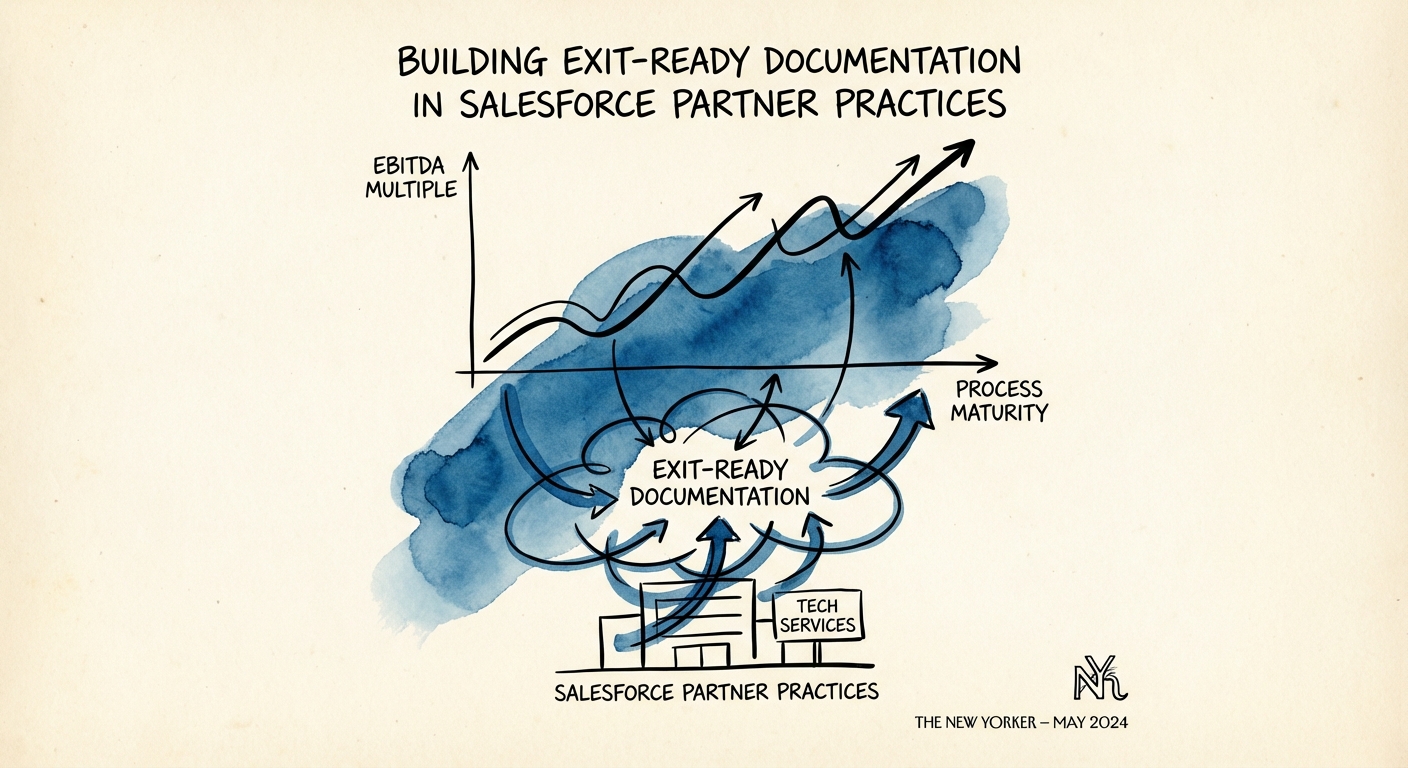
The 90-Day Documentation Sprint: Triage for Exit
You cannot document everything. Trying to create a wiki for every task is a recipe for shelfware. Instead, you need a triage approach focused on the Vital 20% of processes that protect 80% of your revenue. Here is the 90-day sprint I prescribe to founders preparing for a sale:
Month 1: The Revenue Defense Audit
Identify the top 5 processes that, if broken, would cause a client to fire you. Usually, this is Project Kickoff, UAT Sign-off, and Renewal Management. Document these first. Don't write a novel; use Loom videos and checklists. The goal is defensibility.
Month 2: The Knowledge Extraction
Sit down with your top three "irreplaceable" technical leads. Interview them. Record it. Transcribe it. Turn their tribal knowledge into a Technical Playbook. You are literally downloading their brains into corporate assets. This creates the "IP" that buyers pay premiums for.
Month 3: The Validation Test
Hand the new SOP to a junior employee and ask them to execute the task without asking questions. If they fail, the documentation is bad. Fix it. This "blind test" is exactly what a PE Operating Partner will simulate during diligence. Pass this test, and you unlock the exit door.