
The practical answer
- Short answer
- Founder-led sales kill exit valuations. Learn how to document your sales process to unlock the 'Transferability Premium' and drive 2x higher multiples in due diligence.
- Best fit
- Industry: Private Equity. Function: Sales Operations
- Operating path
- Process Documentation → Operational Excellence → Transaction Execution Services
- Key metric
- 5.7 Months average sales rep ramp time in 2025 (up from 4.3 in 2020), highlighting the critical need for documentation.
The 'Founder Magic' Discount: Why Buyers Pay Less for Your Genius
In the lower middle market, there is a paradox that frustrates founders more than any other: the better you are at selling, the less your business might be worth. This is the "Founder Magic" trap. When a Private Equity firm looks at a CIM (Confidential Information Memorandum) and sees $20M in revenue, their first question isn't "how did they grow?" It is "who drove the growth?"
If the answer is "the charismatic founder who holds the key relationships in her head," the valuation multiple compresses immediately. Data from 2025 M&A transactions shows that businesses with high "Founder Dependency" trade at a 30-50% discount compared to systematized peers. While independent, process-driven firms in the $10M-$50M range command 7x-8x EBITDA multiples, founder-reliant shops struggle to fetch 3x-4x. The gap is not about revenue quality; it is about transferability.
Buyers do not buy people; they buy revenue engines. If the engine stops when you leave the room, it is not an asset—it is a job. To unlock the "Transferability Premium," you must convert your intuition into intellectual property. This goes beyond a 50-page Google Doc that nobody reads. It requires a living, breathing operating system that allows a stranger to close a deal with the same efficacy as the founder.
Buyers do not buy people; they buy revenue engines. If the engine stops when you leave the room, it is not an asset—it is a job.
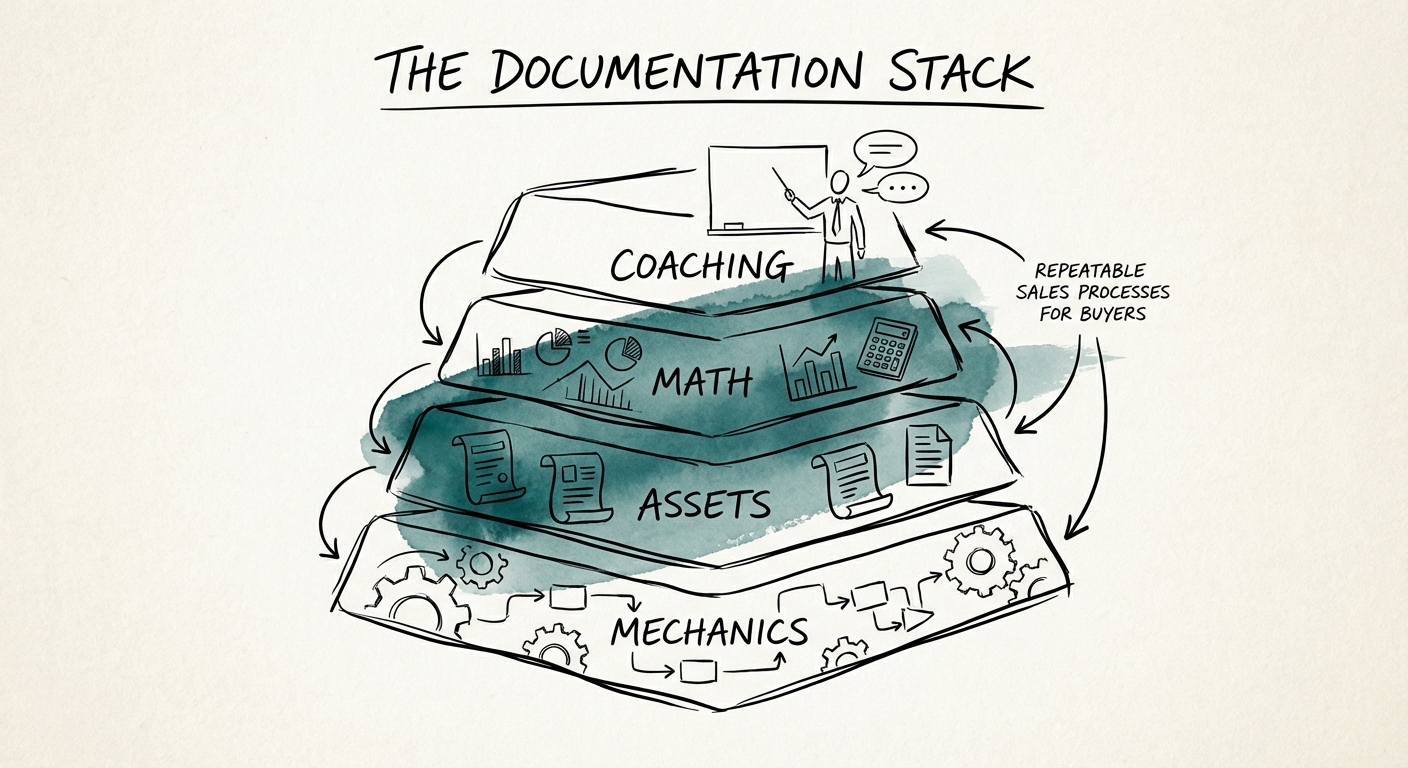
The 4-Layer Documentation Stack: What Buyers Actually Look For
Most "sales playbooks" fail in due diligence because they are merely marketing brochures disguised as process. A PE Operating Partner audits your sales documentation for replicability, not just brand consistency. To pass the test, your documentation must cover four distinct layers:
1. The Mechanics (Entry & Exit Criteria)
Vague pipeline stages like "Qualification" or "Negotiation" are red flags. Buyers look for objective entry and exit criteria for every stage. For example, a deal cannot move from Stage 2 to Stage 3 until a mutual success plan is signed. This prevents the "Happy Ears" phenomenon where reps—or founders—bloat the pipeline with deals that will never close. Documenting these hard gates proves your forecast is based on evidence, not optimism.
2. The Assets (Battlecards & Scripts)
Tribal knowledge dictates that "when a customer asks about security, we mention our SOC 2." Documented process provides the exact script, the objection handling battlecard, and the case study to send immediately after the call. In 2025, founder extraction requires converting your best talk tracks into assets that a B-player rep can use to perform like an A-player.
3. The Math (Unit Economics & Ramp)
Documentation must include the math behind the motion. What is the allowable CAC? What is the expected time-to-productivity? With average sales rep ramp times ballooning to 5.7 months in 2025, buyers scrutinize your onboarding documentation. Organizations with structured sales enablement reduce this ramp time by 40-50%, directly impacting the buyer's model for future growth.
The 'Red Team' Audit: Stress-Testing Your Playbook
Before you enter exclusivity, you must stress-test your documentation. We recommend the "Stranger Test." Hire a consultant or bring in a new sales leader and give them only your documentation. Can they run a discovery call? Can they configure a quote? Can they forecast a deal accurately without asking you a question?
If they cannot, your process is not an asset—it is still tribal knowledge. The goal is to move from "conscious competence" (you know what to do) to "unconscious competence" for the organization. This requires rigorous sales forecasting audits to ensure the documented process matches reality. Remember, a documented process that nobody follows is a liability, not an asset.
Finally, link your documentation to your CRM. If the playbook says "Stage 3 requires a decision-maker meeting," Salesforce should technically prevent the rep from advancing the opportunity until that meeting is logged. This "forced compliance" is what PE firms pay a premium for—it guarantees that the data in the data room is real.
For more on how process impacts valuation, read our guide on why acquirers pay more for documented processes.