
The practical answer
- Short answer
- Use this 20-point sales forecasting diagnostic to move from 'gut feel' to 90%+ accuracy. For Series B/C CEOs and Operating Partners.
- Best fit
- Industry: B2B SaaS. Function: Sales
- Operating path
- GTM Execution → Commercial Performance → Performance Improvement
- Key metric
- 58% Outperformance of accurate forecasters vs. competitors
The Cost of "Feeling Good" About the Quarter
There is a specific moment in every board meeting that defines a CEO's credibility. It isn't the product roadmap slide or the hiring update. It is the moment a Board Director asks, "Are we going to hit the number?"
If your answer starts with "I feel good about..." or "We're cautiously optimistic," you have already lost the room. In the high-stakes environment of Series B and C scaling, feelings are irrelevant. The board doesn't want optimism; they want physics.
Yet, the data suggests that most CEOs are guessing. According to Gartner, fewer than 50% of sales leaders have high confidence in their forecasts. Even worse, average B2B sales teams operate at just 50-70% accuracy. This gap between projection and reality is the primary driver of board friction, cash flow crises, and valuation compression.
The "Gut Feel" Tax
When you miss a forecast, you aren't just missing a revenue target; you are breaking the operational contract of the business. Hiring plans, marketing spend, and runway calculations are all derivative of the Top Line number. A 20% miss on revenue often translates to a 50% miss on burn efficiency.
We call this the "Gut Feel Tax." It is the cost of carrying broken sales forecasting infrastructure. It manifests in three ways:
- Capital Inefficiency: You hired for growth that didn't materialize, burning cash on idle capacity.
- Strategic Paralysis: You delay critical decisions because you can't trust your own dashboard.
- Valuation Compression: Investors pay a premium for predictability. Volatile revenue streams trade at a discount, regardless of the growth rate.
The goal of this diagnostic is to move your organization from "Sales Art" (subjective, personality-driven) to "Revenue Science" (objective, process-driven). If you cannot predict your revenue within +/- 10% by the second month of the quarter, you do not have a sales problem. You have a data problem.
If you cannot predict your revenue within +/- 10% by the second month of the quarter, you do not have a sales problem. You have a data problem.
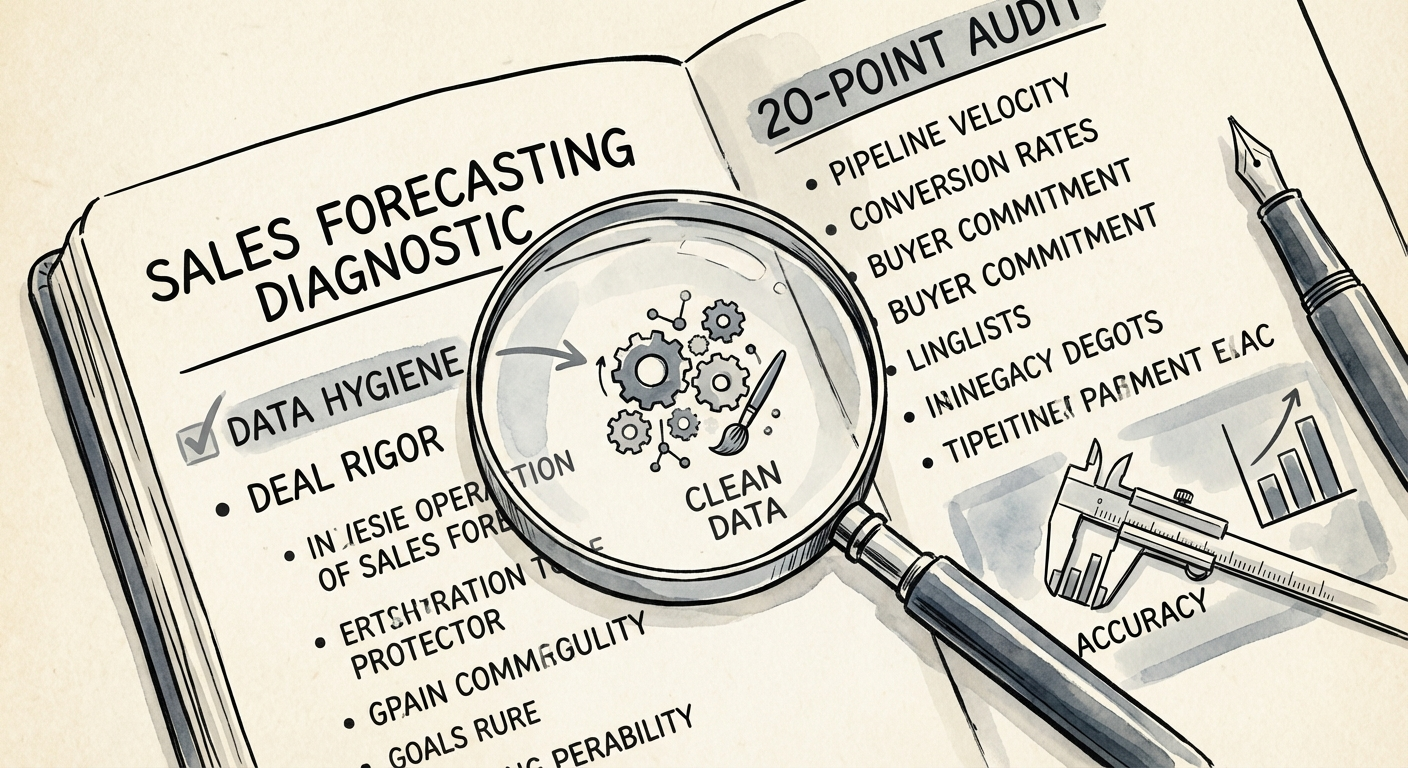
The 20-Point Forecast Diagnostic
This audit is designed to stress-test your forecasting maturity. It moves beyond simple CRM adoption and looks at the behavioral, structural, and mathematical integrity of your number. Score your organization on each point (Yes/No).
Category 1: Data Hygiene & Infrastructure
Bad data in, bad forecast out. If your CRM is a graveyard of expired close dates, your forecast is a fiction.
- 1. The "Past Due" Zero Tolerance: Are there zero opportunities with close dates in the past? (Even one implies a lack of rep discipline).
- 2. Stage Stagnation: Do you automatically flag deals that have sat in a stage longer than the average sales cycle for that stage?
- 3. Next Steps Validity: Does every forecasted deal have a documented, future-dated "Next Step" with a specific date? (e.g., "Follow up" is not valid; "Legal review call on 10/12" is).
- 4. Clean Splits: Are purely speculative "Upside" deals rigorously separated from "Commit" in your reporting?
- 5. Deal Size Deviations: Are deals >3x your ACV automatically flagged for executive review? (Whales skew forecasts and rarely close on time).
Category 2: Methodology & Math
Hope is not a strategy, and 3x coverage is a lie if the underlying math is flawed.
- 6. Weighted Forecast Accuracy: Do you track the variance between your "Weighted Pipeline" and actuals over the last 4 quarters? (If variance >15%, your weightings are wrong).
- 7. Conversion by Cohort: Do you know your exact conversion rates from Stage 3 to Close, and is this applied dynamically?
- 8. Linearity Assumptions: Does your forecast model account for the "Hockey Stick"? (e.g., Do you historically close 40% of revenue in the last week of the quarter?).
- 9. Seasonality Adjustment: Is your current forecast adjusted for verified seasonal dips (e.g., August in Europe, December in Enterprise)?
- 10. Churn Offset: For NRR forecasting, is potential churn explicitly subtracted from the "Expansion" number, or hidden in a separate silo?
Category 3: Deal Rigor (MEDDPICC)
Forecasting is an output of qualification. If you don't know the Economic Buyer, you can't forecast the close date.
- 11. Economic Buyer Confirmed: For every "Commit" deal, has the Economic Buyer explicitly confirmed the budget and timeline?
- 12. Paper Process Mapped: Has the rep seen the procurement steps in writing? (Knowing "Legal needs to sign" is different from "Legal requires 14 days and a wet signature").
- 13. Compelling Event Verified: Is the close date tied to the customer's compelling event, not your end of quarter?
- 14. Champion Tested: Has the internal champion effectively sold the deal internally when you weren't in the room?
- 15. Red Flag Reviews: Is there a formal process where management actively tries to kill the deal to test its resilience?
Category 4: Human Behavior & Governance
The biggest variable in forecasting is human bias.
- 16. The Manager Override: Do sales managers submit a separate "Manager Call" distinct from the roll-up of rep commits?
- 17. Sandbagging Detection: Do you track Rep Accuracy? (Reps who consistently beat forecasts by >20% are just as dangerous as those who miss; they hide capital efficiency).
- 18. Weekly Cadence: Is the forecast submitted at the same time every week, with no exceptions?
- 19. Change Log Tracking: Do you track why a deal slipped? (Product gap vs. Budget loss vs. Ghosting).
- 20. The "Why Now" Test: If a deal slipped from last quarter, has the "Why Now" changed? If not, it will slip again.
From Diagnostic to Action
If you answered "No" to more than 5 of the points above, your forecast is currently a lagging indicator of rep activity, not a leading indicator of revenue. Fixing this requires a cultural shift from "reporting the news" to "making the news."
1. Implement the "Evidence Required" Rule
Stop accepting "Commit" deals that lack verifiable evidence. In your next forecast review, implement a rule: If a deal is in "Commit," the rep must produce an email from the customer confirming the timeline. No email? It moves to "Best Case." This single change usually deflates the pipeline by 30% overnight, but it brings you closer to reality.
2. Calibrate Your Managers
Your sales managers are the filter between rep optimism and your board deck. Measure their Manager Forecast Accuracy separately from their team's quota attainment. A manager who hits quota but misses their forecast by 20% is an operational liability. Reward predictability as highly as performance.
3. The 90% Mandate
Set a clear target: 90% forecast accuracy by Day 45 of the quarter. According to Gartner data, only 7% of sales organizations achieve this. Those that do, however, trade at higher multiples and operate with significantly less cash drag.
When the board trusts your numbers, the conversation shifts from "Can you survive?" to "How fast can we deploy capital?" That is the shift that turns a struggling Series B company into a Series C breakout.