
The practical answer
- Short answer
- Don't let a bad software contract kill your deal. A 5-point vendor contract review checklist for sell-side due diligence preparation. Avoid change-of-control traps.
- Best fit
- Industry: Private Equity. Function: Operations
- Operating path
- Process Documentation → Operational Excellence → Transaction Execution Services
- Key metric
- 30% Increase in software costs typically triggered by Change of Control clauses that reset legacy discounts to list prices.
The "Poison Pills" Hidden in Your Vendor Stack
In the rush to prepare a CIM (Confidential Information Memorandum) and clean up the P&L, founders often overlook a critical liability sitting in their operational stack: vendor contracts. While you are focused on revenue quality and customer churn, private equity buyers are scrutinizing your expense structure for "contract debt." A single poorly negotiated enterprise software agreement can act as a poison pill, either delaying the close by 60+ days or forcing a post-LOI re-trade that shaves percentage points off your multiple.
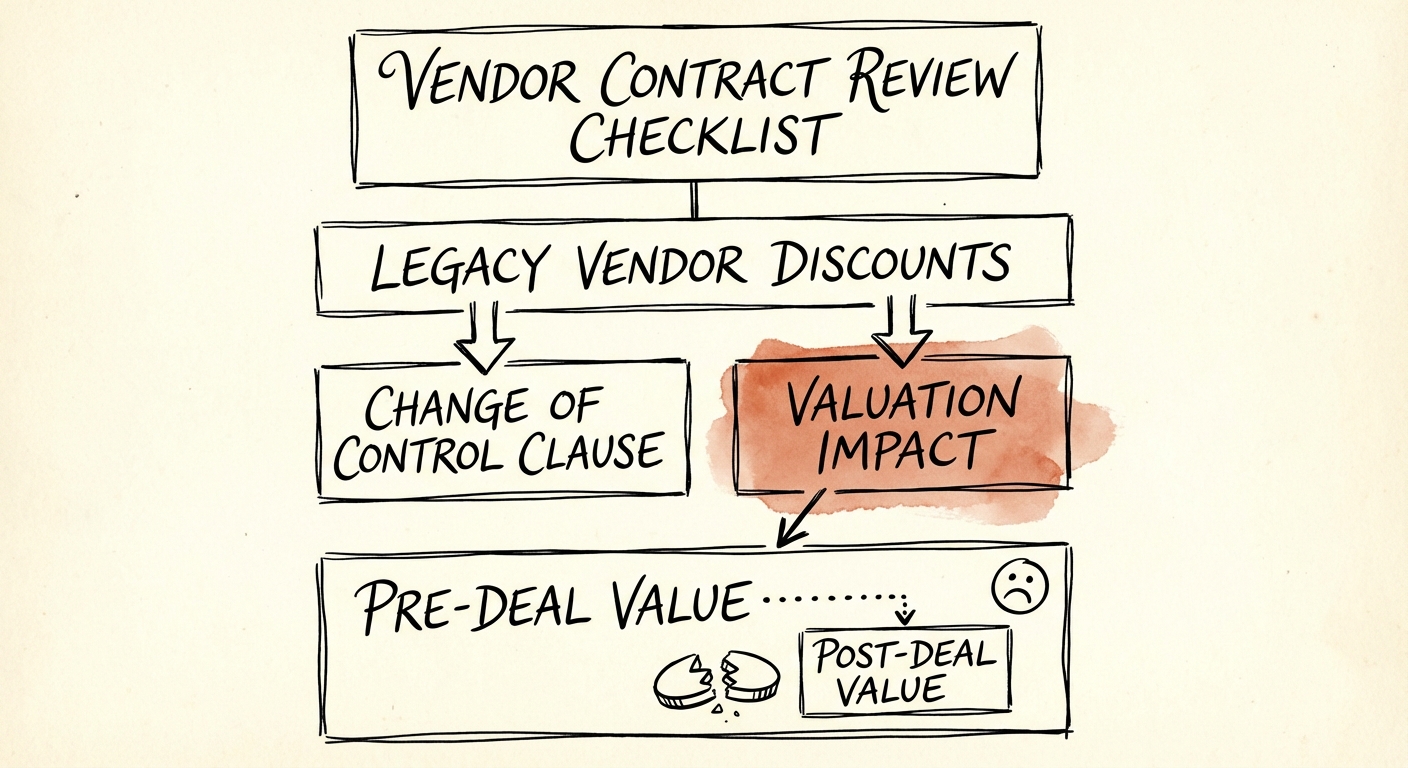
The risk is not theoretical. In 2025, due diligence timelines have lengthened by approximately 30% largely due to increased scrutiny on operational liabilities. When a buyer acquires your company, they are inheriting your obligations. If your $100k/year cloud hosting contract contains a "Change of Control" clause that triggers a price reset to list rates, you haven't just increased OpEx; you have effectively lowered your EBITDA—and your valuation—overnight.
The Three Categories of Vendor Risk
We categorize vendor contract risks into three tiers of severity during sell-side preparation:
- The Deal Killers (Level 1): Contracts that are critical to business continuity (e.g., a core IP license or sole-source manufacturing agreement) but lack assignability. If the vendor refuses to consent to the transaction, the deal effectively stops.
- The Value Eroders (Level 2): Agreements with punitive "Change of Control" fees or loss of legacy discounts. For example, a Salesforce or SAP contract negotiated five years ago at a 40% discount that resets to market rates upon acquisition.
- The Integration Blockers (Level 3): Long-term contracts with no termination for convenience. If a strategic buyer wants to migrate you to their ERP but you are locked into a 3-year renewal with a 100% payout clause, that integration cost is deducted from the purchase price.
In lower-mid-market deals, we consistently see 10-15% of the enterprise value threatened by 'operational debt'—specifically, vendor contracts that cannot be transferred without massive penalties or renegotiation.
The 5-Point Sell-Side Vendor Contract Checklist
To prevent these surprises, run this diagnostic on your top 20 vendor contracts (by spend and criticality) at least six months before going to market.
1. The Assignment Clause: "Consent Not Unreasonably Withheld"
This is the single most common friction point in M&A closing. Buyers prefer "Silent Consent" (no notification needed), but vendors often demand "Prior Written Consent."
- Red Flag: "Sole discretion." If a vendor has sole discretion to approve an assignment, they can demand a fee before approving the transaction.
- The Fix: If you are 12 months out, renegotiate for "Consent not to be unreasonably withheld, conditioned, or delayed." If you are 3 months out, prepare a specific "Consent Request Strategy" document for the data room, detailing your relationship with the vendor to assuage buyer fears.
2. Change of Control (CoC) Triggers
Does the contract define a "Change of Control" as a termination event? In SaaS, this is often used to prevent a competitor from acquiring the software (e.g., Oracle buying a company using SAP). However, generalist PE firms are often caught in the crossfire.
- The Calculation: Calculate the financial impact if the vendor exercises this right. If you lose your grandfathered pricing, what is the delta? Pre-emptively adjusting your EBITDA to reflect "market rates" can sometimes be a safer play than surprising the buyer during Quality of Earnings (QofE).
3. Termination for Convenience & Breakage Fees
Buyers are looking for "Synergies." They want to consolidate your HRIS into theirs. If your contract auto-renewed for 3 years last month with no termination for convenience, the buyer cannot realize that synergy.
Benchmark: A standard "breakage fee" in a healthy vendor contract should be 3-6 months of fees, not the remaining value of the contract. If your contracts demand 100% payout, disclose this in the "Integration Risks" schedule to control the narrative.
4. Data Portability and Exit Rights
If the buyer cancels the contract, can you get your data out? We see deals stall because a niche CRM provider charges exorbitant fees for "data extraction" or delivers data in an unusable proprietary format. Ensure your contracts specify standard formats (CSV, SQL dump) and timeframes (within 30 days of termination) for data return.
5. The "Ticking Time Bomb" Renewal
Identify any major contracts renewing during your projected exclusivity period. You do not want to be negotiating a mission-critical renewal while trying to close a sale. The leverage shifts entirely to the vendor if they know you need the contract signed to close your M&A deal. Extension strategies should be put in place 90 days prior to the LOI.
Remediation: Fixing the Stack Before the Data Room Opens
You cannot rewrite every contract, but you can structure your disclosure to protect value. The goal is to move issues from "Deal Breakers" to "Known Liabilities."
The "Contract Matrix" Playbook
Create a summary matrix as the cover sheet for your Legal Due Diligence folder. Columns should include: Vendor Name, Annual Spend, Expiration Date, Assignability Terms, CoC Triggers, and Termination Fees. By summarizing this upfront, you signal operational maturity. Buyers pay a premium for "transferability"—the assurance that they can step into your shoes without operational friction.
For contracts with severe poison pills, consider a structured vendor exit framework. Often, offering a vendor a multi-year renewal post-close (contingent on the deal closing) can be enough to secure their consent for the assignment today. You are effectively trading future revenue (which the buyer pays) for present deal security.
Operational Due Diligence Context
This review process is a core component of Operational Due Diligence (ODD). While financial diligence looks at the past, ODD looks at the future risks of running the business. A clean contract stack suggests a business that is ready to scale, not one held together by handshake deals and restrictive legacy agreements. For buyers, the acquirer's checklist always includes a review of these liabilities. Anticipating their questions allows you to defend your valuation against the "compliance discount" that often hits unprepared sellers.