
The practical answer
- Short answer
- Why 70% of tech M&A synergies fail due to poor governance. A diagnostic guide to structuring an Agile Integration Management Office (IMO) that reduces decision latency and protects deal value.
- Best fit
- Industry: Private Equity / Technology. Function: Operations
- Operating path
- Process Documentation → Operational Excellence → Transaction Execution Services
- Key metric
- 70-90% Failure rate of M&A deals to achieve stated synergy targets due to poor integration execution (Harvard/Bain).
The 'Bureaucracy Trap': Why Traditional PMOs Kill Tech Deals
In the high-stakes environment of technology M&A, speed is the ultimate currency. Yet, most private equity firms install an integration governance structure that achieves the exact opposite: a bloated, bureaucratic Project Management Office (PMO) that measures activity rather than outcomes. Recent data from 2025 suggests that 70% to 90% of M&A deals fail to achieve their stated synergy targets, not because the strategy was wrong, but because the execution structure was too rigid to adapt to reality.
The traditional "Command and Control" integration model—characterized by weekly status updates, massive Excel trackers, and deferred decision-making—is a material risk for tech acquisitions. In software companies, where talent is mobile and product roadmaps are perishable, a two-week delay in deciding on a cloud migration strategy or an engineering org chart can cost millions in lost momentum and talent attrition. The "Governance Gap" is the void between the deal thesis (what you bought) and the operational reality (how you run it). When governance focuses on reporting rather than unblocking, value leaks from the system.
The Agile IMO: A New Operating Model
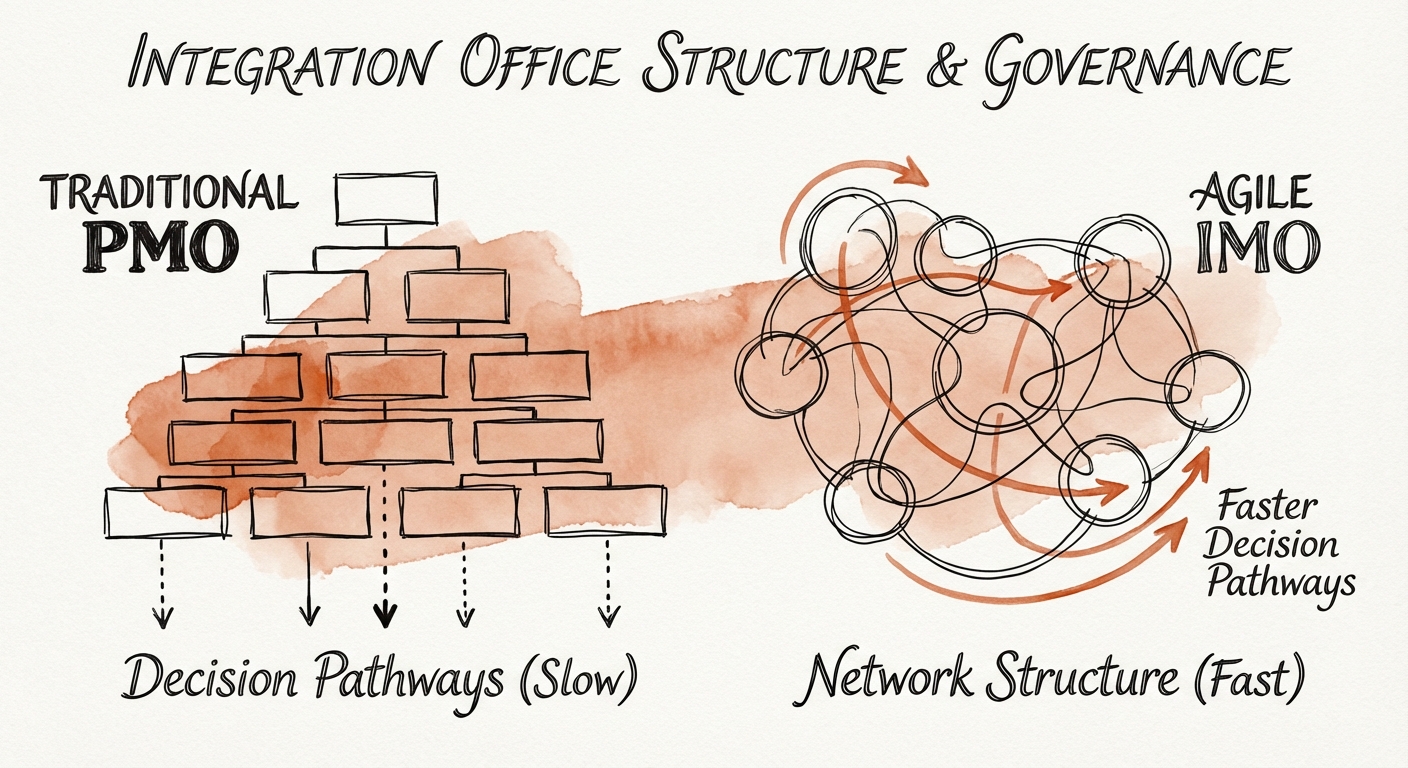
For 2026, top-performing PE sponsors are pivoting to an "Agile IMO" structure. Unlike the administrative PMO of the past, the Agile IMO is a decision-making engine. It operates on 48-hour sprint cycles for critical blockers, rather than monthly steering committees. It prioritizes "Minimum Viable Integration" (MVI)—doing only what is necessary to protect value and enable growth—over comprehensive, checklist-driven unification that distracts the target company from hitting its booking numbers.
The traditional PMO measures activity: 'Did we hold the meeting?' The Agile IMO measures velocity: 'Did we make the decision?' In tech M&A, the difference between the two is often the difference between a 3x and a 5x return.
The Two-Tier Governance Framework
To close the Governance Gap, Operating Partners must implement a bifurcated structure that separates strategic alignment from tactical execution. This prevents the Steering Committee from getting bogged down in IT ticket migration details while ensuring the working teams have clear escalation paths.
Tier 1: The Strategic Steering Committee (SteerCo)
Composition: PE Operating Partner, Deal Lead, CEO of Platform, CEO of Add-on.
Cadence: Bi-weekly (moving to monthly after Day 90).
Mandate: The SteerCo exists for one reason: to make irreversible decisions that involve significant capital or risk. They define the "North Star" of the integration and clear blockers that the IMO cannot resolve. If the SteerCo is reviewing Gantt charts, it is failing. It should be reviewing synergy realization metrics and risk registers.
Tier 2: The Agile Integration Management Office (IMO)
Composition: Full-time Integration Leader (often external), Workstream Leads (Product, Sales, Finance, HR, IT).
Cadence: Daily Stand-ups (15 mins), Weekly Sprints.
Mandate: The IMO is the operational nervous system. It is responsible for cross-functional dependency management—ensuring that the Salesforce integration doesn't break the billing system, and the product roadmap consolidation doesn't trigger a mass engineer exodus. The IMO Lead must have the authority to make tactical decisions without SteerCo approval, provided they stay within the agreed-upon budget and risk guardrails.
Measuring Governance Effectiveness: The 'Decision Latency' Metric
How do you know if your integration governance is working? Stop tracking "tasks completed" and start tracking Decision Latency. This is the time elapsed between a workstream identifying a blocker (e.g., "Should we migrate the target to our ERP or keep them on NetSuite?") and a final decision being communicated.
In high-performing integrations, operational decisions are made in <48 hours and strategic decisions in <5 days. If your Decision Latency averages >2 weeks, your governance structure is actively destroying deal value. Long decision cycles paralyze the acquired team, creating a vacuum of uncertainty that is quickly filled by rumors and cultural high-riskity.
The RACI Reality Check
Governance fails when no one knows who holds the "A" (Accountable) in the RACI matrix. A common symptom of failed tech integrations is the "Committee of No One," where decisions are socialized endlessly but never finalized. Your governance document must explicitly state that for every workstream, there is exactly one person accountable for decisions. For the IT integration, it is the CTO (or interim IT lead), not the "IT Committee." Ambiguity is the enemy of velocity.