The practical answer
- Short answer
- Why 50% of UiPath projects fail to scale. A diagnostic guide for COOs on the 'Maintenance Cliff', process documentation, and selecting the right automation partner.
- Best fit
- Industry: Enterprise Software. Function: Operations
- Operating path
- Process Documentation → Operational Excellence → Transaction Execution Services
- Key metric
- 50% Failure rate of initial RPA projects due to poor process selection and lack of governance (EY).
The 'Maintenance Cliff' That Kills Automation ROI
The promise of Robotic Process Automation (RPA) was seductive: a digital workforce that never sleeps, never makes typos, and costs a fraction of a human employee. Yet, the reality for 50% of organizations is a graveyard of "inactive bots"—automations that require more human intervention to fix than they save in execution time.
This phenomenon, known as the Maintenance Cliff, typically strikes 12 to 18 months into an automation program. In the pilot phase, with 5 to 10 bots, manual oversight is manageable. But as Forrester research reveals, fewer than 4% of RPA-adopting firms reach 50+ robots. Why? Because linear scaling of bot counts creates exponential scaling of maintenance overhead.
The 'Citizen Developer' Trap
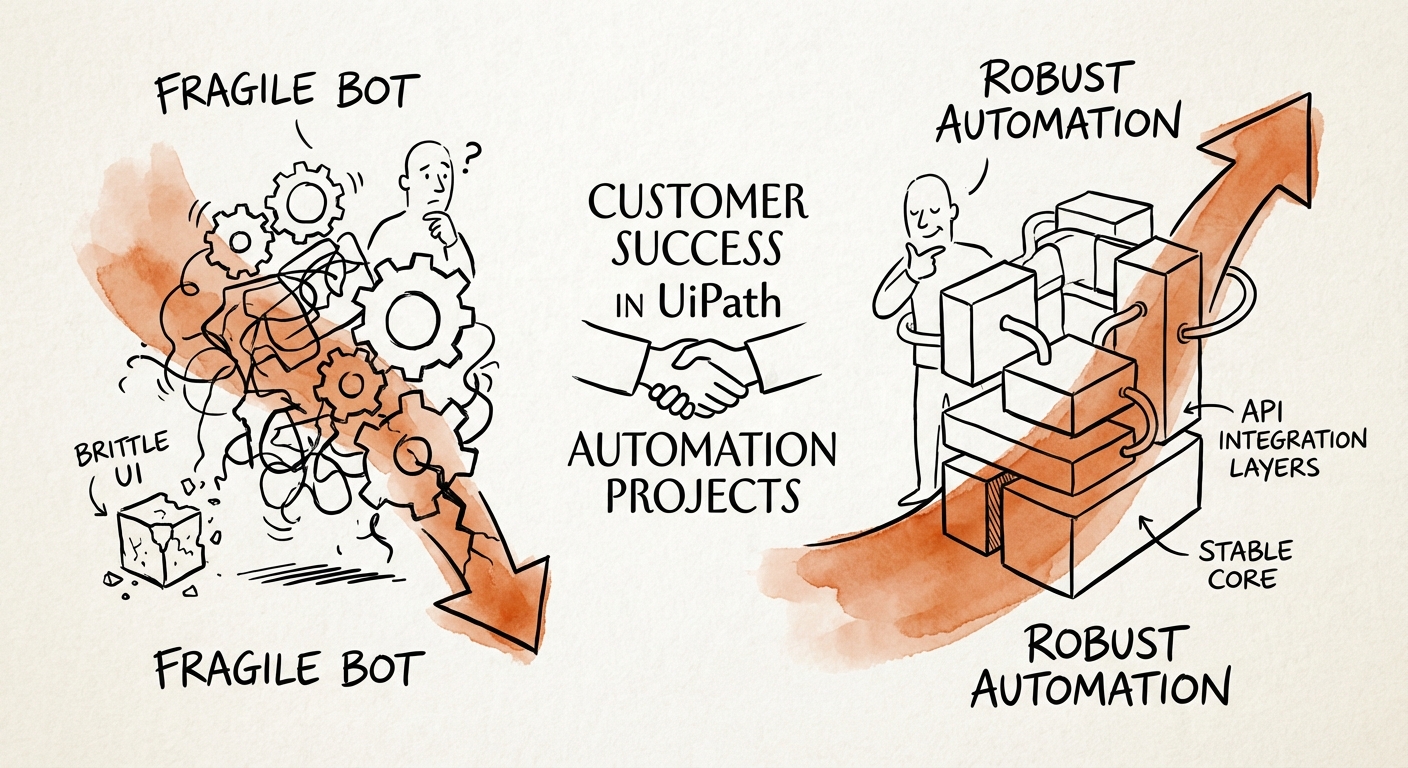
The root cause is rarely the UiPath platform itself, but rather the process (or lack thereof) behind the automation. Many organizations fall into the "Citizen Developer" trap, encouraging rapid development without rigorous governance. The result is brittle automation: bots built on unstable user interfaces (UIs) or undocumented process variations. When a SaaS vendor updates a button color or a field location, the bot breaks. When a process exception occurs that wasn't documented in the PDD (Process Definition Document), the bot stalls.
Instead of a "digital workforce," you have built a technical debt engine. Your high-value engineers stop building new capabilities and start playing "whack-a-mole" with broken scripts, eroding the very ROI the project was promised to deliver.
Automating a broken process just gets you broken results faster. The difference between a stalled pilot and a scalable Center of Excellence is the rigor of your process documentation.
The Metrics: Quantifying Bot Fragility
To determine if your UiPath implementation is suffering from process fragility, you must look beyond "hours saved" and audit the quality of the automation. Successful scaling requires tracking the "hidden" costs that generalist partners often obscure.
1. The Breakage Ratio
Benchmark: < 5% Weekly Failure Rate
Track the percentage of bot runs that terminate in a "System Exception" requiring human triage. If your Breakage Ratio exceeds 5%, your bots are too fragile. This typically indicates that the automation was built on top of a dynamic UI without sufficient selector hardening or API integration. High breakage ratios are the leading indicator of the Maintenance Cliff.
2. Maintenance-to-Build Cost Ratio
Benchmark: 20% Annual Cap
Gartner estimates that ongoing support should account for 20-25% of total RPA costs annually. If you are spending $0.50 on maintenance for every $1.00 spent on development, your program is upside down. This ratio balloons when processes are automated "as-is" without first being optimized and standardized. As the saying goes, "Automating a broken process just gets you broken results faster."
3. The 'Human-in-the-Loop' Dependency
Benchmark: < 10% Exception Rate
If your "unattended" bots require daily hand-holding, they are effectively "attended" bots with a higher price tag. A healthy unattended automation should handle 90%+ of transactions without human input. If your business exception rate is consistently high, it means the process rules were not fully documented or understood before code was written.
The Cure: Governance First, Code Second
Recovering from a stalled UiPath implementation requires a pivot from "bot building" to "process architecture." The most successful automation programs are 80% process documentation and 20% coding.
The 'Process Architect' Requirement
When evaluating partners for remediation or scaling, stop hiring "RPA Developers." Instead, look for Process Architects. A developer asks, "How do I click this button?" A process architect asks, "Why does this button exist, and can we eliminate the step entirely?"
- Demand a PDD Audit: innovative partners will refuse to build a bot until they have a signed, rigorous Process Definition Document (PDD) that maps every exception path.
- Prioritize API over UI: The most robust automations bypass the screen entirely. Require your partner to leverage APIs for data transfer whenever possible, using UI interaction only as a last resort.
- Implement a 'Bot Health' Dashboard: Move beyond vanity metrics like "bots deployed." Implement a dashboard that tracks availability, utilization, and mean time to recovery (MTTR) for broken bots.
The Documentation Guardrail
Ultimately, the guardrail for bot fragility is documenting tribal knowledge before attempting to digitize it. You cannot automate what you cannot define. By enforcing strict process standardization and documentation standards before a single line of code is written, you convert the Maintenance Cliff into a scalable plateau of productivity.