
The practical answer
- Short answer
- Stop 'synergy leakage' in technology acquisitions. A diagnostic guide for PE operating partners on designing dashboards that track value, not just activity.
- Best fit
- Industry: Private Equity. Function: Operations
- Operating path
- Process Documentation → Operational Excellence → Transaction Execution Services
- Key metric
- 30% Average 'Synergy Leakage' in deals that rely solely on spreadsheet tracking rather than real-time dashboards.
The "Green Light" Illusion: Why Standard PMO Dashboards Fail
In the high-stakes environment of technology M&A, the deal thesis often hinges on a specific set of synergies: $5M in cloud consolidation savings, $10M in cross-sell revenue, or $3M in G&A rationalization. Yet, trusted industry data consistently suggests that nearly 70% of mergers fail to fully realize these projected synergies. The culprit is rarely the strategy itself; it is the "Synergy Leakage" that occurs between the deal model and the operational reality.
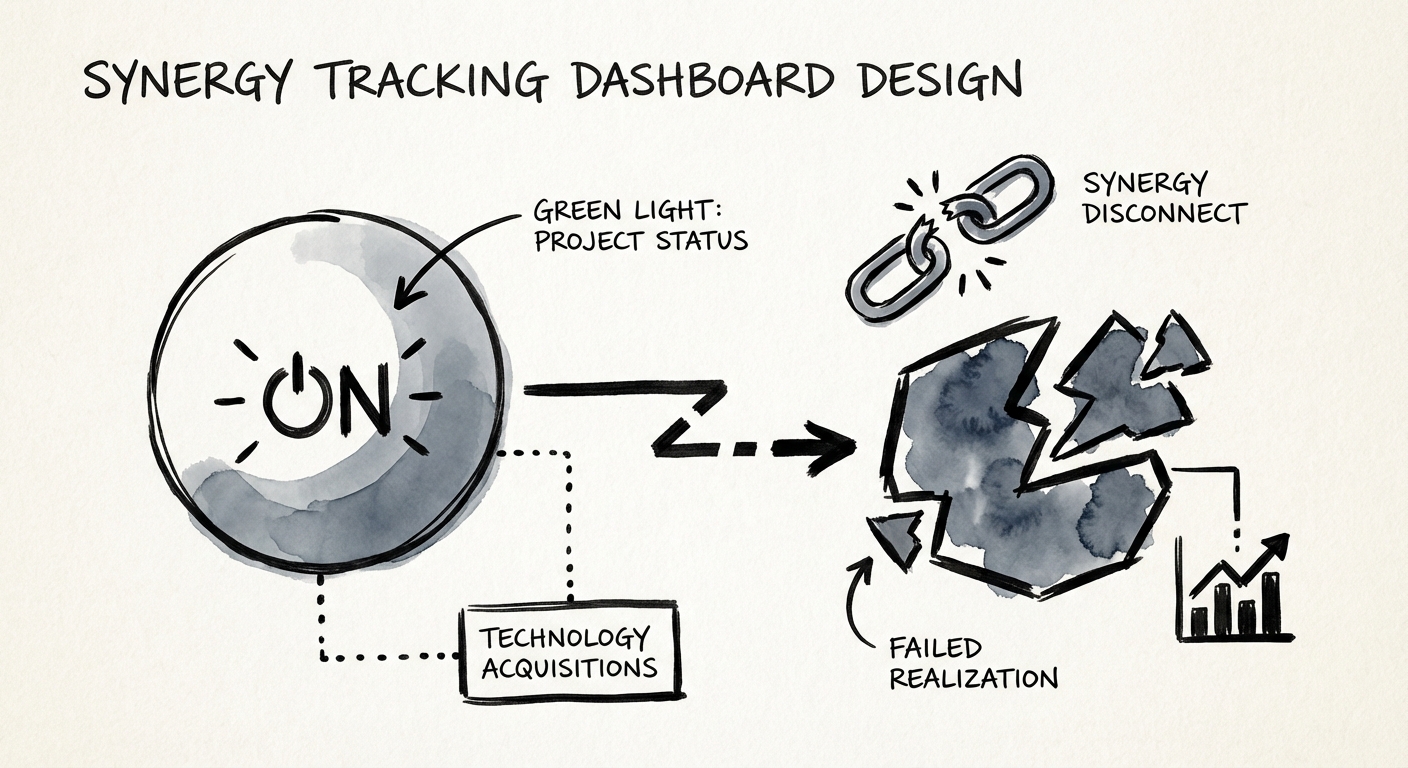
The primary mechanism of this failure is the "Green Light" Illusion. Most Integration Management Offices (IMOs) rely on activity-based dashboards. These dashboards track whether a meeting happened, whether a plan was submitted, or whether a system was migrated. If the tasks are done, the dashboard shows green. However, activity does not equal value. A cloud migration project can be "on time and on budget" (Green) while simultaneously failing to deliver the promised cost savings because the legacy instances weren't decommissioned or the reserved instances weren't optimized.
For Private Equity Operating Partners, this disconnect is fatal to the investment thesis. By the time the missed synergy shows up in the quarterly P&L, it is often too late to recover the lost value. Effective governance requires a shift from tracking milestones to tracking value realization. This requires a dashboard design that explicitly links operational actions to financial outcomes, exposing the "gap to plan" in real-time rather than at month-end close. Without this visibility, you are essentially lacking operating visibility, trusting that executed tasks will magically transmute into EBITDA.
Activity does not equal value. A green project plan can still result in a red P&L if the dashboard doesn't explicitly link operational milestones to financial realization.
The 4-Layer Dashboard Architecture
To prevent leakage, a synergy tracking dashboard must move beyond simple project management gantt charts. It requires a four-layer architecture that connects the basement (operational data) to the boardroom (financial outcomes). This design forces accountability at every level of the organization.
Layer 1: The P&L Bridge (Lagging Indicators)
This is the top-level view for the Steering Committee. It should not just show "Cost Savings," but specifically bridge the gap between the Deal Model Thesis and Actuals. It tracks "Run-Rate Synergies" (annualized value of actions taken) vs. "Realized Synergies" (cash impact in the P&L). A critical metric here is the "Realization Lag"—the time difference between an action being marked complete and the financial benefit appearing. If this lag exceeds 60 days, your integration is stalling.
Layer 2: The Operational Driver (Leading Indicators)
This layer tracks the specific operational drivers that cause the financial result. For a technology acquisition, this might look like:
- Cloud Consolidation: Instead of "Migration Complete," track "Percentage of Workloads on Reserved Instances" or "Legacy Servers Decommissioned."
- Headcount Rationalization: Track "Notification Date" vs. "Payroll Exit Date."
- Cross-Sell: Track "Qualified Pipeline Generated from Acquired Base" rather than just "Deals Closed."
Layer 3: The "Cost to Achieve" (CTA) Monitor
Synergies are not free. A common failure mode is spending $1.50 to save $1.00. This layer tracks the one-time costs (severance, migration fees, consultant spend) against the budget. If the CTA burn rate exceeds the synergy realization rate, the dashboard must flash red immediately. This preserves the Net Value Capture of the deal.
Layer 4: Risk & Sentiment
Often ignored, this qualitative layer tracks the "soft" factors that kill hard numbers. Metrics include key employee retention risk scores, customer sentiment (NPS during migration), and cultural alignment pulse surveys. A spike in key engineer attrition is a leading indicator that your product synergy targets are about to miss.
Governance Rhythm: The "Weekly 15"
A dashboard is useless if it is only reviewed monthly. The most successful integrators establish a "Weekly 15" governance rhythm—a 15-minute standup centered exclusively on the dashboard's exceptions. The rule is simple: "If it's Green, we don't talk about it. If it's Red, who owns the fix?"
This meeting is not for status updates; it is for unblocking value. If the Integration Synergy Tracker shows that the sales team is behind on cross-sell training (Layer 2), the Revenue Leader must commit to a specific recovery date in that meeting. If the synergy realization gap widens, the IMO has the authority to pause other initiatives to focus resources on the bottleneck. This rigorous cadence prevents the "hockey stick" effect, where teams promise to catch up in the final month of the quarter—a promise that is rarely kept.
Furthermore, this dashboard should be the primary artifact for Board Reporting. Rather than creating new slides, Operating Partners should simply present the Layer 1 view. This transparency builds trust with the Investment Committee and demonstrates that the common mistakes that destroy deal value are being actively managed. In 2026, the difference between a 2x and a 4x return often lies not in the deal you struck, but in the rigorous, metric-driven tracking of the value you promised to create.