The practical answer
- Short answer
- Founder dependency costs you 30-50% in valuation. Learn how to quantify key person risk, avoid earnout traps, and build a transferable company.
- Best fit
- Industry: B2B Tech & Services. Function: Operations
- Operating path
- Founder Extraction → Operational Excellence → Interim Management
- Key metric
- 33% Of deals include earnouts, but 60% of those earnouts fail to pay out in full.
The Mathematics of Martyrdom
You think your 80-hour weeks are a badge of honor. To a private equity buyer, they are a liability that costs you millions. In the lower middle market ($10M-$100M transaction value), there is a stark bifurcation in valuation multiples based on one variable: Transferability.
Data from Strategic Exit Advisors and recent transaction benchmarks reveals a brutal reality: Independent, systematized businesses trade at 7x-8x EBITDA. Businesses where the founder is the primary rainmaker, product visionary, or decision hub struggle to fetch 3x-4x EBITDA. That is not a marginal difference; it is a 50% destruction of enterprise value.
We call this the "Martyr's Discount." When you are the business, the business cannot be sold; it can only be hired. And buyers do not want to hire you—they want to acquire an asset that generates cash flow without you. If your calendar is double-booked and your phone rings on vacation, you haven't built a company; you've built a high-paying job that you can never quit.
Furthermore, this risk doesn't just hit the purchase price; it dictates the structure of the deal. High key-person risk almost guarantees a heavy earnout component. According to the American Bar Association's Private Target Deal Points Study, 26-33% of deals include earnouts, but for founder-heavy firms, that number spikes. The tragedy? 60% of earnouts pay out less than 50% of their potential value. You are gambling your exit on a future you won't control.
Buyers don't pay for potential that walks out the door every evening. They pay for systems that stay.
The Three Horsemen of Dependency
Dependency isn't a vague feeling; it's a structural flaw that appears in due diligence in three specific forms. We see these repeatedly in our Founder Delegation Paradox assessments.
1. Revenue Dependency (The Rainmaker Trap)
If you close 80% of the deals, your revenue is not an asset; it's a personal performance bonus. Buyers discount "founder-led revenue" because it rarely survives the transition. If you leave, the relationships leave. This is why we urge founders to transition from "Founder-Led Sales" to a "Founder-Supported Sales Process" at least 24 months before exit.
2. Technical Dependency (The Genius Trap)
In tech-enabled services and SaaS, this is lethal. If you are the only one who understands the legacy code or the architectural vision, you are a single point of failure. I recently saw a $40M LOI crumble because the technical due diligence revealed that the "proprietary algorithm" lived entirely in the founder's head and a few undocumented scripts. That's not IP; that's liability.
3. Operational Dependency (The Hub Trap)
This is the most common. You don't sell, and you don't code, but you decide. If every expense over $500, every hiring decision, and every client escalation routes through you, you are the bottleneck. We call this "Hub-and-Spoke" management. It limits your growth rate to your personal bandwidth and signals to buyers that the management team lacks the autonomy to scale.
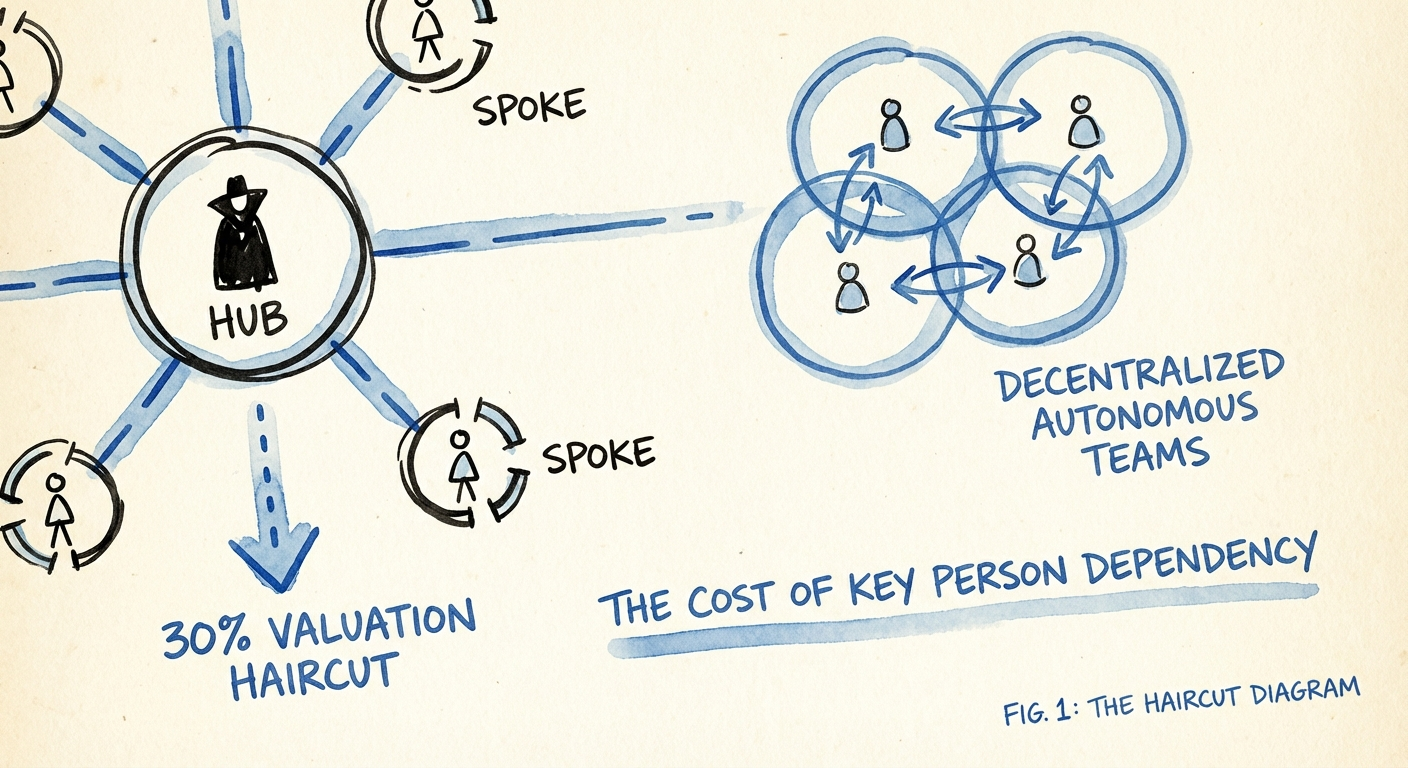
The Extraction Roadmap: From Hero to Owner
The only way to reclaim that lost 30-50% of value is to systematically fire yourself. This is not about "stepping back"—it is about "stepping up" to the role of an owner rather than an operator. This requires a shift from implicit tribal knowledge to explicit process documentation.
Start with the Founder Extraction Checklist. Identify the top 5 decisions you make daily and document the logic so a director-level hire can make them tomorrow. This is how you build the "Transferability Premium." Buyers pay more for documented processes because they reduce the risk of integration failure.
Second, sanitize your financials. Ensure your replacement cost is baked into the P&L. If you are taking a below-market salary to inflate EBITDA, you are masking the underlying economicsrself. A Quality of Earnings (QofE) provider will adjust your salary up to market rates (e.g., $350k for a CEO), instantly lowering your EBITDA. Do it yourself first so there are no surprises.
Finally, test your redundancy. Take a two-week vacation where you are completely unreachable. If revenue dips or operations stall, you are not ready to sell. If the team thrives, you have successfully engineered your own obsolescence—and maximized your exit value. Remember, the most valuable founders are the ones who are no longer needed.