
The practical answer
- Short answer
- Why Shopify agencies stall at $3M revenue. A diagnostic playbook for extracting the founder from sales and delivery to unlock 12x valuation multiples.
- Best fit
- Industry: Shopify Ecosystem. Function: Operations
- Operating path
- Founder Extraction → Operational Excellence → Interim Management
- Key metric
- 9.4x Average EBITDA multiple for specialized e-commerce service partners in 2025.
The 'Hero Architect' Trap: Why You Stalled at $3M
For most Shopify Plus agencies, the journey from $0 to $3 million in revenue is fueled by sheer founder force of will. You are the chief salesperson, the lead strategist, and often the technical escalation point for your most critical clients. This "Hero Architect" model works exceptionally well—until it doesn't. Our data across the commerce ecosystem shows a distinct "Valley of Death" between $3M and $5M in revenue where growth flatlines despite increased headcount.
The root cause is rarely lead generation; it is founder capacity. When every complex Shopify Plus migration or headless architecture decision requires your sign-off, you become the bottleneck that throttles your own growth. In M&A terms, this is quantified as "Key Person Risk," and it is expensive. Private Equity buyers apply a standard 30% valuation haircut to agencies where the founder generates more than 40% of new business or holds unique technical knowledge.
To break the $10M ceiling, you must shift from being the "best player on the field" to the "general on the sidelines." This requires a fundamental restructuring of how your agency sells and delivers value, moving from implicit founder intuition to explicit scalable processes.
You can't sell a business that lives in your head. The difference between a 4x 'job' and a 12x 'asset' is the existence of a playbook that runs without you.
The Sales Extraction: Firing Yourself from the Deal Desk
The most dangerous limiting factor for a scaling Shopify agency is Founder-Led Sales. While your conversion rates are likely high (often 50%+ on qualified referrals), this model is unscalable. The common reaction is to hire a "Rolodex VP"—a senior sales leader from a SaaS company or a competitor—hoping they will replicate your success. This hire fails 70% of the time in professional services.
Why? Because you aren't just selling; you are consulting during the sales process. You are architecting the solution in real-time. A hired salesperson, no matter how senior, cannot replicate that technical authority without a structured "Solutioning Engine."
The Solutioning Engine Framework
To extract yourself from sales, you don't need a better closer; you need a Sales Engineer (SE) or a defined pre-sales process. Your goal is to document the "logic blocks" you use to scope projects. For example:
- Discovery: Standardize the 50 questions you ask to uncover technical debt in a migration.
- Scoping: Create a "T-Shirt Sizing" matrix for common Shopify Plus integrations (e.g., ERP connectors, search/merchandising tools).
- Proposal: Move from custom decks to a modular "Menu of Services" that a non-technical account executive can assemble.
By decoupling "selling" (relationship/commercials) from "solutioning" (technical scope), you enable a sales team to function without your presence on every call.
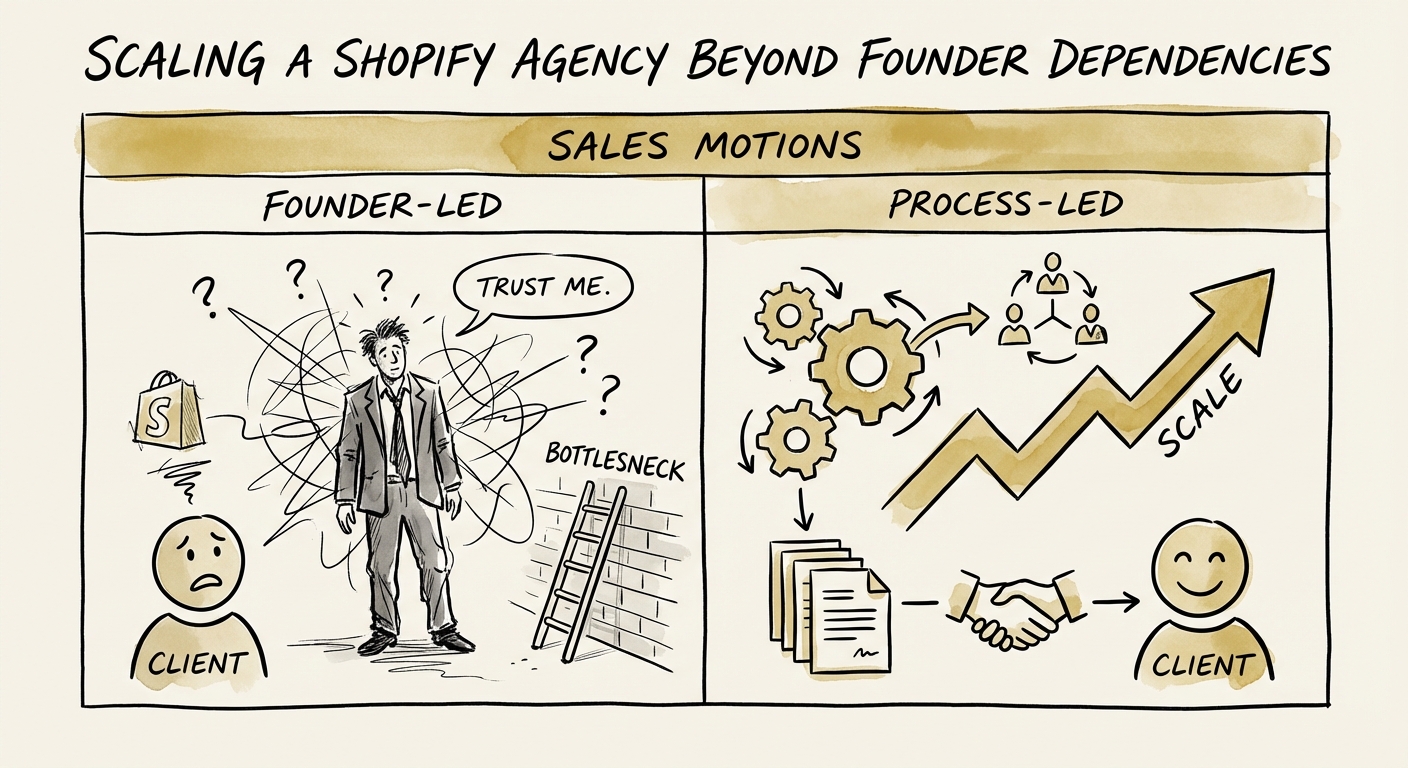
The Delivery Extraction: Escaping the 'Custom' Trap
If sales is the engine, delivery is the transmission—and in many $5M agencies, the transmission is stripping gears. The reliance on "bespoke" development for every Shopify Plus merchant destroys margins and keeps you trapped in code reviews. High-value agencies trading at 12x EBITDA have shifted their mix from 80% Project / 20% Retainer to 40% Project / 60% Managed Services.
To achieve this, you must productize your delivery. This means defining:
- The "Shopify Growth Stack": A standardized set of apps and configurations you deploy for 80% of clients (e.g., Klaviyo for email, Yotpo for reviews, Algolia for search). This reduces the "learning curve" for junior developers.
- Managed Services vs. Support: Stop selling "hours blocks" (which are a race to the bottom) and start selling "Outcomes." A "CRO Retainer" priced at $5,000/month is far more valuable than "20 hours of dev time," even if the underlying labor is identical.
Benchmarking Revenue Per Employee (RPE): The ultimate metric of founder extraction is RPE. In a founder-heavy model, RPE often stagnates around $150k because efficiency is low. In a productized, process-driven agency, RPE should target $250k - $300k. If you are below $200k, you are over-staffed or under-priced, likely because you are solving every problem from scratch.