
The practical answer
- Short answer
- A playbook for Splunk partners hitting the $15M ceiling. Learn how to extract the founder from delivery, navigate the Cisco 360 integration, and build a valuation-ready practice.
- Best fit
- Industry: Cybersecurity & Observability. Function: Operations
- Operating path
- Founder Extraction → Operational Excellence → Interim Management
- Key metric
- 30% Valuation haircut applied by PE firms when key revenue relationships are tied to the founder.
The Cisco 360 Reality: Why 'Generalist' Splunk Partners Are Endangered
For the last decade, you could build a $10M Splunk practice simply by being smarter than the customer. You knew the ins and outs of Search Processing Language (SPL), you could architect a distributed indexer cluster in your sleep, and you had a Rolodex of CISOs who trusted you to fix their SIEM mess.
But as we settle into 2026, the game has changed. The integration of Splunk Partnerverse into the Cisco 360 Partner Program effectively erases the middle ground. The new ecosystem rewards two types of partners: the massive global integrators (GSIs) who move volume, and the hyper-specialized boutiques who solve specific, high-value problems in Observability or SecOps.
If you are a 'generalist' Splunk shop relying on Founder-led sales and 'heroic' delivery, you are in the danger zone. Cisco's partner algorithm prioritizes capability and specialization over general tenure. In the new Splunk Partner Value Index, your value is no longer defined by how many years you've been a partner, but by your ability to deliver standardized outcomes without friction.
The 'Hero' Trap in a Standardized World
The problem for most founders is that your differentiation is currently trapped in your own head. You win deals because you show up to the presales meeting and dazzle the CISO with a custom architecture. You save projects because you jump in at 2 AM to rewrite the correlation searches.
This 'Hero Model' works brilliantly to get you to $5M or even $10M in revenue. But it hits a hard wall at $15M. Why? Because you cannot scale you. When Cisco 360 looks at your firm, they don't see a scalable machine; they see a bottleneck. And when private equity buyers look at your firm, they see Key Person Risk.
When you are the smartest person in the room, you are the bottleneck. True scale happens when your 'average' consultant can deliver 'expert' results because the process creates the excellence, not the person.
The Mechanics of Extraction: From 'Chief Architect' to CEO
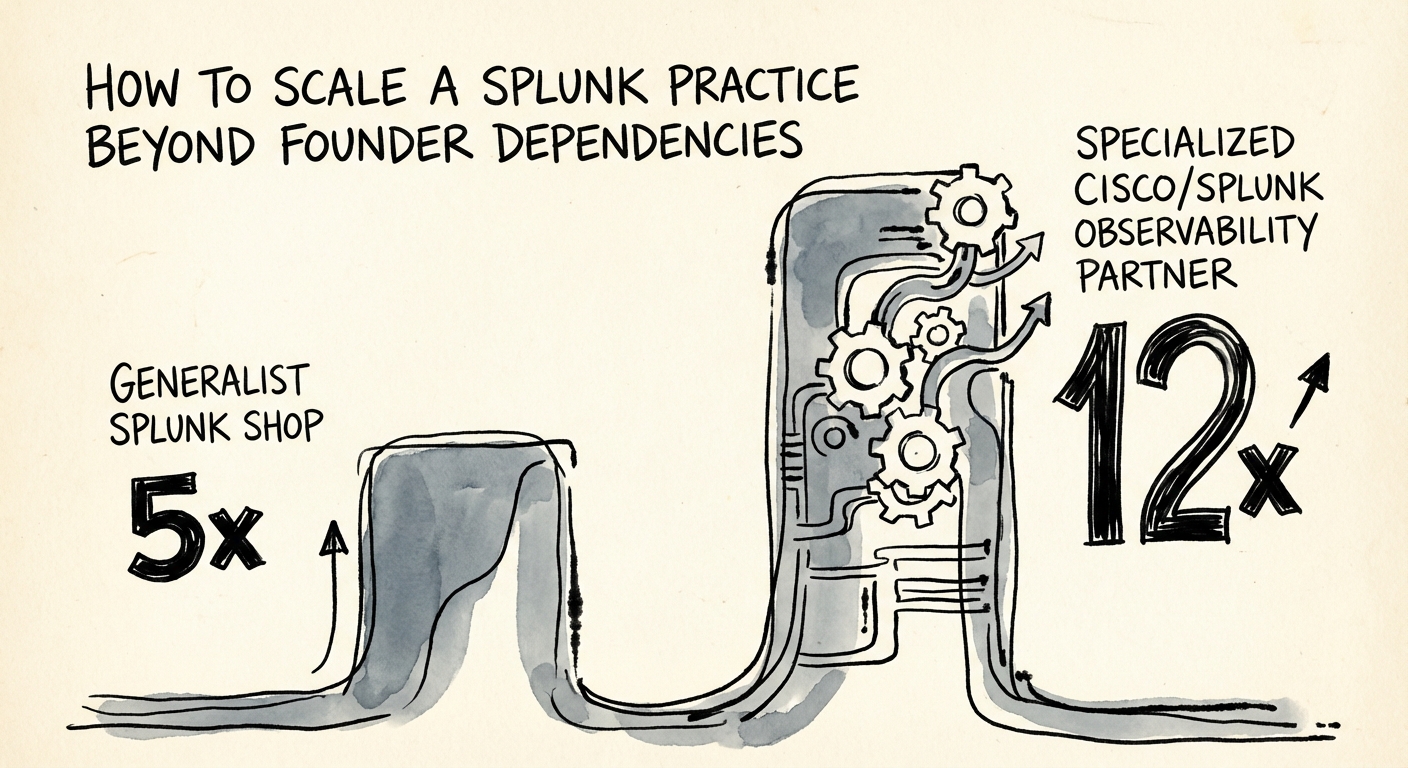
To break through the $15M ceiling and secure a premium exit multiple (think 12x EBITDA instead of 5x), you must fundamentally restructure how you deliver value. This isn't just about hiring more people; it's about changing the unit of value from 'hours of your time' to 'standardized products.'
1. The 'Pod' Model vs. The 'Bench' Model
Stop hiring individual engineers and hoping they can replicate your genius. Instead, build Delivery Pods. A Pod consists of:
- One Lead Architect (The 'Mini-You' who owns the technical standard)
- Two Senior Engineers (Who execute the complex SPL and data onboarding)
- Two Junior Analysts (Who handle documentation, basic dashboards, and alerts)
This structure forces knowledge transfer. The Lead Architect is responsible for the output of the Pod, not just their own ticket queue. Your role shifts from 'doing the work' to 'governing the standard' that the Pods execute.
2. Productizing the 'Magic'
You likely have a library of custom scripts, apps, and dashboards that you've built over the years. This is your Intellectual Property (IP), but currently, it lives in your laptop or a dusty Git repository. To scale, you must package this into Accelerators.
Instead of selling "500 hours of Splunk Consulting," sell a "90-Day SOC Modernization Package" that includes your pre-built correlation rules, dashboard templates, and data onboarding scripts. This decouples revenue from your personal time and allows sales reps to sell a product rather than a person.
3. The Utilization Trap
Founders often obsess over utilization rates, pushing for 85% billability. This is a mistake for scaling firms. If your senior architects are 85% utilized on client work, they have zero capacity to mentor juniors, document processes, or build IP.
The New Benchmark: Aim for 68-72% utilization for your senior technical leaders. The remaining time is not 'bench time'—it is 'scale time.' It is the investment required to build the machinery that makes your firm valuable without you.
The Valuation Reality: Staffing Shop vs. Strategic Asset
In the eyes of a strategic acquirer or PE firm, founder dependency is a massive liability. They quantify this risk with a specific metric: the Valuation Haircut.
If your revenue is tied to your personal relationships and your technical delivery, buyers will apply a 30% discount to your enterprise value. They assume that the moment you leave (or burn out), 30% of the revenue will evaporate. On a $20M exit, that is a $6M loss—literally the cost of your inability to let go.
The Cisco Premium
However, there is a flip side. Partners who successfully navigate the Cisco 360 transition and build autonomous Observability or Security practices are trading at a premium. Why? Because Cisco needs partners who can drive consumption, not just license transactions.
If you can prove that your system—not just your founder—drives adoption, retention, and expansion (NRR > 115%), you move from being valued as a "Service Provider" (4x-6x EBITDA) to a "Platform Partner" (10x-14x EBITDA).
Your Strategic Roadmap:
- Document the 'Why': Create a playbook that explains how you make architectural decisions, not just what you do. See our Founder Extraction Checklist.
- Hire a VP of Delivery: You need someone whose sole job is to enforce the standard you created.
- Specialize: Pick a lane—SecOps or Observability. Generalists don't get the "Cisco Powered" designation, and they don't get the 12x multiple.
The path to $50M isn't paved with more late nights writing SPL. It's paved with the processes, leaders, and IP that allow you to step back and finally be the CEO.