The practical answer
- Short answer
- Stuck at $10M ARR? Here is the operator's guide to scaling a Microsoft Dynamics 365 practice past $20M. Benchmarks, valuation multiples, and founder extraction strategies.
- Best fit
- Industry: IT Services. Function: Operations
- Operating path
- Founder Extraction → Operational Excellence → Interim Management
- Key metric
- 9.8% Average EBITDA margin for services firms in 2025 (SPI Research), a decade low driven by utilization drag.
The $15M Ceiling: Why Your "Heroics" Stopped Working
If you are a Microsoft Dynamics partner stuck between $10M and $15M ARR, you are in the "Valley of Death." This is the revenue band where the tactics that got you here—founder-led sales, "heroic" delivery by expensive senior architects, and a "say yes to everything" scoping philosophy—start to kill you.
According to the 2025 SPI Professional Services Maturity Benchmark, average billable utilization across the sector has plummeted to 68.9%, driving EBITDA margins down to a decade-low of 9.8%. Why? Because you are carrying too much overhead relative to your billable output, and you (the founder) are the bottleneck for both.
At $5M, you could personally review every Solution Design Document (SDD). At $15M, attempting to do so creates a delivery backlog that pushes revenue recognition into the next quarter. You are likely trading at a 4x-6x EBITDA multiple because your business is not a system; it is a collection of projects dependent on your personal intervention. To break $20M, you must stop building a "consulting firm" and start building a delivery factory.
You are not a consulting firm. You are a product company that sells outcomes. If your 'product' requires you to be in the room to work, it's not scalable.
The Fix: From "Art" to "Factory" (Success by Design)
The difference between a $15M practice and a $50M practice is not the quality of the code; it is the predictability of the outcome. You need to implement a rigid delivery methodology—aligned with Microsoft's Success by Design framework—that removes the reliance on tribal knowledge.
Start by auditing your "Inactive Projects"—those fixed-fee implementations that are 20% over budget and 3 months late. These are bleeding your utilization rates. In 2026, the target for a healthy Dynamics practice is 75% firm-wide utilization. Achieving this requires strict role definition:
- Juniors (85-90%): Shield them from clients; keep them configuring.
- Seniors (70%): Focus on architecture and mentorship, not code.
- Partners/You (<20%): If you are billing, you aren't selling the next $5M deal.
Without this discipline, you will fall into the "Hero Tax" trap described in our Founder Delegation Paradox. You must document your processes until they are transferrable assets, not just good intentions.
Valuation Engineering: The Shift to IP and Recurring Revenue
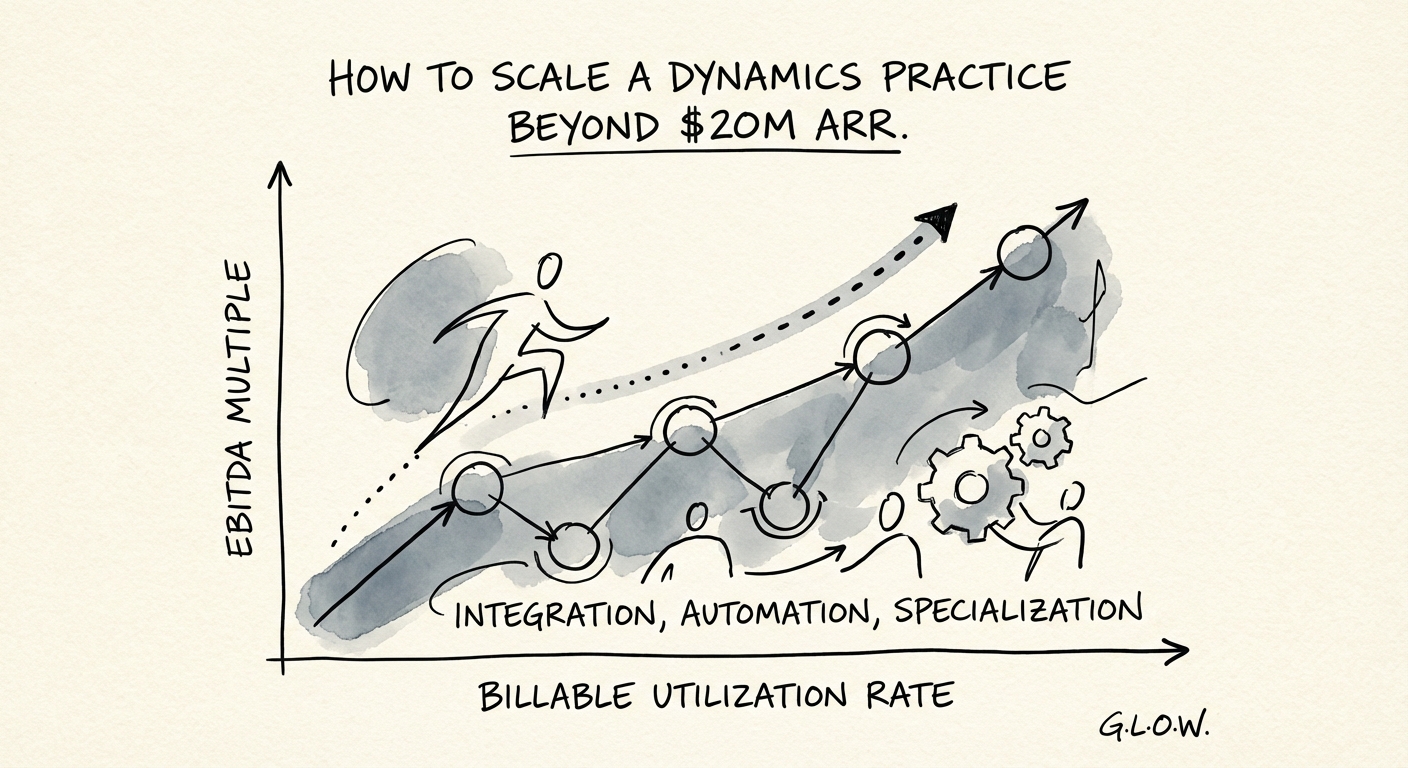
Private Equity buyers in 2026 do not pay premiums for time-and-materials services. They pay for IP and Annual Recurring Revenue (ARR). A pure-play services firm trades at ~6x EBITDA. A "platform" Dynamics partner with proprietary IP (e.g., a "Manufacturing Accelerator" or "FinTech Connector") and strong AMS (Application Management Services) contracts trades at 10x-12x.
Your job is to rebalance your revenue mix. Stop treating post-go-live support as an afterthought. Structure high-margin, multi-year Managed Services contracts that secure your valuation multiple. Microsoft's own 2025 data shows Dynamics 365 revenue growing at 23%—demand is not the issue. Capture value by specializing. Don't be a "Dynamics Partner"; be the "Dynamics Partner for Mid-Market Manufacturing in the Midwest."
Finally, prepare for your own exit from the org chart. Use our Founder Extraction Checklist to systematically remove yourself from critical path decisions. If the business can't grow without you, you can't sell it.