
The practical answer
- Short answer
- Atlassian Solution Partners stall at $5M-$10M because the founder owns every complex deployment. Engineer yourself out before diligence cuts 30% off your number.
- Best fit
- Industry: Technology Services. Function: Operations
- Operating path
- Founder Extraction → Operational Excellence → Interim Management
- Key metric
- 30% Valuation discount applied to firms with high 'Key Person Dependency' in due diligence.
The diligence call where your value gets cut in half
Picture the moment your Atlassian practice gets sold. A buyer's analyst is on a call with three of your senior consultants and asks one question: "Walk me through how you'd scope a 4,000-seat Cloud migration with a hard data-residency requirement." If all three answers end with some version of "we'd loop in the founder," you just watched your multiple drop. Not because your team is weak — because you've proven the company is a wrapper around one calendar.
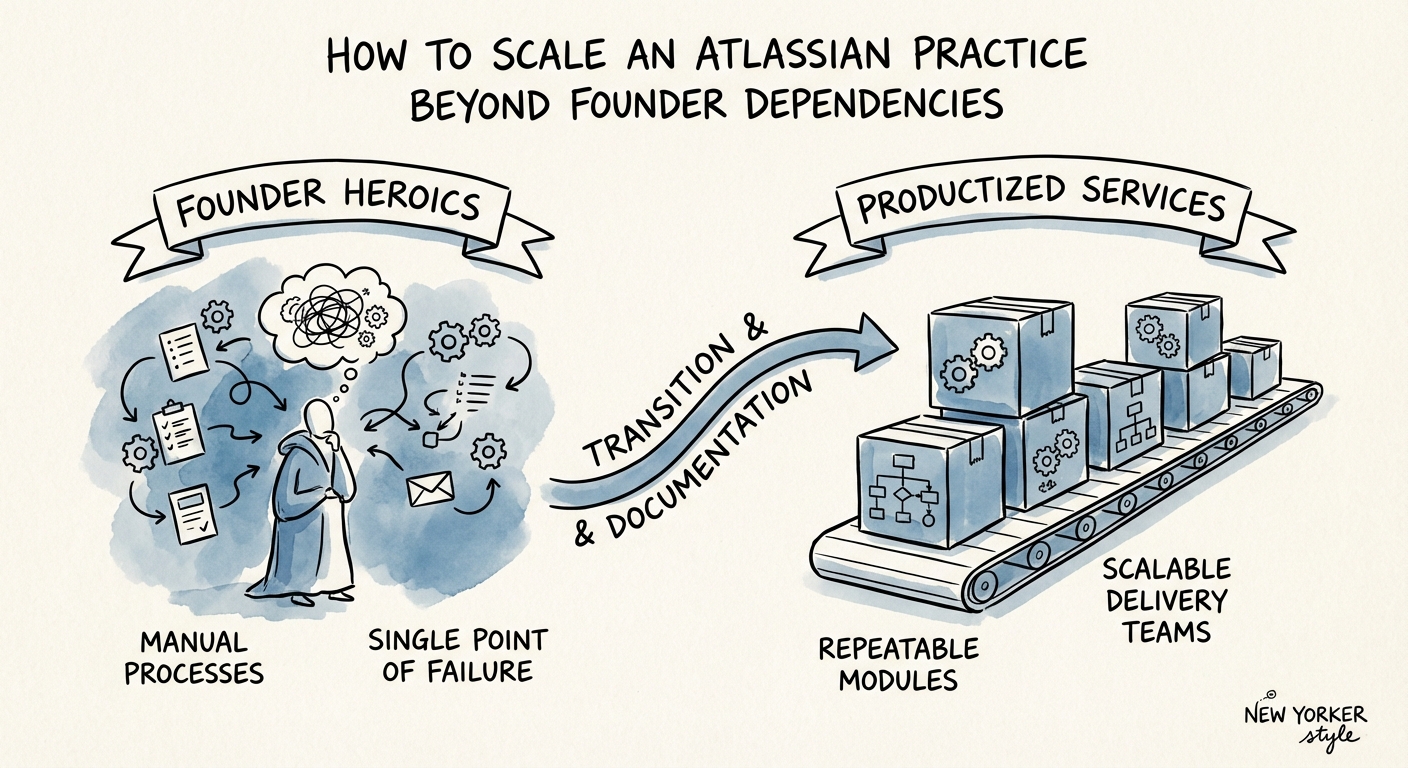
This is the trap baked into how Atlassian practices grow. You went from Silver to Platinum because you were the person who could look at a tangled Jira instance, see the workflow nobody else saw, and rescue the implementation that was three weeks from a churned logo. That instinct is real, and it's exactly why the business worked up to about $5M — high trust, high margin, no VP of Sales to pay, no chief architect to carry. The founder is the methodology.
Then the work changes shape. Cloud migrations with compliance constraints and Enterprise Service Management rollouts into HR, Legal, and Finance don't fit in one head anymore. You start hiring expensive senior people not to scale, but to clone your intuition — and your margin quietly bleeds out through senior salaries doing mid-level-priced work. Buyers have a name for what they see in that pattern: key person dependency. Firms carrying it trade at a 30% to 50% discount to peers that systematized. You're not selling a company at that point. You're selling a job with your name still on the door.
A buyer doesn't pay a premium for your judgment. They pay a premium for the day your judgment stops being load-bearing.
The resale subsidy is what's hiding your real problem
Here's the uncomfortable part most Atlassian partners won't say out loud: license resale margin has been covering for a delivery org that doesn't actually run well. For years, the renewal cash was steady enough that you could carry consultants at a utilization rate well under the services benchmark of 68.9% and never feel it on the P&L. The subsidy paid for the slack.
That cover is gone. As resale margins commoditized and the Cloud transition reshaped the economics, pure resale revenue now trades at less than 1x — a rounding error in a valuation — while high-IP managed services command 10x to 12x. The two revenue lines are no longer in the same business. If you want to clear the $10M wall, the services engine has to stand on its own unit economics, profitable without a dollar of license margin propping it up. That's the real test, and resale revenue had been letting you skip it.
The escape route runs straight through the work Atlassian itself is pushing hardest: Enterprise Service Management for teams that have never touched a Jira board — onboarding flows for HR, intake and approvals for Legal, request management for Finance. Atlassian sizes that non-technical-team opportunity at $14 billion, and it's a different sale entirely: you're not configuring a DevOps board, you're redesigning how a department runs requests. Partners who stay parked in IT and DevOps tuning end up bidding hourly rates against five other Platinum shops on the same RFP. The ones who pull ahead build something narrow and ownable — a Jira intake model for life-sciences quality events, a Confluence approval framework for legal matter management — that a buyer can resell long after you've left.
What the consolidators are actually buying — and what you do Monday
Watch what the roll-up platforms acquiring Atlassian partners — Contegix, Eficode, and the others assembling the ecosystem — actually pay up for. They are not buying generalist body shops; those they can build internally for the cost of recruiting. A generalist Platinum Partner clears maybe 6x EBITDA. A partner with Marketplace apps generating recurring revenue, or genuine vertical depth, gets 12x or better. The gap between those two numbers is the entire return on the work below.
Three moves, in order, starting this week:
- Take yourself out of one deployment type. Pick your most repeatable engagement — say, a standard ITSM Cloud migration — and write the scope, the build steps, and the QA checklist down to the point a senior consultant runs the next one end to end without you on a single call. One template beats a hundred good intentions.
- Productize the sale, not just the delivery. Convert your common engagements into fixed-shape packages with set price bands, so a hired sales lead can quote them without your gut-check on every SOW. If pricing still requires your judgment, you haven't extracted yourself — you've just moved the bottleneck upstream.
- Ship something to the Marketplace. A connector, a tested configuration, a plugin — anything that turns billable hours into ARR a buyer can underwrite. This is the line item that moves you from 6x to 12x, and it's the one nobody can do for you.
The IDC market notes on the partner ecosystem point to the same place: the firms winning in 2026 are co-selling with Atlassian's field team to drive Cloud maturity, and that demands an organization predictable enough to forecast without the founder in the loop. The blunt test of whether you've cleared the wall is this — sit through your next Quarterly Business Review and aim to be the least necessary person in the room. The day that's true is the day your practice is finally worth what you think it is.