
The practical answer
- Short answer
- A scaling playbook for Databricks partners hitting the $10M ceiling. Learn how to extract founders from delivery, build 'Delivery Lieutenants,' and unlock 12x valuation multiples.
- Best fit
- Industry: Data & AI Consulting. Function: Operations & Delivery
- Operating path
- Founder Extraction → Operational Excellence → Interim Management
- Key metric
- 12x EBITDA multiple for 'Scaled' Data & AI consultancies vs. 5x for Founder-Dependent firms.
The 'Hero Architect' Trap in a $62B Ecosystem
Databricks is growing at a velocity that few service partners can match. With the company reporting over $2.6 billion in revenue for FY2025 and projecting 50% growth through mid-2025, the demand for specialized implementation partners has never been higher. Yet, while the ecosystem expands—Databricks added nearly 230 new consulting partners in the last year alone—most boutique firms are hitting a hard wall at the $5M to $10M revenue mark.
The culprit isn't a lack of pipeline; it's the 'Hero Architect' model. In the early stages, your ability to personally architect complex Lakehouse migrations or Agentic AI deployments was your competitive advantage. You won deals because you were in the room. You delivered success because you reviewed the code. But as Databricks moves upmarket into the Fortune 500, that same reliance on your technical genius becomes your firm's biggest liability.
Private Equity buyers refer to this as 'Key Person Risk,' and in 2026, it is the single largest destroy of deal value. Data from the 2025 M&A market shows a bifurcation in valuations: 'Scaled' data consultancies with transferable IP and management layers are trading at 12x-15x EBITDA, while founder-dependent shops are seeing offers capped at 5x-6x, often heavily contingent on multi-year earnouts. If you cannot leave for a month without the delivery engine stalling, you haven't built a business; you've built a high-paying job with overhead.
Private equity firms do not buy businesses the way founders sell them. Buyers focus first on earnings quality... Businesses that rely heavily on the owner for sales, operations, or key relationships are perceived as higher risk.
Diagnostic: Are You Scaling or Just Swelling?
Scaling a Databricks practice requires more than just adding headcount; it requires a fundamental shift in unit economics and delivery structure. The recent surge in partners with 100-500 employees (up 46% YoY) suggests a 'graduation' of firms that have solved this puzzle. To determine if you are ready to join them, audit your firm against these three critical benchmarks.
1. The 'Key Person Dependency' of Revenue
Calculate the percentage of your revenue that is directly tied to the Founder's personal involvement in the sales cycle or delivery oversight. If >30% of your ARR depends on you being the primary architect or closer, you are uninvestable as a platform asset. Scaled firms operate with a 'pod' structure where a Delivery Lieutenant (not the founder) owns the client outcome.
2. The 'Elite' Certification Trap
Databricks 'Elite' status requires 200+ certifications. Many founders chase this by hiring junior staff and cramming them through exams. This creates a 'Paper Tiger' workforce—certified on paper but incapable of delivering without your intervention. The metric that matters is not 'Total Certifications,' but 'Ratio of Lead Architects to Juniors.' A healthy ratio for scaling is 1:5. If you are the only Lead Architect, your ratio is effectively 1:Infinite, and your quality will collapse as you scale.
3. Utilization vs. Innovation
Are you running at 85% utilization? Stop. While high utilization looks good on a P&L, in a rapid-growth ecosystem like Databricks, it's a material risk for scaling. You need 15-20% slack capacity dedicated to harvesting IP (like 'Brickbuilder' solutions) and training the next layer of architects. Without this slack, you cannot extract the founder's knowledge into repeatable assets.
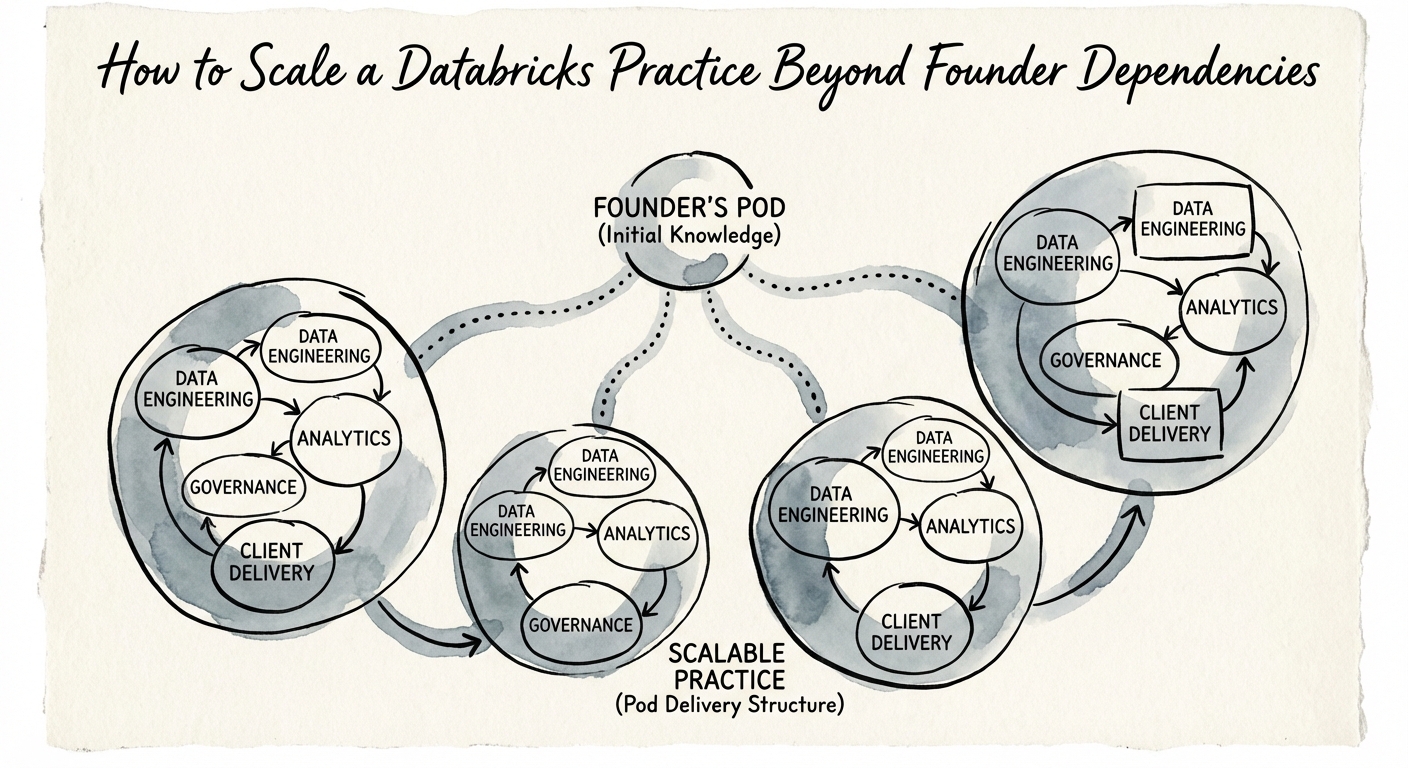
The Playbook: From Founder-Led to Platform-Led
To break the $10M ceiling and unlock a premium exit multiple, you must execute a disciplined 'Founder Extraction' strategy. This is not about retiring; it's about elevating your role from 'Chief Architect' to 'Chief Executive.'
Step 1: Hire or Promote 'Delivery Lieutenants'
You cannot scale if you are the only person trusted to put out fires. You need Delivery Lieutenants—senior architects who can own the technical relationship with clients. This is an expensive hire ($200k+), but the ROI is immediate. One Lieutenant can oversee $3M-$5M in revenue, freeing you to focus on strategy and key partnerships.
Step 2: Productize Your 'Secret Sauce'
Stop treating every Lakehouse migration as a bespoke art project. Document your methodology into standard operating procedures (SOPs) and accelerators. If you have a specific way of handling Unity Catalog migrations, turn it into a reusable toolkit. This shifts value from your brain to the firm's IP, a critical driver for the Data Analytics Premium in valuations.
Step 3: Separate Sales from Delivery
The final step in Founder Extraction is decoupling your identity from the sale. Buyers need to see that the brand wins deals, not the founder's handshake. Implement a formal sales process where a dedicated sales leader closes deals based on the firm's track record and IP, not your personal promise of 'I'll make sure it gets done.'
The market for Databricks services is bifurcating. On one side are the 'Body Shops'—low-margin, commoditized, and founder-dependent. On the other are the 'Strategic Partners'—high-margin, IP-driven, and scalable. The choice you make in the next 12 months will determine which side of the 50% valuation gap you fall on.