The practical answer
- Short answer
- Why Zendesk partners stall at $5M, the 'Hero Architect' trap, and how to pivot to 'Agentic AI' services to command a 12x exit multiple.
- Best fit
- Industry: Customer Experience (CX) Technology. Function: Operations & Delivery
- Operating path
- Founder Extraction → Operational Excellence → Interim Management
- Key metric
- 50% Valuation discount applied to firms where the founder manages key client relationships.
The $5M Ceiling and the 'Hero Architect' Trap
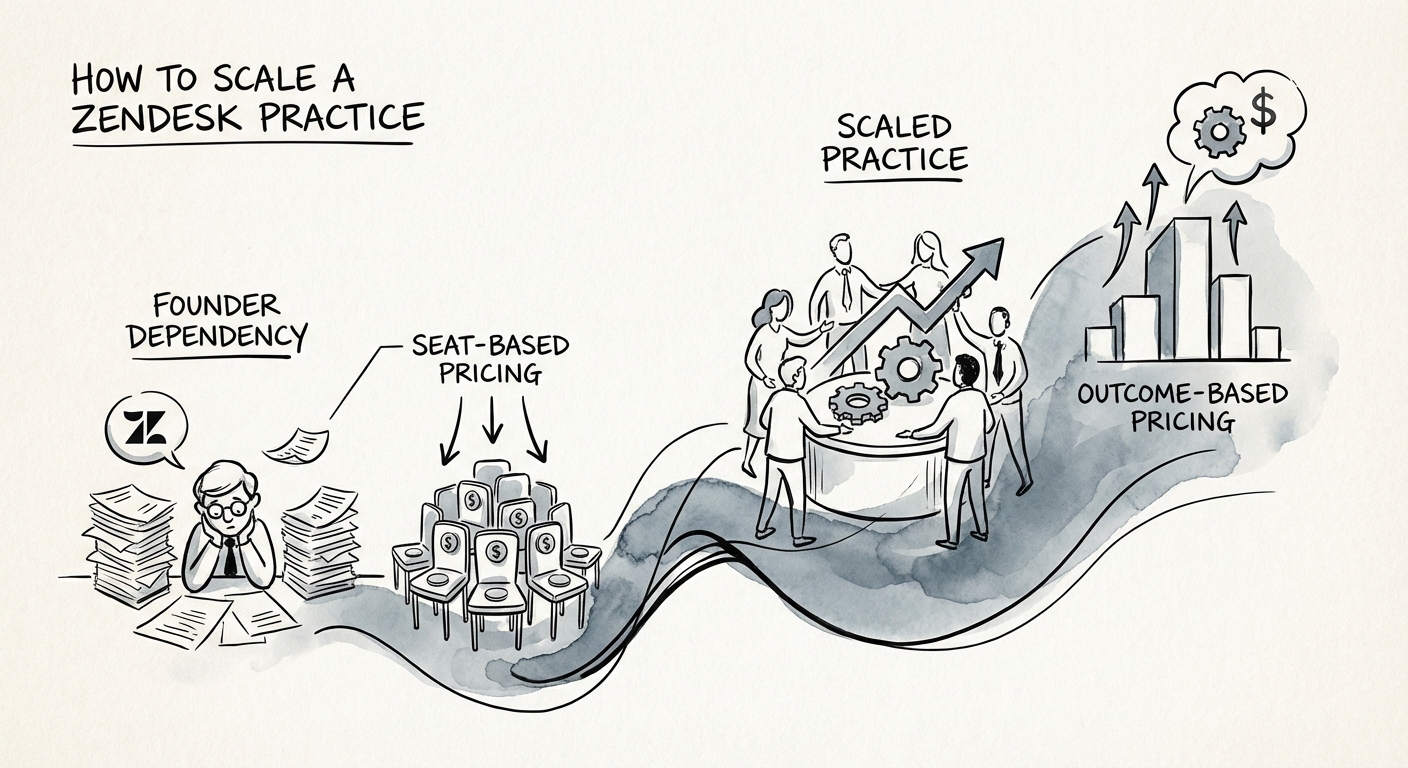
In the Zendesk partner ecosystem, there is a specific revenue band—typically between $3M and $5M—where growth violently stalls. Until this point, the founder’s sheer force of will (and ability to architect complex triggers, macros, and Sunshine integrations in their head) drives the business. We call this the "Hero Architect" phase. The founder is the primary sales engineer, the lead solution architect, and the escalation point for every critical project.
This model works beautifully for high-margin boutique work, but it is high-risk to enterprise value. Private equity buyers do not buy "genius founders"; they buy transferable cash flow. When 80% of your revenue relies on the founder being in the room to close the deal or design the solution, you have created a single point of failure that no acquirer will tolerate.
The Valuation Penalty
According to 2025 valuation data, professional services firms with significant "key person dependency" trade at a 30-50% discount compared to their systematized peers. For a Zendesk partner generating $2M in EBITDA, that dependency isn't just an operational headache—it is a $5M to $8M loss in exit value. The shift in Zendesk’s own strategy—moving from simple support ticketing to "Agentic AI" and outcome-based pricing—exacerbates this issue. The complexity of deploying autonomous AI agents cannot rest on one person's intuition; it requires a standardized engineering discipline.
Private equity buyers do not buy 'genius founders'; they buy transferable cash flow. If your revenue relies on you being in the room, you haven't built a business—you've built a high-paid job that you can't quit.
Pivoting from 'Implementation' to 'Resolution Architecture'
To break the $5M ceiling, you must fundamentally change what you sell. The traditional model of "selling hours" to configure Zendesk Support is dying, commoditized by Zendesk’s own improved out-of-the-box AI features. The new value—and the path to scaling—lies in "Resolution Architecture."
Zendesk’s 2025 shift to outcome-based pricing for AI agents means customers now pay for results (successful automated resolutions) rather than just seat licenses. This creates a massive opportunity for partners to pivot from low-margin "setup" work to high-margin "optimization" retainers. However, you cannot scale this if the Founder is the only one who understands the nuances of CX strategy.
Productizing Your IP
To extract yourself, you must turn your "Hero Architect" intuition into documented IP. Instead of custom-scoping every engagement, develop pre-packaged "Agentic Workflows" for specific verticals. For example:
- The FinTech Triage Pack: A standardized set of intents and answer flows for dispute resolution and KYC checks.
- The Retail Returns Engine: A pre-configured integration between Zendesk AI and Shopify/NetSuite to handle returns without human intervention.
By packaging these solutions, you allow non-founder consultants to deliver "Founder-level" outcomes. This not only improves margins (as you can deploy junior resources on high-value IP) but also creates the "transferable value" that PE buyers crave.
The Exit Strategy: Commanding the 'AI Premium'
The difference between a 6x EBITDA multiple and a 12x multiple in the current market is the difference between a "Services Shop" and a "Platform Enabler." Buyers are aggressively hunting for partners who can navigate the "Agentic AI" shift, but they need proof that the engine runs without you.
To prepare for a premium exit, your metrics need to tell a story of independence:
- Revenue per Consultant: Should exceed $250k, driven by IP/assets rather than just billable hours.
- Project vs. Recurring Mix: Shift from 80% one-off implementation to at least 40% "Managed AI Optimization" recurring revenue.
- Sales Velocity: Track the % of deals closed without the founder on the demo. If this is under 50%, you are not ready to sell.
The goal is to transition your role from "Lead Architect" to "Product Owner" of your practice methodology. When you sell the methodology rather than the man-hours, you remove the founder bottleneck and unlock the true enterprise value of your firm.