
The practical answer
- Short answer
- Why Snowflake partners stall at $10M ARR. A diagnostic playbook for extracting founder 'heroics' and building a consumption-first operating model.
- Best fit
- Industry: Data & Analytics Services. Function: Operations & Strategy
- Operating path
- Founder Extraction → Operational Excellence → Interim Management
- Key metric
- 9.8% Average EBITDA margin for professional services firms in 2025, the lowest in 5 years (SPI Research), driving the need for IP-led differentiation.
The 'Hero Architect' Trap: Why You Stall at $10M
The Snowflake partner ecosystem is bifurcating. On one side, 'Elite' partners are capitalizing on the AI Data Cloud boom, actively packaging solutions as Native Apps and driving massive consumption revenue. On the other, boutique shops are stalling at $5M to $10M in revenue, trapped in a cycle of high-effort, low-leverage delivery.
The culprit is almost never technical incompetence. It is Founder Dependency. In the early days, the founder's ability to walk into a room, sketch a complex data mesh architecture on a whiteboard, and close the deal is a superpower. But as valuation benchmarks show, this 'Hero Architect' model becomes a liability the moment you attempt to scale past 50 headcount.
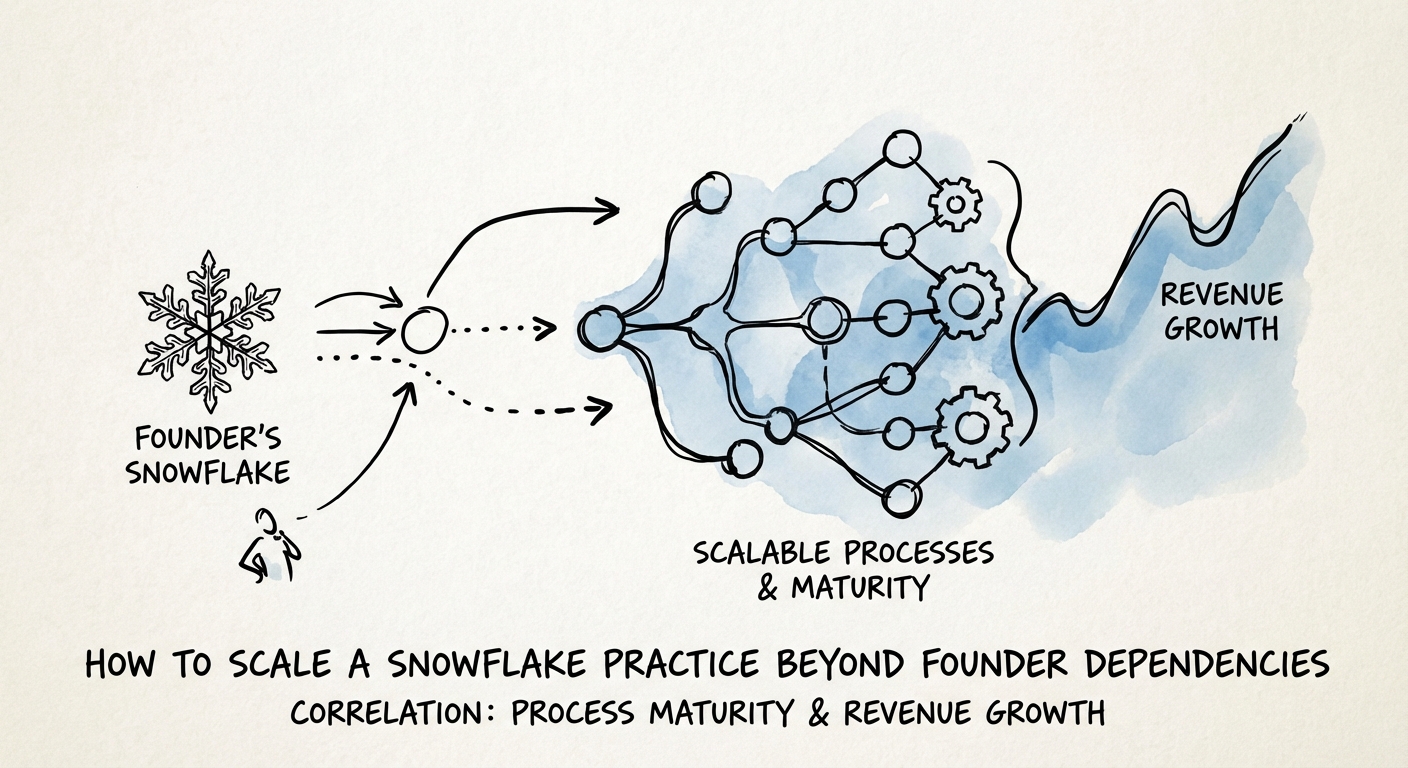
According to the 2025 SPI Professional Services Maturity Benchmark, firms that rely on ad-hoc, hero-driven delivery (Level 1 Maturity) see significantly lower margins than their process-driven peers. While the industry average for revenue growth slowed to 4.6% in 2025, firms with mature, documented delivery processes (Level 5) outperformed their peers by 433% in revenue growth. The message to PE buyers is clear: if the founder is the only one who can sell the vision or architect the solution, the business is not an asset—it's a job.
If the founder is the only one who can architect the solution, you haven't built a business; you've built a high-paid job that no acquirer wants to buy.
The Consumption-First Operating Model
Scaling a Snowflake practice requires a fundamental shift in your operating model: moving from 'selling hours' to 'selling consumption.' Traditional systems integrators optimize for utilization—keeping consultants busy. But Snowflake's 2025 incentives, specifically the Service Registration Incentive (SRI), reward partners who drive actual platform consumption, not just successful 'go-lives.'
This creates a conflict for founder-led firms. The founder is often the only one incentivized to think about the client's long-term data strategy, while the delivery team is incentivized to close tickets. To break this cycle, you must implement a Consumption-First Operating Model:
- Pre-Sales is Not Just for Founders: You must document your 'Magic' into a Solution Architecture Playbook. If your Solution Architects (SAs) cannot scope a migration without you, you have no enterprise value.
- The 'consumption Cliff': Many projects fail to generate revenue after deployment because the data isn't usable. You need a post-deployment customer success motion that is compensated on credit consumption, not just renewal.
- Pricing for Value, Not Time: Shift from Time & Materials (T&M) to fixed-price outcomes or managed services. This forces your team to be efficient (margin accretive) rather than busy (revenue flat).
From Service Shop to Data Product Factory
The highest valuation multiples in the 2026 market are reserved for partners who have successfully pivoted from pure services to IP-led revenue. With the rise of Snowflake Native Apps and the Marketplace, the 'Generalist' service shop is becoming a commodity.
Founders often resist this transition because it requires capital investment without immediate billable return. However, the data is undeniable. 'Model Builders' and 'Data Intelligence' firms command valuation multiples nearly double that of generalist IT consultancies. To escape the founder dependency trap, you must productize your repeated service motions. If you have built the same 'Marketing Analytics Warehouse' five times, it should be a packaged accelerator, not a custom project.
Strategic Imperative: Stop treating every client as a blank canvas. The path to 'Elite' status—and a 12x exit—lies in standardization. Your goal is to build a machine that delivers excellence without your constant intervention.