
The practical answer
- Short answer
- Why Adobe partners stall at $10M revenue. A diagnostic guide to founder extraction, valuation benchmarks, and the 2026 Unified Partner Program changes.
- Best fit
- Industry: Digital Transformation / Marketing Technology. Function: Executive Leadership
- Operating path
- Founder Extraction → Operational Excellence → Interim Management
- Key metric
- $10M The revenue ceiling where founder-led Adobe practices typically stall without process extraction.
The 'Hero Architect' Trap: Why Adobe Practices Stall at $10M
In the Adobe ecosystem, the journey from $1 million to $5 million is often fueled by sheer technical competence. A founder with deep expertise in Adobe Experience Manager (AEM) or Adobe Commerce (Magento) delivers exceptional work, hires a few smart developers, and wins contracts based on reputation. This is the "Hero Architect" phase. But as the firm approaches the $10 million revenue mark, this strength becomes a suffocating constraint.
The complexity of the Adobe stack—particularly the shift toward Composable Marketing Stacks and the integration of Firefly GenAI into content supply chains—creates a dangerous dependency. If you, the founder, are the only one who understands the full architecture of your largest client's AEM implementation, you are not a CEO; you are a constraint. In our analysis of mid-market digital agencies, we find that firms where the founder leads technical delivery hit a hard ceiling at $8M–$12M in revenue.
This ceiling is reinforced by the changing landscape of the Adobe Partner Program. With the launch of the Adobe Digital Experience Partner Program in March 2026, the ecosystem is shifting away from fragmented "Solution" and "Technology" silos into a unified model that rewards scale and specialization. Partners who cannot decouple revenue generation from founder involvement will struggle to meet the new "Total Qualifying Revenue" thresholds required for Gold and Platinum status, effectively locking them out of enterprise deal flow.
In the early years, founder dependency isn't a flaw—it's survival. But in an M&A context, what once fueled growth becomes a risk buyers price at a 30% discount.
The Valuation Penalty: Agency vs. Strategic Partner
The difference between a founder-dependent "agency" and a scalable "consultancy" isn't just operational; it is financial. In the current M&A market, digital agencies trading on "revenue" (often project-based and founder-led) command multiples of 3x–5x EBITDA. In contrast, specialized Adobe partners with documented IP, transferable client relationships, and recurring managed services trade at 8x–12x EBITDA.
This gap represents a 30% to 50% valuation haircut for founder-dependent firms. Buyers—whether private equity firms or larger strategic acquirers—conduct rigorous diligence on "Key Person Risk." If your top three accounts would churn if you left the building, those revenues are discounted to zero in the enterprise value calculation.
The "Project Trap" in Adobe Services
Many Adobe partners inadvertently deepen this dependency by focusing on "Big Bang" implementations. While a $2M AEM migration looks great on the P&L, it is often non-recurring "bad revenue" from a valuation perspective. The highest-value firms pivot to Managed Services and Customer Success models. With utilization rates of marketing clouds often dropping below 40% post-implementation, the real value—and the exit multiple—lies in the "stay and grow" motion, not the "land and leave" project. If the founder is the only one who can sell the "vision" of the project, you are trapped. If a Customer Success team can drive adoption and renewals, you are building an asset.
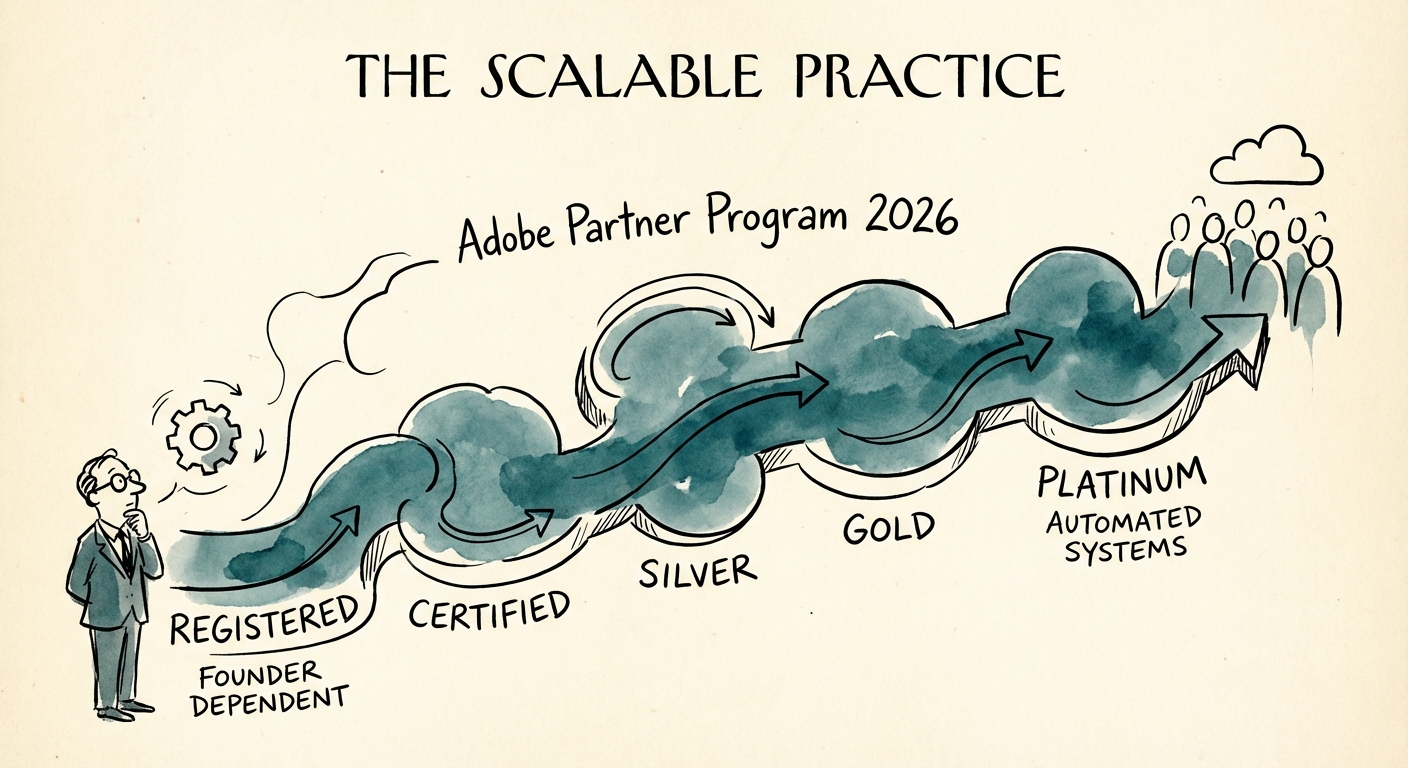
The Scaling Playbook: 3 Steps to Extraction
To break the $10M ceiling and remove the valuation haircut, Adobe partners must execute a deliberate "Founder Extraction" strategy. This is not about abdicating leadership, but about productizing your expertise.
1. Specialization Over Generalization
The new Adobe program explicitly rewards specialization. Generalist "Adobe Shops" are a commodity. To scale, pivot to a vertical (e.g., "AEM for Healthcare Compliance") or a technical niche (e.g., "GenAI Content Supply Chain Automation"). Specialization allows you to document processes that mere mortals can execute, removing the need for the founder's "magic."
2. The "Solution Sales" Layer
Stop hiring "rolodex" salespeople who expect you to close the deal. Hire Solution Architects who can partner with mid-level sales reps. Your goal is to move the technical presales validation out of your brain and into a team that can run a demo, scope a Statement of Work (SOW), and defend the pricing without you in the room.
3. The Certification Strategy
Don't just collect badges. Under the 2026 Unified Program, your team's certifications must align with your chosen specialization. Map your "Hero" knowledge to specific Adobe certification tracks and incentivize your delivery leads to achieve them. If you hold the only "Architect" certification in the company, you are failing the scalability test.