
The practical answer
- Short answer
- A technical founder's instinct to debug everything caps growth around $14M ARR. Here's the diagnostic, the Rich vs. King tradeoff, and a 3-phase extraction plan.
- Best fit
- Industry: B2B Tech. Function: Executive Leadership
- Operating path
- Founder Extraction → Operational Excellence → Interim Management
- Key metric
- 50% Potential Valuation Discount for Founder-Dependent Firms
The night the deploy broke and only one person could fix it
Picture a 110-person B2B software company doing roughly $14M ARR. It's 11:40 PM. A release is wedged, a Tier-1 customer's instance is throwing 500s, and three engineers are in a thread waiting. Then the founder pushes the fix from a laptop on the kitchen counter. Crisis over. Everyone exhales. And that, precisely, is the problem.
The instinct that built the company is now the thing capping its value. A technical founder is trained on a clean loop: see a fault, reproduce it, patch it, ship. That loop is undefeated against code. It is catastrophic against an organization. So you "debug" the sales team by jumping on the demo yourself. You "refactor" marketing by rewriting the landing copy at midnight. You keep the deploy keys, the architecture decisions, and the gnarly customer relationships routed through you, because the system still feels fragile and you are the most reliable node in it.
Somewhere between $10M and $20M ARR, that reliability inverts. The company stops being limited by what it can build and starts being limited by what it can build without you. An acquirer's diligence team will find this fast. Analysis from Strategic Exit Advisors and exit-readiness practitioners shows that businesses with extreme founder dependency trade at materially lower multiples than systematized peers. The discount isn't punitive sentiment. It's a risk price: when the product roadmap, the hardest customer trust, and final decision authority all live in one skull, the buyer is purchasing a person who can quit, burn out, or get hit by a bus.
You're probably telling yourself nobody can do it as well as you. On the technical merits, you may be right. But diligence doesn't ask whether you're brilliant. It asks what breaks the week after you stop answering Slack. As long as you're the one stepping in to save the quarter, the honest answer is: a lot.
Diligence doesn't ask whether you're brilliant. It asks what breaks the week after you stop answering Slack.
Rich vs. King — and why control is line-itemed in your valuation
The move from technical founder to enterprise CEO is not a skills upgrade. It's an identity swap: from product-centric to distribution-centric, from output you produce to outcomes a system produces. Most technical founders resist it because "management" reads as overhead — meetings that steal hours from the real work, which is obviously the code. At $14M ARR, that framing is the trap. The real work is now the commercial machine that sells and renews the code at scale. The code is table stakes.
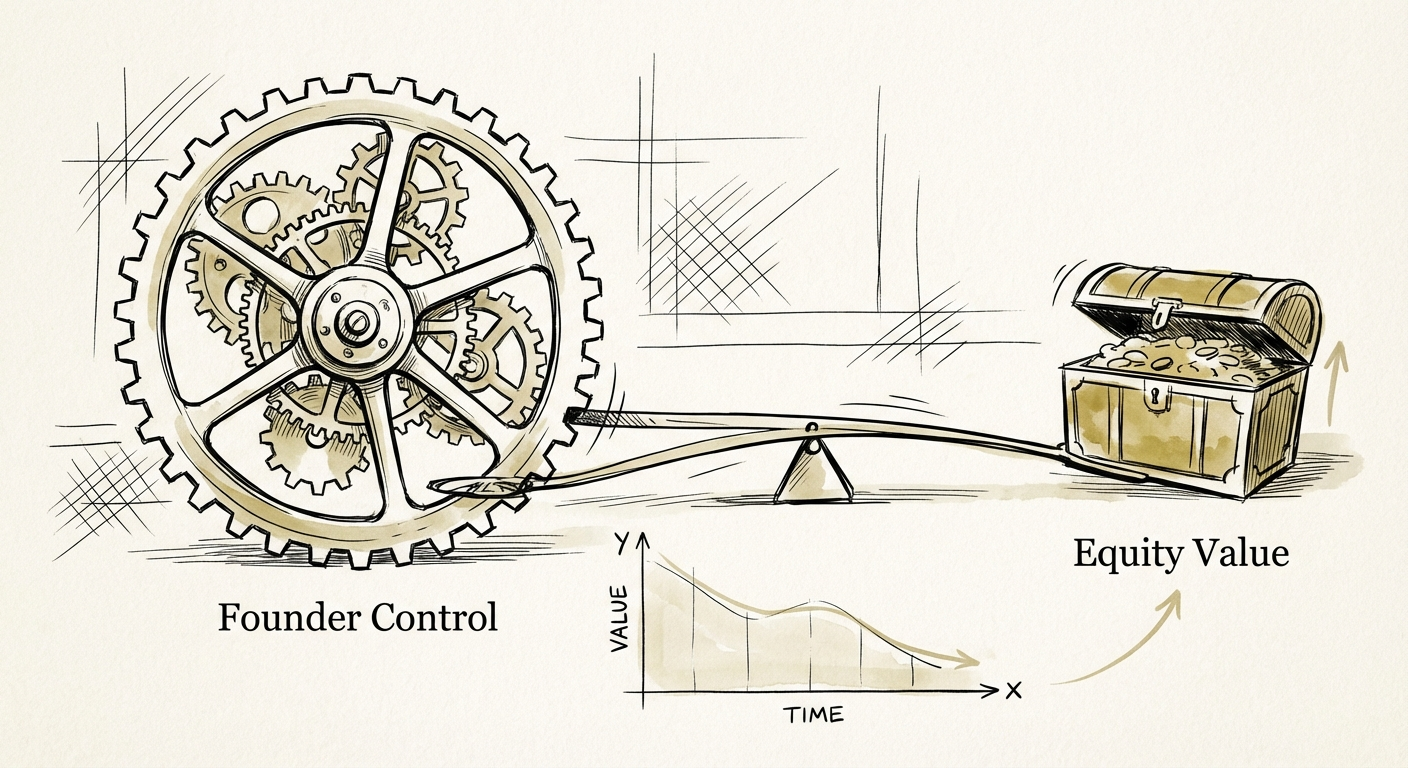
Harvard Business School's Noam Wasserman put numbers to the cost. After studying 212 startups and nearly 3,000 founders in The Founder's Dilemma, he found a tradeoff founders almost never price correctly: Rich vs. King.
- King: You keep total control, stay CEO, and remain the final node on every decision. The company's ceiling becomes your personal bandwidth — and a 110-person org outgrows one person's working memory long before the cap table stops mattering.
- Rich: You trade some control — hiring real operators, or engineering yourself off the critical path — for a smaller slice of a much larger, more valuable, more sellable company.
Wasserman's data is blunt about which choice pays: founders who optimized for control consistently ended up with less valuable equity than those who let go. This is not an argument that you should quit being CEO. It's an argument that control is not free, and that you should choose to pay for it on purpose rather than discover the bill in a term sheet.
The replacement cliff is a calendar, not a coup
If you don't make the call, your board eventually will. Wasserman's succession data shows a large share of founding CEOs are replaced by the later venture stages — not because they failed, but because the skills that win product-market fit (intuition, speed, raw technical depth) are not the skills that scale a company (governance, delegation, boring repetition). If you're still running in Founder Mode with 150 people on the org chart, growth doesn't crash dramatically. It just quietly drags, quarter after quarter, until someone with a spreadsheet decides to act.
Engineering your own removability: a 3-phase extraction
If you want to keep the chair, you have to stop being the only builder in the building. Treat your own dependency the way you'd treat a single point of failure in production: identify it, document it, and route around it. Three phases, in order.
Phase 1: Get out of the demo
Technical founders cling to sales because they're the only ones who "truly get" the product. The result is a delegation paradox where revenue is hard-capped by your calendar. Run the test: pull your last ten closed deals and count how many you personally demoed or saved. If it's most of them, you don't have a sales process — you have a performance that only one actor can give. Document the technical objections you actually field, script the answers, and hire a VP of Sales who builds a repeatable motion rather than one who just rides your relationships. You'll know it worked when a rep closes a technical buyer without pinging you.
Phase 2: Get out of delivery
Still merging the night before a release? Still hopping on escalation calls because you can read the stack trace fastest? Every rescue you perform robs your team of the failure they needed to own and fix. Stand up real SOPs and on-call rotations, and then — this is the hard part — let a small incident happen without you. Your job is to build the feedback loop, not to be the feedback loop. Remove your name from the deploy permissions and watch what the team builds to compensate. That scaffolding is the asset a buyer is actually paying for.
Phase 3: The honest audit
Now the question most founders skip: do you even want the job? A later-stage CEO's week is recruiting, board management, capital, and saying the same vision out loud until it's operationally numb. It is mostly not building. Plenty of technical founders are happier — and worth more to the company — stepping into CTO or Chief Product Officer and handing the CEO seat to an operator. Staying world-class in a role you love beats white-knuckling a role that needs a different cadence than yours.
Pick your Monday move: count the deals you personally saved, or pull your name off the deploy keys for one release. Either one starts converting "the founder is the company" into "the company runs the founder's playbook." You already built the product. The work now is building the thing that outlives your involvement — because that's the only version a buyer will pay a premium for.