The practical answer
- Short answer
- Learn how to scale your Azure practice beyond $10M revenue by eliminating founder dependencies. A diagnostic guide for MSP CEOs on process, packaging, and valuation.
- Best fit
- Industry: Cloud Services / MSP. Function: Operations & Strategy
- Operating path
- Founder Extraction → Operational Excellence → Interim Management
- Key metric
- 31% Azure revenue growth in FY25 Q2, driven largely by AI services.
The $10M Ceiling: Why 'Founder-Led Architecture' Stops Working
If you are reading this, you are likely the smartest Azure architect in your company. You built the first 50 landing zones yourself. You know the difference between a vNet peering issue and a NSG misconfiguration by looking at a single log line. And that is precisely why your growth has flatlined.
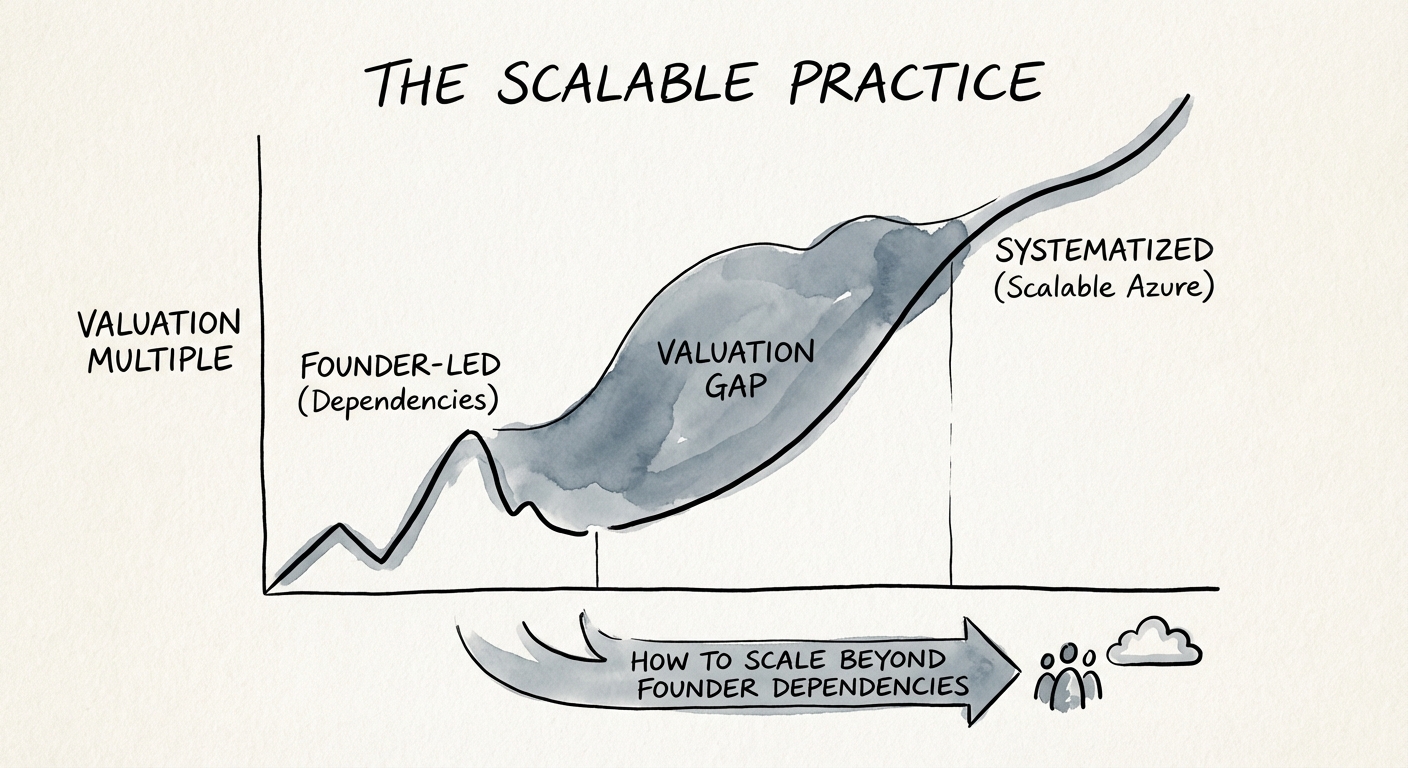
I call this the "Founder-Led Architecture" trap. Up to $5M in revenue, your personal technical brilliance is a competitive advantage. You win deals because clients trust you. But between $5M and $10M, that advantage becomes a chokehold. I see this diagnostic pattern constantly in Series B service firms: the CEO is still the final reviewer on major deployments. This creates a hard revenue ceiling because you simply run out of hours in the day.
The market data is punishing for this behavior. In 2025, Azure practices with significant key-person risk traded at 4x to 6x EBITDA, while fully systematized practices commanded 11x to 14x. Why? Because private equity buyers aren't buying your brain; they are buying a money-printing machine. If that machine stops when you go on vacation, it's not a business—it's a high-paid job. With Azure revenue growing at 31% (FY25 Q2), the complexity of the ecosystem (AI, Data, Security) has surpassed the ability of any single human to master. If you are still the "Chief Problem Solver," you are the bottleneck.
Private equity buyers aren't buying your brain; they are buying a money-printing machine. If that machine stops when you go on vacation, it's not a business—it's a high-paid job.
The Fix: Replace Your Brain with the Cloud Adoption Framework (CAF)
The hardest pivot for a technical founder is realizing that good enough standardization scales better than perfect customization. To scale beyond founder dependencies, you must stop treating every client as a unique snowflake and start treating them as a deployment target for standard IP.
Your tool for this is already provided by Microsoft: the Cloud Adoption Framework (CAF). But you need to use it differently. Most partners treat CAF as a consulting deliverable. You need to treat it as your internal operating system. Here is the operational shift:
- Stop: allowing engineers to build custom landing zones based on their personal preferences.
- Start: Mandating "CAF-compliant" infrastructure-as-code (IaC) libraries. If it isn't in the library, we don't sell it.
When you standardize your delivery on CAF, you lower the skill floor required to deliver excellence. You can hire mid-level engineers who follow the playbook rather than expensive senior architects who need to "invent" solutions. This is how you break the founder dependency cycle. By embedding your knowledge into code templates and SOPs, you effectively clone yourself. This isn't just about efficiency; it's about transferability. A PE firm can buy a library of Terraform scripts and a team that knows how to run them. They cannot buy your intuition.
Commercial Packaging: Selling Products, Not 'Hours of You'
The final step in extracting yourself is fixing the sales motion. If your sales team brings you into every deal to "explain the technical vision," you haven't built a sales team—you've hired appointment setters. This happens because you are selling "Azure Expertise" (which is abstract and requires an expert to sell) rather than "Azure Products."
You must productize your services. Instead of "Cloud Migration Services," sell a "90-Day Azure Landing Zone Accelerator." Define the scope, the price, the deliverables, and the outcome rigidly. This allows non-technical sales reps to sell complex solutions because the boundaries are fixed. It also prevents scope creep, which is the silent killer of services margins.
Data from 2025 shows that specialized, productized Azure shops (focusing on AI or Security) sustain gross margins of 50-60%, whereas generalist "time and materials" shops struggle to break 35%. Valuation multiples follow margins. When you package your IP, you detach revenue generation from your personal time. That is the moment you transition from a Founder to a CEO, and it is the only way to unlock a double-digit exit multiple.