
The practical answer
- Short answer
- Founder-led sales won't scale your GCP practice past $10M. Here is the operator's guide to extracting yourself from delivery and tripling your exit multiple.
- Best fit
- Industry: Cloud Consulting / IT Services. Function: Operations / Founder Transition
- Operating path
- Founder Extraction → Operational Excellence → Interim Management
- Key metric
- 30% Valuation Haircut applied to firms with high Key Person Risk.
The "Hero Architect" Trap: Why You Hit the $10M Wall
You built this practice on your ability to out-engineer anyone in the room. In the early days, that was your superpower. You could walk into a meeting, whiteboard a Kubernetes architecture that solved a massive latency issue, and walk out with a signed SOW. That is how you got to $5M. It is likely how you scraped your way to $8M.
But at $10M, that superpower becomes your prison. In the Private Equity world, we call this Key Person Risk, and it is the single most common reason for a re-trade during due diligence. If the revenue stops when you go on vacation, you do not own a business; you own a high-stress job with overhead.
The math is brutal. An audit-ready, transferable GCP practice trading on EBITDA might command a 10x-12x multiple. A founder-dependent shop "selling the founder's brain" trades at 4x—if it sells at all. Buyers deduct a standard 30% "Key Person Discount" from your valuation because they know they have to spend millions to replace you (and likely fail). You are currently valuing your firm based on your revenue; the market is valuing it based on your transferability.
The "Capacity vs. Capability" Problem
Google's own partner program has shifted to recognize this. The new competency frameworks distinguish between capability (can you do it?) and capacity (can you do it at scale?). You have high capability but low capacity because your "capacity" is limited to the number of hours you can stay awake. Until you extract the architectural decision-making from your own head and put it into a playbook, your growth is capped by your own burnout.
If the revenue stops when you go on vacation, you do not own a business; you own a high-stress job with overhead.
The Pivot: From "We Do GCP" to "We Solve Data Problems"
The generalist "Lift & Shift" market is dead. It is a race to the bottom on margin, and the Global Systems Integrators (GSIs) have already won that war with armies of offshore resources. If your pitch is "we help you move to the cloud," you are a commodity.
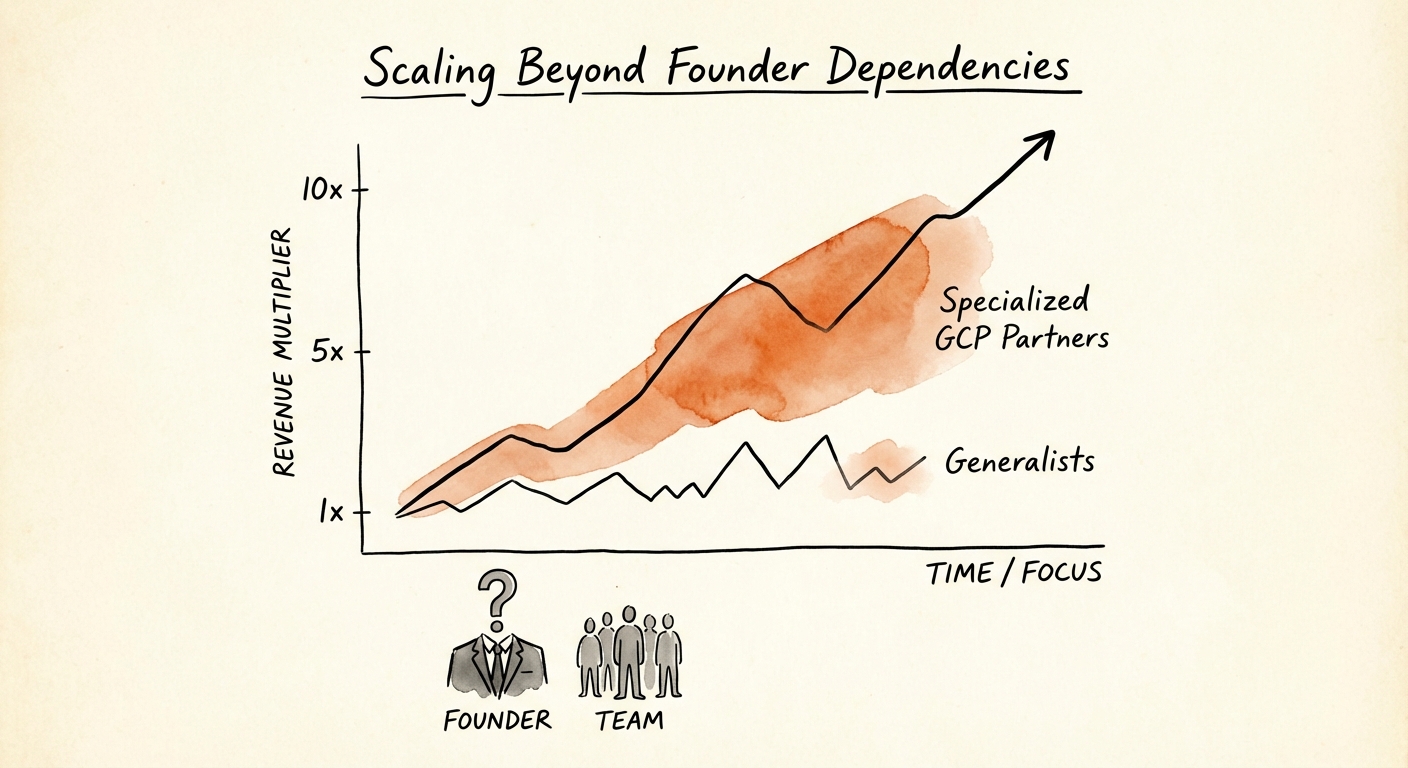
The data confirms this. According to recent ecosystem studies, partners focused on specialized IP (Intellectual Property)—specifically in Data, AI, and Analytics—generate $7.54 for every $1 of Google Cloud consumption sold. Generalist resellers? They are fighting for scraps. To scale beyond founder dependencies, you must stop selling "hours of smart engineering" and start selling "outcomes."
Productizing the Service
You cannot delegate "genius." You cannot hire a junior engineer and tell them to "be smart like me." But you can package your genius into a product. Instead of selling a custom 6-month data project, sell a "Retail BigQuery Accelerator" that deploys in 6 weeks with a fixed scope.
- Standardize the Input: Define exactly what the client must provide before you start.
- Script the Process: Automate the Terraform scripts for the environment setup.
- Template the Output: Have pre-built Looker dashboards ready to go.
When you sell a "productized service," you lower the skill floor required to deliver it. Suddenly, your mid-level engineers can deliver "founder-level" quality because the guardrails are built into the product. This allows you to step out of delivery and into strategy.
The Extraction Roadmap: 3 Steps to Remove Yourself
Scaling requires a systematic extraction of the founder from three critical loops: Sales Engineering, Delivery, and Firefighting. Here is the operator's playbook for the next 12 months.
1. The "Black Box" Audit (Months 1-3)
Your first step is to document the "magic." For the next 90 days, record every sales call and technical review you lead. Transcribe them. What questions do you ask? What patterns do you spot? You are building the Founder Extraction Checklist. You need to turn your intuition into a decision tree that a solution architect can follow.
2. Hire the "Second Engine" (Months 4-6)
You need a VP of Engineering or a Practice Lead who is not you. Do not promote your best individual contributor; they will likely fail as a manager. Hire someone who has seen "good" at a larger firm. Their job is not to be a better coder than you; their job is to enforce the process you built. Read our guide on Replacing Irreplaceable Leadership to avoid the $240k mis-hire.
3. The "No-Fly" Zone (Months 7-12)
Draw a line in the sand. Pick a revenue tier (e.g., deals under $50k) or a technical domain (e.g., basic infrastructure migration) and declare it a "Founder No-Fly Zone." You are literally forbidden from working on these projects. If the team fails, let them fail small and learn. If you swoop in to save them, you reset the clock on their dependency. Your goal is to make yourself the "break glass in case of emergency" option, not the daily driver.
The market for GCP partners is white-hot, but only for those who can scale. You can keep being the hero, or you can build a business that runs without you. You cannot do both.