
The practical answer
- Short answer
- Veeva partners face a $10M ceiling. Learn how to scale beyond founder dependencies, capitalize on the Vault CRM migration, and unlock 12x exit multiples.
- Best fit
- Industry: Life Sciences Technology. Function: Professional Services
- Operating path
- Founder Extraction → Operational Excellence → Interim Management
- Key metric
- 2030 Hard deadline for all Veeva customers to migrate to Vault CRM, creating a 5-year 'burning platform' for partners.
The 'Subject Matter Expert' Trap in Life Sciences
In the Veeva ecosystem, the 'Founder Trap' is particularly seductive. Unlike generalist IT services where founders often sell on speed or price, Veeva founders sell on pedigree. You likely came from Veeva Systems, a major Pharma commercial ops team, or a Tier 1 consulting firm. You know the difference between a promotional and non-promotional claim in Vault PromoMats. You understand the specific data stewardship nightmares of OpenData.
This expertise allowed you to sprint to $5M in revenue. Pharma buyers trust you. They sign contracts because they believe you will personally oversee the implementation. But this 'Expert Witness' sales model creates a hard ceiling at roughly $10M in revenue.
The Symptom: The 'Hero Architect' Dynamic
At $5M, you are involved in every major deal. By $8M, you are the bottleneck. By $10M, your growth stalls because there are no more hours in your week. Our Founder Extraction benchmarks show that in specialized Life Sciences firms, 80% of revenue is often directly tied to the founder's personal network or technical oversight. When Private Equity buyers look at this, they don't see a business; they see a high-paid job that they can't acquire.
The risk is compounded by the current market shift. The migration from Salesforce-based Veeva CRM to Vault CRM (running 2025–2030) is the largest services opportunity in a decade. However, it requires a shift from 'customization' (Apex/Visualforce) to 'configuration and integration' (Vault Java SDK/APIs). If you are the only one who understands the strategic implication of this shift, your firm cannot capture the volume. You will remain a boutique shop while scalable competitors eat the migration market.
In Life Sciences, buyers don't acquire 'genius.' They acquire predictability. If your revenue depends on you being the smartest person in the room, your multiple is capped at 5x. If your revenue comes from a system that replicates your intelligence, you unlock 12x.
The Vault CRM Pivot: From 'Hours' to 'IP'
Scaling beyond the founder requires productizing your knowledge. In the Veeva world, this means moving away from 'Time & Materials' staff augmentation and toward 'Managed Outcomes.' The Vault CRM migration provides the perfect catalyst for this. Buyers are terrified of this migration—they fear data loss, field disruption, and compliance gaps. They don't want a 'smart consultant'; they want a proven playbook.
Defining Your 'Migration Factory'
To extract yourself, you must codify your methodology into a 'Migration Factory' that your team can execute without you. This involves:
- standardized Data Mapping: Pre-built accelerators for mapping Veeva CRM objects to Vault CRM.
- Automated Validation: Scripts that prove GxP compliance without manual screenshotting.
- Adoption Playbooks: A change management framework for field teams that doesn't rely on you flying to a sales kickoff to give a pep talk.
Firms that successfully productize this service mix are trading at 10x-14x EBITDA, compared to 6x for generalist Veeva staffing firms. This aligns with broader Healthcare IT valuation trends where specialized IP commands a premium.
The Talent Gap: Why Your 'Salesforce' Team Can't Scale
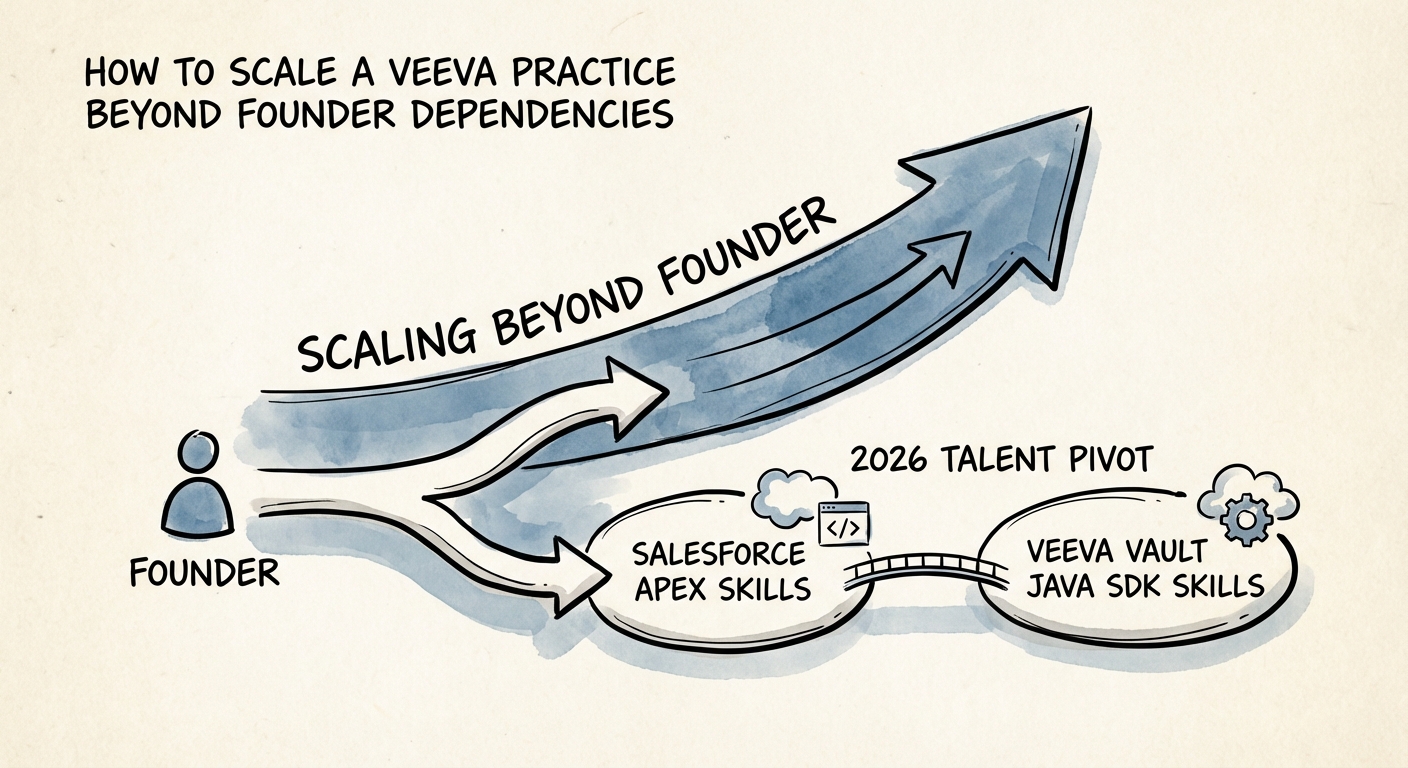
A hidden barrier to scaling is your legacy talent. Your team is likely heavy on Salesforce platform skills (Apex, Visualforce, SOQL). The new world is Vault-centric (Java, Rest APIs, Vault Query Language). Founder dependency often persists because the founder is the only one bridging this technical gap. You must aggressively retrain or hire for Vault architecture to delegate delivery confidence.
Valuation Impact: The Price of Dependency
In Life Sciences M&A, the 'Key Person Discount' is brutal. If a PE firm believes the client relationships sit with you, they will structure the deal with a heavy earnout (often 50%+ of consideration) spanning 3-5 years. They are buying insurance against you leaving. To unlock an all-cash or high-cash close, you must demonstrate transferability.
Metrics That Prove Independence
Buyers look for three specific metrics to verify you have broken the founder dependency:
- Non-Founder Revenue Origination: Can your sales team close net-new logos without you in the room? (Target: >70% of new ARR).
- Delivery Margins: Do margins hold up when you aren't the Engagement Manager? (Target: >50% Gross Margin on Services).
- Account Expansion: Does the CS team drive upsells (e.g., adding Vault Quality or Regulatory to a Commercial client) without your intervention?
Achieving this requires a rigorous focus on process. As detailed in our Key Person Dependency analysis, removing the founder from the critical path isn't about abdication; it's about elevation. You move from 'Chief Architect' to 'Chief Strategy Officer,' focusing on the next 3-year horizon (like Veeva AI Agents) while your machine handles the Vault CRM migration.