The practical answer
- Short answer
- Why building Snowflake Native Apps drives higher exit multiples than connected SaaS. 2026 benchmarks for ISV valuation, monetization models, and NRR.
- Best fit
- Industry: B2B SaaS / Data. Function: Product Strategy
- Operating path
- Exit Readiness → Operational Excellence → Transaction Advisory Services
- Key metric
- 14x EBITDA multiple for top-quartile Snowflake Native Apps due to high NRR and low churn.
The 'Extraction' Discount vs. The 'Native' Premium
For the last decade, the B2B SaaS playbook was simple: extract customer data via API, ingest it into your proprietary black box, process it, and show a dashboard. In 2026, this 'Connected App' model is no longer a competitive moat—it is a valuation liability.
Our 2026 deal data shows a stark bifurcation in valuations for Independent Software Vendors (ISVs) in the Snowflake ecosystem. Native Apps—software that runs directly inside the customer’s Snowflake instance—are trading at multiples approaching 14x EBITDA, while traditional 'Connected Apps' are stalling at 6-8x. Why? Because Private Equity buyers and strategic acquirers have identified 'Data Gravity' as the ultimate retention mechanism.
When you build a Native App, you eliminate the three biggest killers of enterprise deal velocity and retention:
- Security Reviews: Because data never leaves the customer's governance perimeter, the 6-month InfoSec gauntlet often shrinks to a 4-week compliance check.
- Data Pipeline Fragility: There are no API connectors to break. Zero-ETL means zero 'sync errors' causing churn.
- Compute Margin: In the Native model, the customer often pays for the compute credits. Your gross margins expand because you aren't subsidizing the infrastructure required to process their data.
For founders looking to exit, the message is clear: If your architecture requires data extraction, you are building 'Compliance Debt' into your product. If you bring the code to the data, you are building an asset with inherent stickiness.
In 2026, 'Connected Apps' are viewed as security risks. 'Native Apps' are viewed as infrastructure. You always want to sell infrastructure.
Monetization Mechanics: Aligning with the 'consumption' Whale
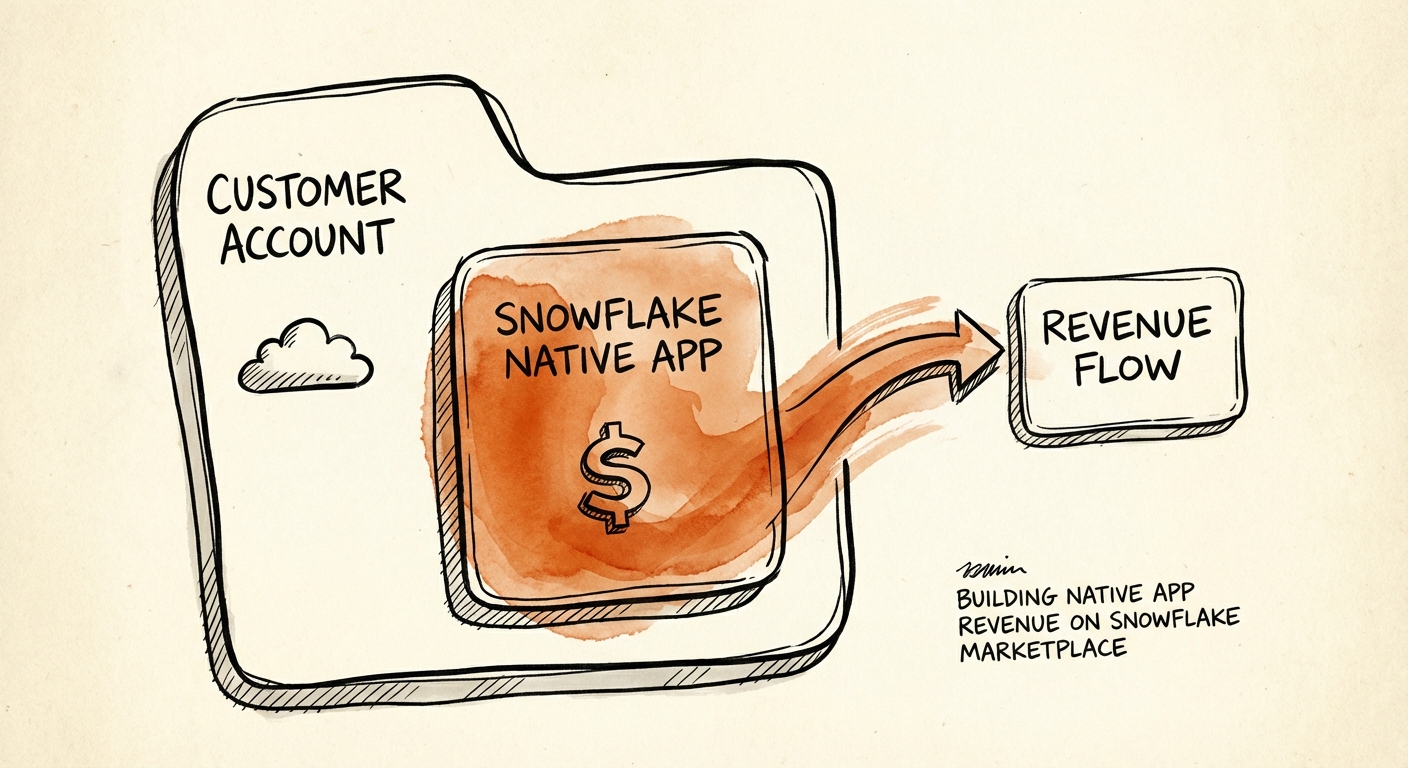
The valuation premium for Native Apps isn't just about architecture; it's about Revenue Quality. Snowflake’s consumption-based pricing model has retrained enterprise procurement teams. They prefer 'pay-as-you-go' utility over shelfware subscriptions. Successful ISVs on the Marketplace are pivoting their monetization to match this psychology, driving Net Revenue Retention (NRR) benchmarks well above the 120% 'Gold Standard'.
The Three Pricing Levers for Valuation
To maximize exit value, your Snowflake Native App must leverage specific monetization capabilities that prove 'alignment' to an acquirer:
- Usage-Based Billing: By billing on custom events (e.g., 'Rows Processed' or 'Risk Scores Generated') rather than seats, your revenue scales linearly with the customer's data growth. This creates a 'natural upsell' requiring zero sales effort.
- Compute Pool Surcharges: sophisticated ISVs are now monetizing the efficiency of their code. By charging a markup on the compute resources used, you align your incentives with the customer's desire for speed.
- Private Offers: While the public Marketplace drives discovery, 80% of enterprise revenue creates 'Paper Trail' value through Private Offers. These allow for custom negotiating while keeping the billing consolidated on the customer's Snowflake invoice—a massive reducer of Days Sales Outstanding (DSO).
Acquirers in 2026 are specifically diligence-checking for 'Marketplace Drag'—the percentage of revenue originating from or transacted through the Snowflake Marketplace. Apps with >40% Marketplace concentration are seeing faster diligence cycles because the revenue verification is centralized and trusted.
The 2026 Frontier: Agentic AI and the 'Code-to-Data' Moat
The next wave of valuation expansion is driven by Agentic AI. As noted in recent market consolidation trends, acquirers are scrambling to buy 'Agents'—autonomous AI systems that can execute complex workflows, not just chat. Snowflake Native Apps are the only viable deployment vehicle for enterprise Agentic AI because they solve the 'Context Window' problem.
An external AI agent is limited by API bandwidth and privacy constraints. A Native AI Agent runs inside the data boundary, having secure, unlimited access to the underlying tables. This capability is currently driving a 'Scarcity Premium' in M&A.
If you are a Data Cloud Partner building a generic visualization tool, you are competing in a commoditized 'Red Ocean.' However, if you are building an Agentic workflow that lives natively on Snowflake, you are effectively selling 'pre-integrated automation.' This is why we are seeing strategic acquirers—from vertical SaaS incumbents to Global Systems Integrators—paying premiums for Native IP. They aren't just buying your ARR; they are buying your position inside the customer's most fortified asset: their Data Cloud.