
The practical answer
- Short answer
- Acquiring an SAP consultancy? Your partner tier, your margin, and your earnout all hinge on a few certified architects. Here's the diagnostic to run before you sign.
- Best fit
- Industry: Private Equity / Technology Services. Function: Post-Merger Integration (PMI)
- Operating path
- Migration & Integration → Turnaround & Restructuring → Transaction Advisory Services
- Key metric
- 33% Average increase in consultant turnover during the first 90 days post-acquisition in the IT services sector.
The asset you bought can resign by Friday
Picture the close call on a 60-person S/4HANA implementation shop. The CIM showed a healthy book, a Gold partner badge, and a roster of "certified experts." What it did not show you on a single page: which of those certifications belong to which humans, and what happens to your SAP partner tier when four of them update their LinkedIn in the same week.
This is the specific trap of buying inside the SAP ecosystem. You are not acquiring a codebase or recurring license revenue. You are acquiring the right to staff projects — and that right is gated by individual people holding individual credentials: S/4HANA Cloud, BTP, SuccessFactors, Ariba. Those certifications attach to the consultant, not the entity. SAP's own partner program ties tier status (and the deal-registration discounts and lead flow that come with it) to a minimum count of certified heads on specific solution lines. Lose the wrong five architects and you do not just lose delivery capacity — you can drop a tier, which quietly resets your access to pipeline. SAP's own guidance on acquisition integration treats certified-headcount continuity as a first-order risk, not a footnote.
And the people most likely to walk are exactly the ones you most need. Across IT services deals, consultant turnover spikes roughly 33% in the first 90 days after an acquisition closes — the period when your synergy clock is also running fastest. An SAP architect with ten years across ECC migrations and a clean BTP track record is, right now, one of the scarcest assets in enterprise tech. Treat that person like generic IT headcount in a back-office consolidation and a competitor who understands what they're worth will have them within a quarter.
You don't integrate a services firm with a spreadsheet. You integrate it by protecting the dozen people whose certifications are quietly holding up your entire partner tier — break that, and you've bought a logo, not a business.
Run the headcount diagnostic before the LOI, not after
Here is the math most diligence misses. Ask the seller for two things they will not volunteer: a certification map and a single-point-of-failure read on it.
The certification map. Not a count — a named matrix. Which living person holds which active credential, on which solution line, expiring when. SAP credentials lapse; a "certified architect" whose S/4HANA cert expired last year is a liability dressed as an asset. Cross-reference the map against your partner-tier requirements. If the firm needs, say, six certified S/4HANA consultants to hold Gold and currently has seven, you have a margin of one. That is not a roster — that is a cliff.
The concentration read. If the firm's genuinely hard-to-replace IP sits with three or four senior architects, your integration plan is your real risk model. The classic mistake: an investment thesis built on "synergy capture" through aggressive back-office consolidation, applied to a firm whose entire value is the retention of a dozen people. You are underwriting a revenue collapse and calling it efficiency.
The structural fix lives in the deal terms, not the integration plan. Stop building earnouts purely on EBITDA. In a certified-headcount business, tie a meaningful slice of the payout to the retention of named staff holding the credentials that hold your tier — call it key technical retention. It aligns the seller's incentive with the only thing that actually protects your thesis, and it forces the certification map to be honest before you sign rather than after the first resignation. This is also why Bain's read on why most integrations underdeliver keeps pointing back to people and continuity, not process — the spreadsheet synergies were never the fragile part.
Then fight the two integration impulses that kill the margin
Once you own it, two reflexes will quietly destroy the deal. Name them so your integration lead can refuse them.
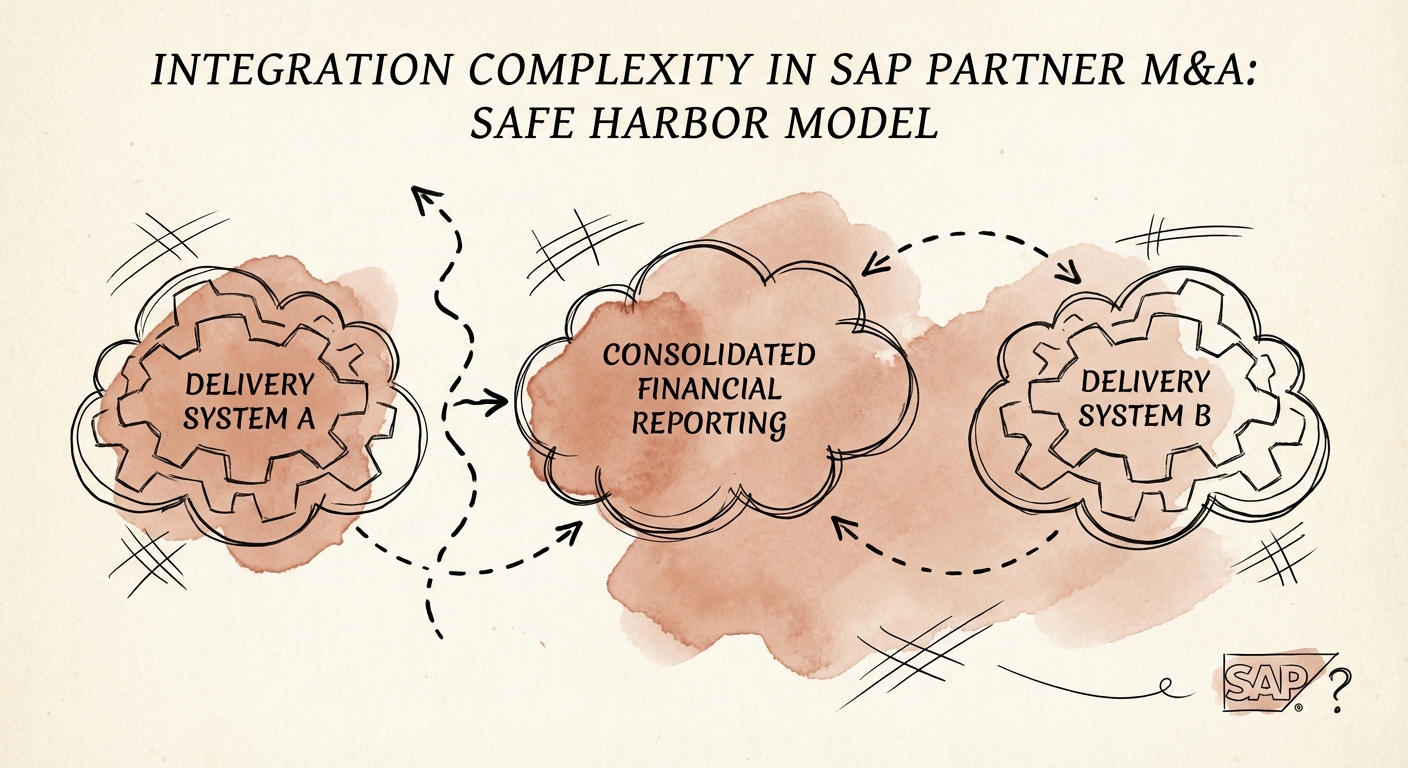
Impulse one: merge the delivery stack. The irony of buying an SAP implementation partner is that their own internal systems are usually held together with tape — a legacy ECC instance, QuickBooks, and a PSA tool nobody fully trusts. Your thesis says consolidate it all into your platform. Resist for the delivery engine specifically. IT integration in services-firm deals runs over budget by something like 56% on average, and the reason is rarely the data migration — it's that you're merging two delivery methodologies, one running SAP Activate, one running waterfall, while a six-month tooling war eats billable hours. Consolidate financial reporting at the top layer in the first quarter. Leave the PSA, the dev/test environments, and the time-entry system the consultants live in untouched for 12 to 18 months, until retention is stable. Every hour an architect spends learning your time-entry tool is an hour off the client's invoice and one more reason to take the recruiter's call. EY's integration-cost benchmarks for tech and services show how fast those rushed-consolidation overruns compound.
Impulse two: track tasks instead of utilization. Most integration offices report activity — "payroll migrated," "benefits enrolled." Meanwhile billable utilization quietly slides from 75% to 65% as town halls and synergy meetings eat delivery time, and in a services P&L that ten-point dip can erase a large chunk of the quarter's margin. The metric that actually predicts the deal is billable utilization variance and net revenue retention through the transition. Build a "fee-earner bubble": name one integration manager whose entire job is to absorb corporate requests so consultants never see them, and watch NRR weekly. If NRR slips under 100% in the first two quarters, your integration is failing — no matter how many cost synergies the deck says you captured.
Do this Monday: ask for the named certification matrix and check it against your tier minimums before you commit to a number. If the map shows your partner status resting on a margin of one or two people, you don't have a price problem — you have a retention problem, and it belongs in the deal structure.