
The practical answer
- Short answer
- Stop buying 'hollow' revenue. These 15 diagnostic questions reveal the true quality of earnings (QoE) in PE targets, covering NRR, concentration, and churn.
- Best fit
- Industry: Private Equity. Function: Finance
- Operating path
- Exit Readiness → Operational Excellence → Transaction Advisory Services
- Key metric
- 63% Valuation premium for companies with NRR > 120% (Source: SEG)
The EBITDA Mirage: Why You Overpaid for "Hollow" Revenue
You signed the LOI at 12x EBITDA. The CIM promised a rocket ship: 40% YoY growth, blue-chip logos, and a charismatic founder who swears the pipeline is "conservative." But six months post-close, you aren't planning the exit—you're planning a rescue operation.
The forecast missed by 20% in the first quarter. Three major accounts just churned. And that "proprietary tech"? It's held together by duct tape and two contractors in Eastern Europe. What happened?
You fell for the Accounting Revenue Trap. You audited the past (GAAP financials), but you didn't audit the future (Revenue Quality). In the current vintage of deals, where companies with Net Revenue Retention (NRR) above 120% trade at a 63% premium over the median, "revenue" is a meaningless metric without context. A dollar of revenue from a 5-year contract with 5% annual escalators is worth 5x more than a dollar of revenue from a one-off project with a difficult client.
Most Quality of Earnings (QoE) reports are backward-looking autopsies. They confirm the cash arrived, but they rarely ask why it arrived, or if it will arrive again. As an Operating Partner, your job is to distinguish between Economic Revenue (high-margin, recurring, sticky) and Hollow Revenue (low-margin, churn-prone, expensive to acquire).
If you are looking at a target—or trying to fix a portfolio company that just missed its numbers—you need a diagnostic that cuts through the sales narrative. You need to ask the questions the investment bankers hope you skip.
A dollar of revenue from a 5-year contract with 5% annual escalators is worth 5x more than a dollar of revenue from a one-off project. Revenue without context is a vanity metric.
The 15-Point Revenue Quality Diagnostic
Don't just hand this list to KPMG. Ask these questions directly to the VP of Sales and the Founder. Watch how they answer as closely as what they answer.
Category A: Stability & Retention (The Valuation Defender)
1. What is the divergence between Gross Revenue Retention (GRR) and Net Revenue Retention (NRR)?
The Trap: High NRR (110%+) can mask a leaky bucket. If NRR is high but GRR is low (e.g., <85%), the company is churning customers but hiding it by upselling the survivors. This works until the upsell well runs dry. See our full audit framework here.
2. What is the Logo Churn vs. Dollar Churn variance?
The Trap: "We only have 2% churn!" usually means 2% dollar churn. If they are losing 15% of their logos (smaller customers) annually, they have a product-market fit problem that will eventually kill the enterprise deals too.
3. What percentage of the "Recurring" revenue is actually "Re-occurring"?
The Trap: Services firms love to call repeat projects "recurring." Unless there is a contract with a cancellation penalty, it's not recurring. It's re-occurring, and it warrants a 4x multiple, not 12x.
4. What is the NRR of the cohort acquired 24 months ago?
The Trap: First-year retention is often artificially high due to lock-in contracts. The "Cliff of Death" happens in Month 13 or Month 25. If the Year 2 cohort drops below 90%, the business model is broken.
Category B: Concentration Risk (The Deal Killer)
5. If the top customer churns tomorrow, is the remaining EBITDA positive?
The Trap: Many founders run lifestyle businesses subsidized by one "Whale." If that whale leaves, you aren't buying a cash-flowing asset; you're buying a burn rate. Read more on concentration thresholds here.
6. What is the "Key Person Dependency" of the top 5 relationships?
The Trap: Does the CEO hold the relationship with the top 3 accounts personally? If so, you have 100% "Key Person Risk" disguised as revenue.
7. What is the margin profile of the top 10% of customers vs. the bottom 50%?
The Trap: Often, the biggest customers have the lowest margins due to volume discounts and custom support demands. You might improve EBITDA by firing the biggest client.
8. Are there "Change of Control" clauses in the top 5 contracts?
The Trap: Discovering 30 days post-close that your biggest customer has the right to renegotiate or walk because you bought the company.
Category C: Scalability & Efficiency (The Growth Engine)
9. What is the CAC Payback Period by segment (SMB vs. Enterprise)?
The Trap: A blended CAC payback of 12 months looks fine. But if Enterprise is 6 months and SMB is 24 months, you are lighting money on fire chasing small deals.
10. What is the "Magic Number" for the last 4 quarters?
The Trap: (New ARR / Sales & Marketing Spend). If it's below 0.7, the sales engine is inefficient. If it's below 0.5, stop spending on growth immediately.
11. What is the Win Rate against the primary competitor (head-to-head only)?
The Trap: "We win 60% of deals!" usually includes deals where there was no competitor. Demand the win rate only when Competitor X was in the room. Gartner data shows average B2B win rates hover around 21%; if they claim 60%, they are using inconsistent definitions or not competing.
Category D: Operational Reality (The Truth Serum)
12. What is the delta between Bookings and Recognized Revenue?
The Trap: Sales reps celebrate bookings. CFOs report revenue. If bookings are growing 20% but recognized revenue is flat, you have a deployment bottleneck (or revenue recognition issues).
13. How much of the pipeline is "Phantom Revenue"?
The Trap: Deals stuck in "Negotiation" for >90 days. Deals with no "Next Steps" date. Discount 100% of this pipeline to zero during diligence.
14. What is the ratio of "Hunter" compensation to "Farmer" compensation?
The Trap: If the Account Managers (Farmers) are paid like Hunters, you have a culture of order-taking, not value creation.
15. What is the average discount given at the end of the quarter?
The Trap: A trend of hockey-stick discounts in the last week of the quarter indicates a product that is sold on price, not value.
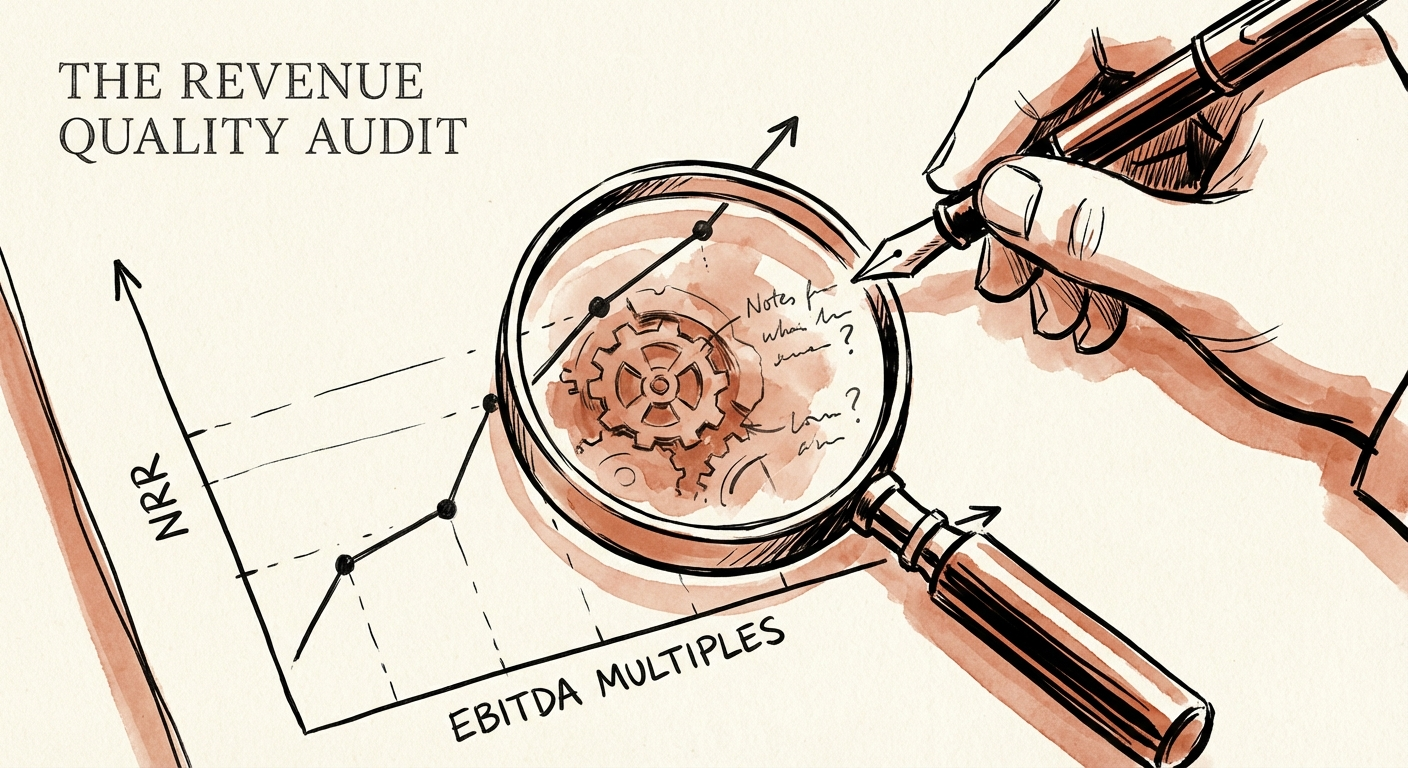
Scoring the Answers: When to Re-Trade
You won't get perfect answers. But the nature of the imperfection tells you how to price the deal.
- The "Red Flag" Zone (Re-Trade or Walk): NRR < 90%. Top customer > 25% of Revenue. CAC Payback > 18 months. In this zone, you aren't buying a growth platform; you're buying a turnaround. Adjust the multiple down by 2-3 turns or structure 30% of the consideration as an earnout based on retention.
- The "Yellow Flag" Zone (Operational Opportunity): Strong NRR (105%+) but poor CAC efficiency. High concentration but high margins. These are fixable operational problems. This is where Human Renaissance operates—installing the systems to fix the engine while you drive the car.
- The "Green Flag" Zone (The Unicorn): NRR > 120%. Magic Number > 1.0. 80%+ Gross Margins. Pay the premium. These assets are rare.
The Operator's Mandate
Revenue quality is not an accounting metric; it is an operational truth. When you ask these 15 questions, you move the conversation from "How much did you sell?" to "How much is the business worth?"
According to PwC's 2025 Outlook, nearly 40% of firms now rank operational exposure as a top threat to deal value. Don't be the Operating Partner who finds the landmines after the wire transfer clears.