
The practical answer
- Short answer
- Standard IT due diligence misses 53% of security risks. Use this operator-led security posture assessment checklist to protect deal value and avoid the $4.88M average breach liability.
- Best fit
- Industry: Private Equity. Function: Risk Management
- Operating path
- Compliance & Security → Turnaround & Restructuring → Turnaround & Restructuring Services
- Key metric
- $4.88M Global avg. cost of a data breach in 2024 (IBM)
The $4.88 Million Liability Hiding in Your LOI
You wouldn’t buy a manufacturing plant without checking for asbestos. Yet, in 2024, private equity firms routinely acquire software and tech-enabled services companies with the digital equivalent of high-risk waste in their codebases. The standard IT due diligence checklist—often delegated to a generalist IT consultant—asks binary questions: Do you have a firewall? Is there an incident response plan? Are backups running?
These ‘check-the-box’ exercises are actively dangerous because they provide a false sense of security. They tell you if the lights are on, but not if the wiring is about to spark a fire. According to Forescout’s M&A analysis, 53% of buyers discover critical cybersecurity issues after the deal closes. By then, the leverage is gone, and the liability is yours.
The financial impact of this oversight is no longer a rounding error. IBM’s 2024 Cost of a Data Breach Report pegs the average global cost of a breach at $4.88 million—a 10% increase year-over-year. For a mid-market portfolio company with $5M-$10M in EBITDA, a single breach doesn’t just hurt cash flow; it can wipe out an entire year’s value creation. More critically, for PE sponsors looking to exit, unresolved security debt is a valuation killer. Acquirers are now pricing ‘remediation risk’ directly into their offers, effectively treating security gaps as off-balance-sheet debt.
The "Shadow Data" Problem
The risk landscape has shifted. It is no longer just about hackers breaking in; it is about what you are unknowingly buying. A significant 35% of breaches now involve ‘shadow data’—sensitive information stored in unmanaged, unmonitored data sources (IBM). When you acquire a founder-led firm, you are often inheriting years of ‘move fast and break things’: customer databases duplicated in dev environments, hardcoded API keys in GitHub repositories, and open S3 buckets that haven’t been audited since the Series A.
78% of buyers would walk away from a deal if undisclosed cybersecurity breaches were found during due diligence.
The Operator’s Security Posture Assessment Checklist
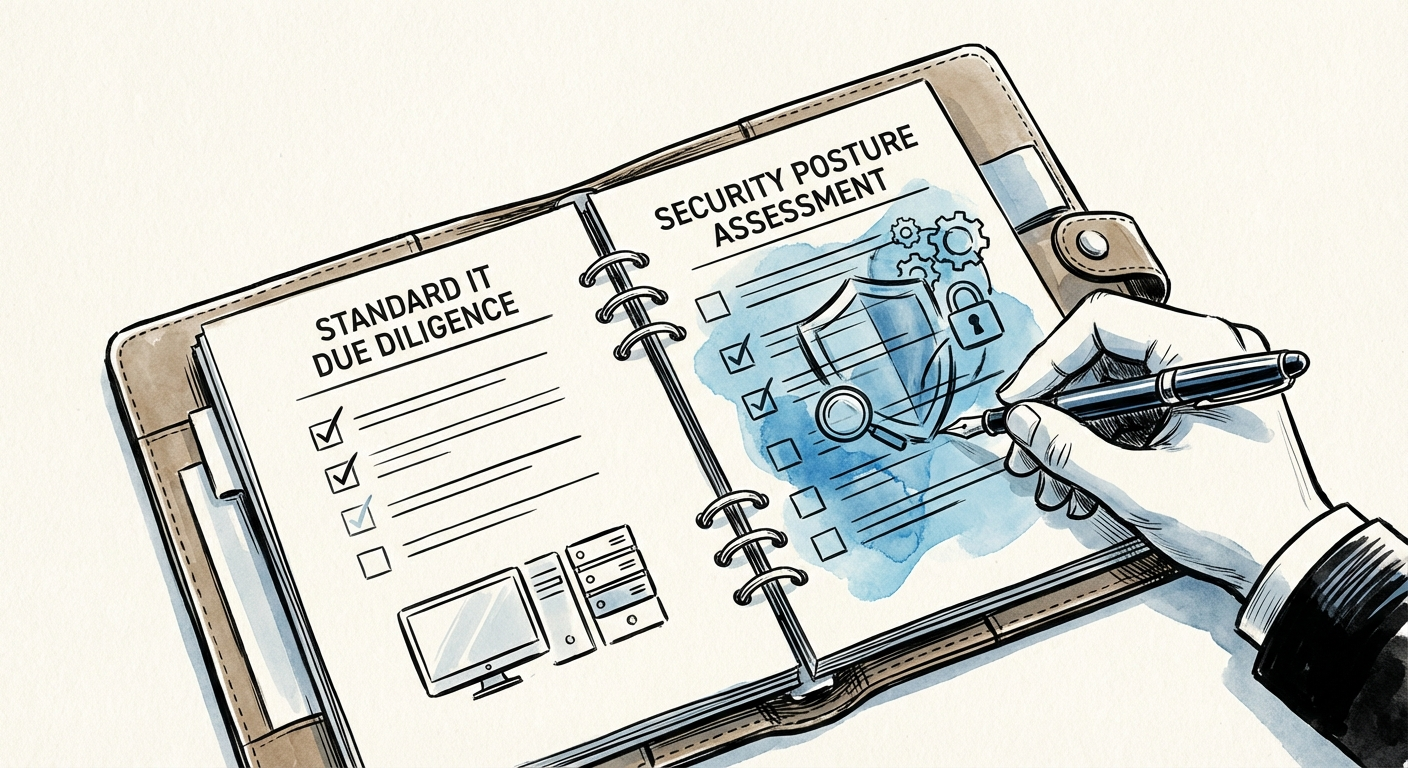
To protect the multiple, Operating Partners must move beyond high-level governance questionnaires and demand a Security Posture Assessment (SPA) that interrogates the actual technical reality of the target. This is not about achieving 100% security (which is impossible) but about quantifying risk so it can be priced into the deal.
1. The Code & Supply Chain Layer (The "IP Risk")
In modern software M&A, you are buying code. If that code is legally compromised or technically porous, the asset value collapses.
- Open Source License Analysis: Does the codebase contain ‘copyleft’ libraries (e.g., GPL) that legally force you to open-source your proprietary IP? (This is a deal-killer).
- Hardcoded Secrets Scan: Are AWS keys, Stripe tokens, or database credentials hardcoded directly into the source code?
- Software Bill of Materials (SBOM): Can they produce an SBOM? If not, they don’t know what vulnerabilities (like Log4j) are buried in their dependencies.
2. The Infrastructure & Access Layer (The "Breach Risk")
This is where the "technical debt" argument becomes a financial debt argument. If the architecture is fundamentally insecure, you will spend the first 12 months of the hold period rebuilding it instead of shipping features.
- Shadow IT Audit: automated scanning of public-facing assets. Do they have forgotten marketing servers or dev environments exposed to the public web?
- Identity & Access Management (IAM): Is Multi-Factor Authentication (MFA) enforced on all administrative access? (Credential theft accounts for 16% of all breaches).
- Privileged Access Review: How many "Super Admins" exist? In founder-led firms, this number is often terrifyingly high.
3. The Compliance & Governance Layer (The "Fine Risk")
Regulatory fines are EBITDA deductions. You need to know if the target is compliant with their actual obligations, not just their theoretical ones.
- Data Mapping Validation: Do they actually know where PII (Personally Identifiable Information) lives? If they can't map it, they can't protect it.
- Third-Party Risk Management: Have they audited their vendors? Gartner notes that third-party risk is a top vector, yet often ignored in lower-middle market diligence.
The 5-Day "Red Flag" Assessment Plan
You do not need a 6-week engagement to find the bodies buried in the server room. For a standard mid-market deal, you can execute a high-impact Security Posture Assessment in 5 days. The goal is not to fix the issues, but to quantify the remediation cost for the Net Working Capital (NWC) adjustment or specific indemnity.
Day 1-2: Outside-In Discovery
Before asking the target a single question, run non-invasive scans. Use tools to map their external attack surface. Look for exposed ports, leaked credentials on the dark web, and misconfigured DNS records. This provides the ‘truth’ to compare against their disclosure schedules.
Day 3-4: The Code & Cloud Audit
Request read-only access to their primary code repository and cloud environment configuration. Run automated scans for secrets and high-severity vulnerabilities (CVEs). If they refuse access citing "security concerns," that is a red flag—savvy sellers understand that transparency drives value.
Day 5: The Financial Translation
Convert technical findings into dollars. A lack of MFA isn't just a "High" risk; it is a $150,000 implementation project. A GPL license violation isn't a "Medium" risk; it is a $2M code rewrite. Present these findings to the Investment Committee not as technical jargon, but as EBITDA adjustments and Integration Budget requirements.
Conclusion: Buy Eyes Wide Open
Security debt is inevitable in growing companies. Your job as an Operating Partner isn't to find a perfect company, but to ensure you aren't paying a premium for a liability. By using a rigorous Security Posture Assessment, you shift the conversation from "Is it secure?" to "How much will it cost to secure?"—a question that every Investment Committee understands.