
The practical answer
- Short answer
- Type I proves control design; Type II proves operating evidence. See how PE buyers evaluate SOC 2 readiness before LOI and during diligence.
- Best fit
- Industry: B2B Tech. Function: Operations
- Operating path
- Compliance & Security → Turnaround & Restructuring → Turnaround & Restructuring Services
- Key metric
- $4.88M IBM's reported average global cost of a data breach in 2024
The Check-the-Box Trap
In the lead-up to an exit, founders sometimes treat a SOC 2 Type I report as proof of enterprise maturity. It is useful, but it is not the same thing as sustained operating evidence.
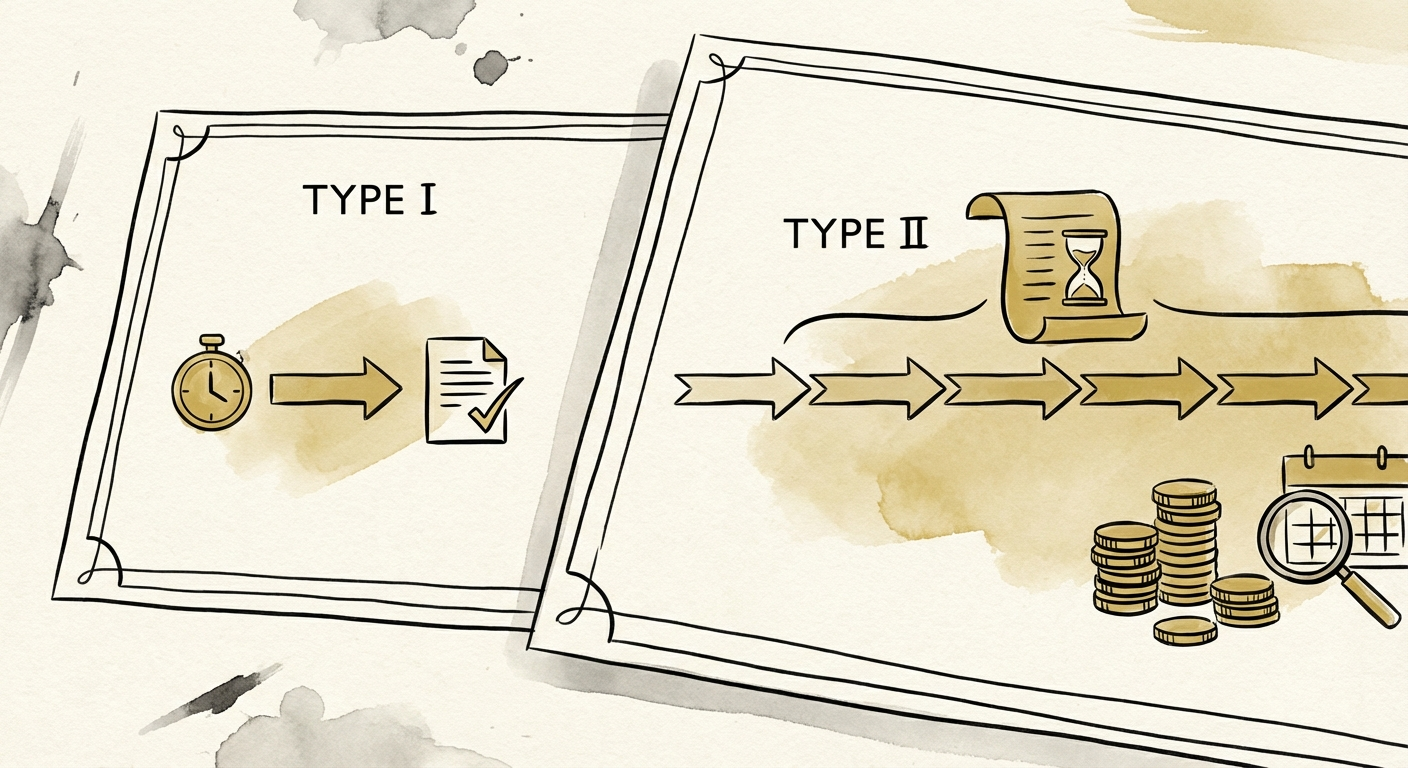
The distinction between Type I and Type II is the difference between design and execution. A SOC 2 Type I audit evaluates the design of a company's controls at a specific point in time. It confirms that, on paper, the company has written policies for password complexity, backups, employee offboarding, and other controls.
A SOC 2 Type II audit evaluates operating effectiveness over a period of time, typically 6 to 12 months. It requires evidence that controls actually operated during the observation period.
Why Founders Prefer Type I
Founders prefer Type I because it is faster and cheaper. A motivated team can often complete a Type I with a compliance automation platform and an auditor in a shorter window than Type II. It can satisfy early procurement conversations, but a PE buyer will still ask for the Type II plan.
When we see a Type I report in the data room without a corresponding Type II roadmap, we do not see a finished security program. We see operational debt that still needs to be retired.
A Type I report is useful, but a Type II roadmap shows buyers whether the company can operate controls consistently after close.
The Economics of Trust: Valuation and RWI
The absence of a SOC 2 Type II report can affect financial mechanics in two areas: Reps and Warranties Insurance and revenue quality.
1. RWI Cyber Review
Reps and Warranties insurers are paying closer attention to cyber risk. IBM reported that the average global cost of a data breach reached $4.88 million in 2024, which gives underwriters a reason to scrutinize security control evidence. A SOC 2 report is not required for every policy, but lack of demonstrated operating controls can create exclusions, higher retentions, or additional buyer diligence.
2. Revenue Quality and Churn Risk
Enterprise procurement teams increasingly ask for SOC 2 evidence during sales cycles. A Type I report can help at an early stage, but larger buyers often want Type II attestation or a dated roadmap to it. If the company cannot produce that evidence, the issue becomes more than compliance. It can slow sales cycles, create customer renewal risk, and reduce buyer confidence.
- Type I value: establishes control design at a point in time.
- Type II value: demonstrates that controls operated over time.
The Operator's Playbook: When to Execute
Do you force every portfolio company to get SOC 2 Type II immediately? Not necessarily. It depends on hold period, customer mix, and exit horizon.
Scenario A: The 12+ Month Hold
If you are more than a year from exit and the company sells to enterprise customers, start the Type II observation period now. A clean Type II report needs operating history, not a last-minute policy sprint.
Scenario B: Sprint to Sale Under 6 Months
If the company is preparing for a near-term transaction and Type II is not feasible, execute a Type I plus roadmap strategy. Secure the design validation, document the Type II plan, issue bridge evidence where appropriate, and make sure cyber insurance is aligned with the actual risk profile.
The Verdict
For a PE buyer, SOC 2 Type II usually carries more diligence weight than Type I because it proves operating effectiveness over time. Type I can be useful as a starting point, but Type II is the stronger buyer signal.
If you are buying, model the cost and timeline of bringing a Type I-only company up to Type II readiness. If you are selling, understand that Type I is not the end of the conversation. It is the beginning of the operating-evidence roadmap.
Do not sell security debt. Sell a system that works.