
The practical answer
- Short answer
- Run your own tech-services exit and you risk torching 20-50% of value in one missed quarter. Here's what a specialist banker actually buys you, with the data.
- Best fit
- Industry: Tech Services. Function: CEO/Founder
- Operating path
- Exit Readiness → Operational Excellence → Transaction Advisory Services
- Key metric
- +50% Valuation Premium with Top-Tier Advisor
You closed your first 50 customers. That's exactly why you'll botch this
Picture a 60-person managed services firm, $14M in revenue, the founder still personally owning the two biggest accounts. A strategic acquirer reaches out. The founder thinks: I've pitched VCs, I've won bake-offs against firms ten times our size, I can run this deal myself and save the banker's fee. Four months later the company misses its quarter by 15%, the acquirer retrades, and the founder signs for a number that haunts him at 2am.
I've watched this exact movie too many times in tech services. The instinct is understandable and completely wrong. Selling your product and selling your company are two different languages. When you sell an MSP retainer or a SaaS seat, you're selling a fix for a customer's pain. When you sell the company, you're selling a risk-adjusted stream of future cash flows to someone whose entire job is to find reasons that stream is shakier than you claim. You are fluent in the first language and a tourist in the second.
The day you start the process, you fire your best CEO
An exit is not a side quest you run between standups. It's a second full-time job: building and policing a data room, fielding diligence requests that arrive in waves, modeling working-capital adjustments, and negotiating indemnity caps clause by clause. The math problem is simple. There is one of you, and now there are two jobs. Something gets dropped, and in a services business the thing that gets dropped is usually the relationship that drove this quarter's bookings.
I call the resulting damage the distraction tax, and it is the single most expensive line item in a founder-run sale. By trying to save the 3-5% success fee, you routinely surrender 20% of enterprise value because you took your eye off the number during the one stretch where the buyer is watching the number most closely. Harvard Business Review's analysis of why M&A so often disappoints keeps circling the same culprit: deals fall apart on execution and integration risk, not on the pitch. A buyer who senses operational wobble during diligence is already pricing in the cleanup.
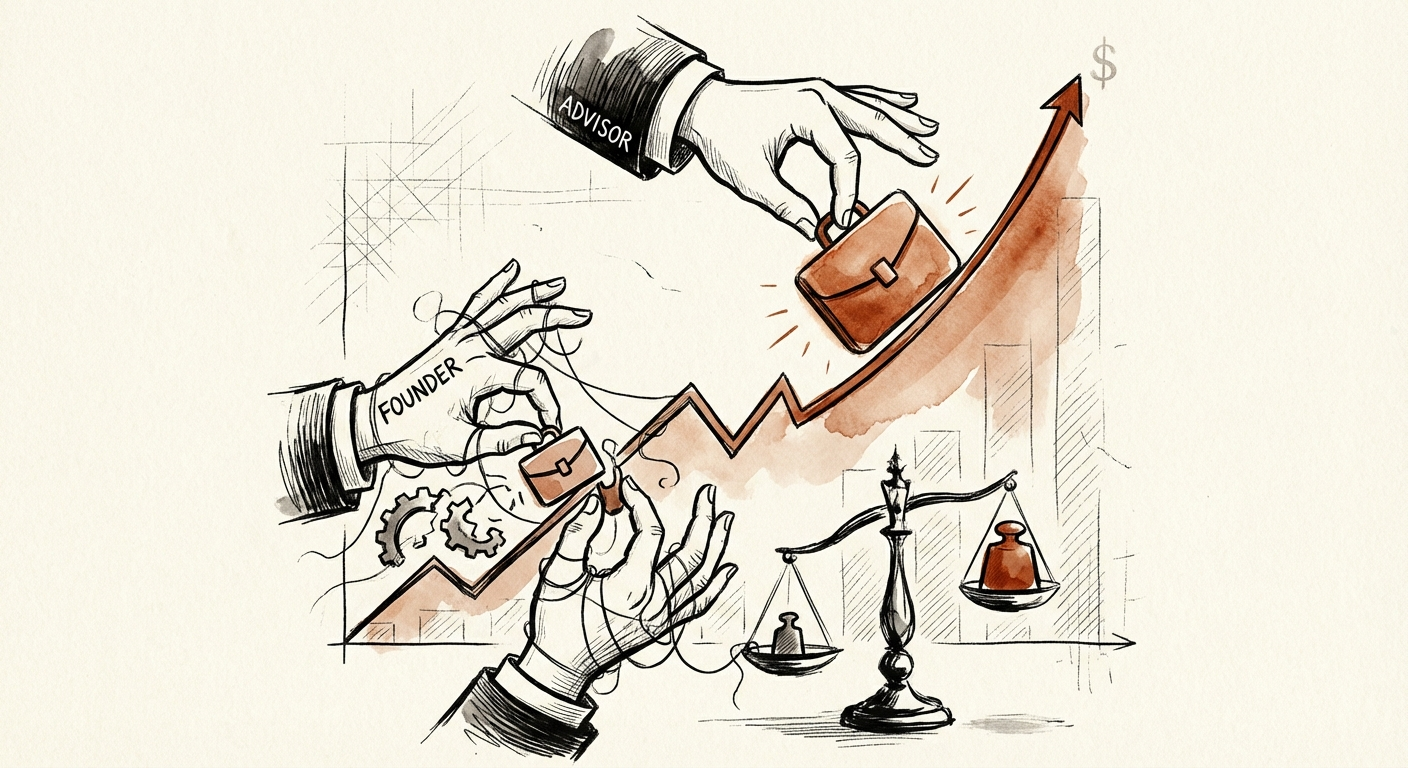
By trying to save the 3-5% success fee of an advisor, you often cost yourself 20% of the enterprise value in a missed quarter.
The data on DIY exits is not flattering, and the gap between advisors is brutal
This isn't a banker's sales pitch dressed up as advice. A study of more than 4,000 private acquisitions found that sellers who retain an M&A advisor capture meaningfully higher acquisition premiums than those who go it alone. Private-company M&A is opaque by design — there's no public comp sheet, no efficient market, and the information asymmetry runs entirely in the buyer's favor, especially when the buyer is a PE platform or a serial acquirer who has done forty of these and you've done zero.
Not all help closes the gap — most of it doesn't close at all
Here's the part founders never see coming. Advisors aren't a commodity. The tiered framework documented by ATB Financial and Basil Peters shows outcomes that are not close:
- The generalist business broker: the person who also lists restaurants and HVAC companies. Probability of actually closing your deal: roughly 1 in 10.
- The specialist banker: knows your exact vertical, has a live buyer rolodex, runs a real process. Probability of closing: better than 75%.
The valuation spread is the bigger story. A specialist who manufactures genuine competitive tension — two or three credible buyers at the table instead of one inbound tire-kicker — can drive a premium of +20% to +50% over what you'd get fielding the call yourself. On a $50M deal, that banker's fee gets repaid many times over purely in the spread, before you count the deals they save from dying in diligence.
Someone has to be the bad cop, and it cannot be you
There's a reason beyond the math. Negotiations over working-capital pegs and indemnity caps get ugly, and in a services acquisition you frequently end up reporting to the buyer for a one-to-two-year earnout. Every fight you personally pick over a holdback is a scar on the relationship you'll be living inside next quarter. The banker exists to absorb that friction — to be the one demanding more while you stay the visionary the buyer wants to keep and pay out. Spend your relationship capital before close and you'll feel it in the earnout you negotiated away.
What you actually do in the 12-24 months before you sell
If your exit window is a year or two out, here's the reframe: your job is not to sell the company. Your job is to make it sellable, then hand the selling to someone who does it for a living. The division of labor is clean.
Hire a specialist, audition them with tombstones
Do not hire the broker who sold your golf buddy's distribution business. Hire a banker who lives in your vertical — vertical SaaS, MSP, IT services, whatever your exact lane is — and make them earn it. Ask for tombstones: closed deals in your revenue range and your sector in the last 24 months. If they can't show you three, they don't have the buyer network that creates the competitive tension you're paying for.
Build the data room before the LOI lands, not after
Deals don't usually die on price. They die in diligence, in the three weeks it takes a distracted founder to produce a customer churn analysis that should have taken three hours. Pre-populate the room while you still have time — use the Acquirer's Checklist to anticipate what they'll ask and have the answers sitting in folders. If you're assembling diligence after the request arrives, you're already behind and the buyer can smell it.
Guard the forecast like it's the only number that matters — because it is
During exclusivity, your single job is to hit plan. Nothing torches valuation faster than a missed quarter while the buyer is mid-diligence. Push the document-gathering grind to your CFO or an outside exit readiness partner so your attention stays on revenue and delivery. And remember the close is a starting line, not a finish line — the earnout and the integration are where the rest of your payout lives, so read The Founder's Last 100 Days before you sign. The goal isn't a signature. It's a number that reflects the systems you built, not the heroics you ran solo.