
The practical answer
- Short answer
- Stop relying on 'hope' in your pipeline reviews. The Champion Risk Assessment differentiates true Mobilizers from mere Coaches, doubling win rates from 19% to 37%.
- Best fit
- Industry: Private Equity. Function: Sales Leadership
- Operating path
- Revenue Architecture → Commercial Performance → Office of the CFO
- Key metric
- 37% Win rate for deals with a verified Champion, compared to 19% for standard opportunities.
The 'Happy Ears' Epidemic in Board Meetings
Every quarter, the same scene plays out in Private Equity boardrooms across the middle market. The VP of Sales presents a pipeline that looks healthy—perhaps 3x coverage on the quarter's number. Confidence is high. The narrative is strong. Yet, 90 days later, the board is looking at a 20% miss and listening to a new set of excuses about "unexpected delays" and "procurement hold-ups."
The root cause is rarely the product, and it is rarely the market. The cause is a fundamental misclassification of risk in the pipeline. Specifically, the confusion between a "Coach" (someone who wants you to win) and a "Champion" (someone who can make you win).
According to audit benchmarks for sales forecasting, 60% of stalled deals in Series B and C companies are stuck because the sales rep is multi-threading with the wrong people. They have "Happy Ears"—interpreting a friendly contact's enthusiasm as organizational buy-in. In the current economic climate, where Gartner forecasts an "uncertainty pause" despite IT spending growth, this distinction is fatal. A Coach can guide you through the org chart; a Champion can unlock the budget that was frozen last week.
Your pipeline isn't a funnel; it's a fiction unless validated by someone inside the building who loses their bonus if the deal doesn't sign.
The 3-Point Champion Risk Assessment
To move pipeline forecasting from "creative writing" to "revenue science," we apply the Champion Risk Assessment. This is not a sentiment check; it is a binary diagnostic used to re-weight pipeline probabilities. If a deal is marked "Commit" but fails this test, it is immediately downgraded to "Upside" or removed from the forecast entirely.
1. Power: The 'Veto' Test
A true Champion has the authority to spend budget, but more importantly, they have the political capital to override a "No" from IT, Legal, or Procurement. If your contact has to ask for permission to schedule the next meeting, they are a Coach, not a Champion. Ask your rep: "Has this person ever spent this amount of money on a single vendor before?" If the answer is no, the risk profile of the deal doubles.
2. Capital: The 'Budget Access' Test
Does your Champion have direct access to P&L funds, or are they relying on a business case to get funding? In revenue quality audits, we often see pipeline inflated with "unfunded opportunities." A true Champion doesn't just hope for budget; they reallocate it from other failed initiatives to fund yours.
3. Skin in the Game: The 'Reputation' Test
This is the ultimate differentiator. A Coach risks nothing if you lose. A Champion risks their internal reputation if you don't get selected. Why? Because they have tied their personal success metrics (promotion, bonus, quarterly initiatives) to the problem your product solves. If the deal slips, they lose. If your rep cannot articulate what the Champion personally loses by not buying, you do not have a Champion.
Quantifying the Impact: From 19% to 37%
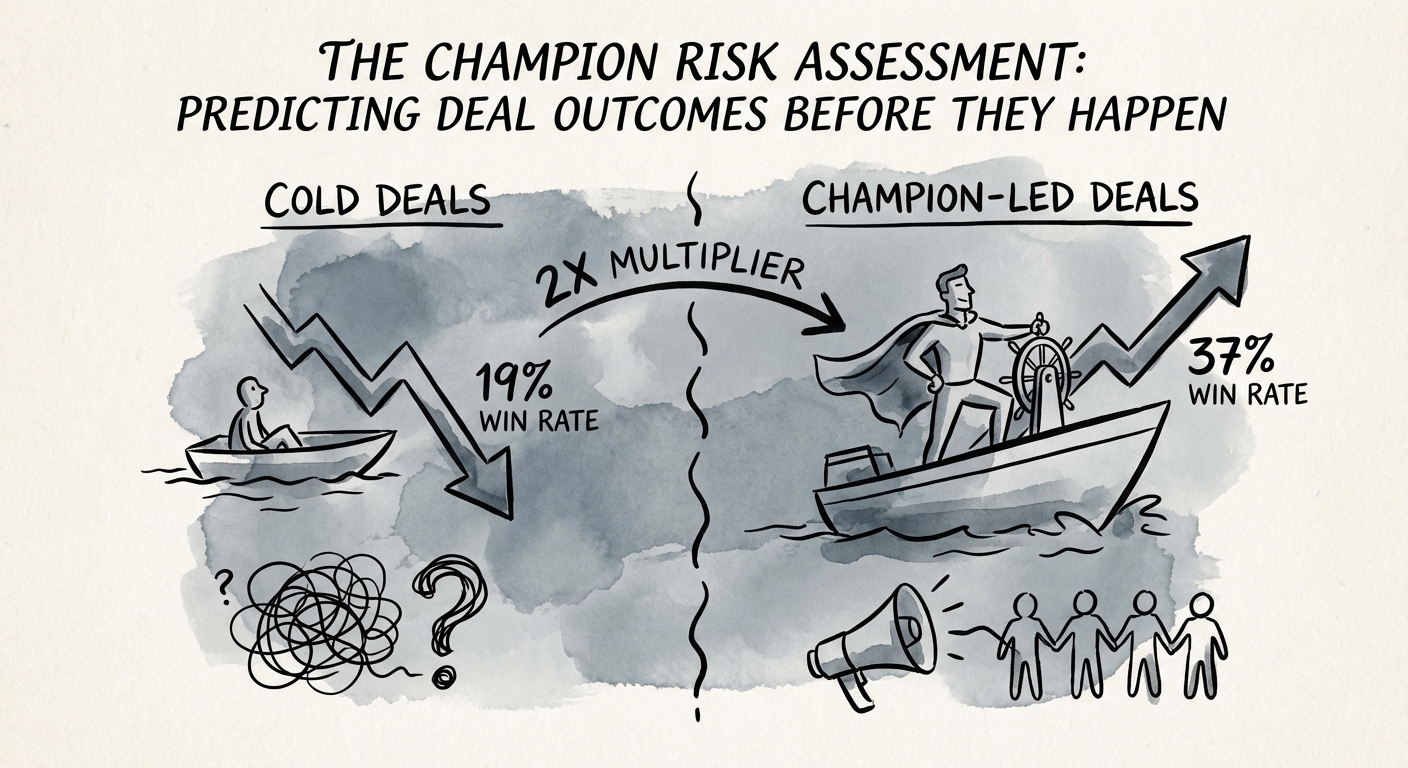
Implementing this assessment isn't just about hygiene; it's about valuation. Data from the 2025 Champify Impact Report indicates that deals with a "known contact"—a proxy for a verified Champion—close at a 37% win rate, compared to just 19% for deals driven by cold outreach or weak relationships. That is a nearly 2x multiplier on sales efficiency.
For a Portfolio Company doing $20M in ARR, shifting the pipeline mix toward Champion-led deals can mean the difference between 20% and 40% growth without adding a single headcount. Conversely, failing to diagnose "fake champions" is why 40% of first-time VP Sales hires fail—they inherit a pipeline of "friends" and forecast it as revenue.
The Fix: Mandate a "Champion Affidavit" for any deal entering the "Proposal" stage. If the rep cannot verify Power, Capital, and Skin in the Game, the probability weighting is capped at 20%. This forces intellectual honesty into the forecast and exposes the "hollow" deals before they cause a board-level surprise.